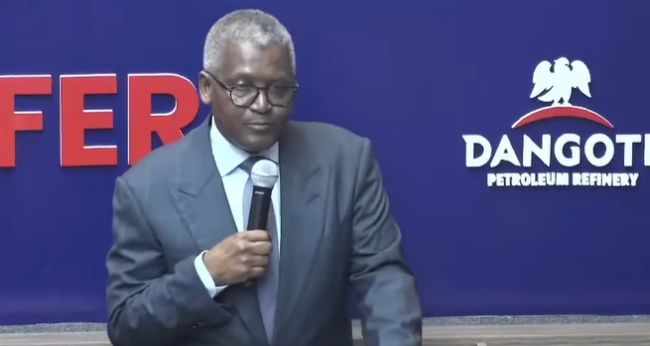
President of Dangote Group, Aliko Dangote, has expressed confidence that Dangote Petroleum Refinery and Petrochemicals FZE will emerge as the most viable and largest company in Africa by the end of December 2026.
Dangote made the declaration on Monday, September 14, 2026, at the trading floor of the Nigerian Exchange (NGX) in Lagos, where he delivered the opening address to formally launch the refinery’s Initial Public Offering (IPO).
The public offer comprises 4.1 billion new ordinary shares priced at ₦525 per share, with a minimum subscription of 10 shares valued at ₦5,250. The offer opened on September 14 and is scheduled to close on October 13, 2026, subject to the terms and conditions contained in the Prospectus.
The IPO is targeted at retail and institutional investors, as well as eligible investors across Africa and other parts of the world, as Dangote Refinery seeks to broaden ownership and deepen participation in Nigeria’s capital market.
Speaking at the event, Dangote urged Nigerians and other investors not to underestimate the potential of the refinery, saying the company was positioned for significant growth and value creation.
“Everything is in the hands of God, but by the end of this year, this is going to be the largest company in Africa, not in Nigeria,” Dangote said.
He described the IPO as an opportunity for investors to participate in the future growth of the refinery, urging prospective shareholders not to miss the opportunity.
According to him, the public offer is not primarily about raising funds for the Dangote Group, but about democratising wealth creation by giving ordinary Nigerians and other investors an opportunity to own a stake in one of Africa’s biggest industrial projects.
Dangote said the decision to open the refinery’s ownership to the public followed a long-standing commitment to ensure that the benefits of the project extend beyond a small group of investors.
He explained that the company waited until the refinery became operational, sustainable and sufficiently de-risked before taking the decision to invite the public to participate in its ownership.
“Today is not about listing a company but about listing a company for Nigerians, for Africa and for the black race,” he said, while inviting investors from across Africa, the Caribbean, Europe, America, China and other parts of the world to become shareholders.
Dangote also highlighted the potential benefits of the investment to Nigerians, particularly teachers, civil servants and parents with children studying abroad.
He said investors could potentially benefit from dollar-denominated dividends, which could provide some protection against the impact of naira depreciation on families with foreign currency obligations.
According to him, the opportunity could give parents with children abroad greater confidence in meeting future school-fee obligations even during periods of currency devaluation.
The Dangote Group president further disclosed that the group currently has about $46 billion worth of projects and investments in its pipeline, aimed at expanding its various businesses and achieving its Vision 2030 objectives.
He stressed that the IPO was therefore not driven by a need for additional capital to execute the group’s projects.
“If it is the question of raising money, I think we have raised more than what we need as a group to execute all our projects,” Dangote said.
The public offer is expected to raise approximately ₦2.15 trillion, potentially making it one of the largest equity offerings ever undertaken in Africa.
The proceeds, according to the company, will be deployed towards the refinery’s long-term growth plans, operational expansion, strategic investments and further value creation for shareholders and other stakeholders.
Dangote also disclosed that the group had previously conducted a private placement as part of its capital-raising strategy.
He said the original plan involved raising $2.5 billion, comprising a $1.5 billion IPO and a $1 billion private placement. According to him, the private placement attracted significant demand, leading the company to allocate and reallocate applications.
Dangote said the company ultimately returned applications worth about $1.2 billion after receiving strong demand during the process.
He explained that the funds raised through the private placement had already met the group’s immediate funding requirements, reinforcing his position that the current IPO is primarily aimed at expanding public ownership and allowing more people to share in the refinery’s future prosperity.
Meanwhile, Nigerian Exchange Group’s Group Managing Director and Chief Executive Officer, Temi Popoola, said the participation process had been designed to be accessible, transparent and technology-enabled.
Eligible investors can subscribe through approved distribution channels, including NGX Invest, designated commercial banks and authorised investment platforms, subject to the requirements contained in the Prospectus.
Dangote said the broader objective was to ensure that the economic benefits generated by the refinery are shared among a wider pool of investors, rather than being concentrated among a limited number of private shareholders.
The development marks a significant step in the evolution of the Dangote Refinery, which has become one of the most prominent industrial investments in Africa and a major component of Nigeria’s ambition to strengthen domestic refining capacity, reduce dependence on imported petroleum products and expand its participation in the global energy market.