Connect with us

Defence and Security

Senate Backs Death Penalty for Kidnapping, Moves to Redefine Crime as Terrorism

Published

on

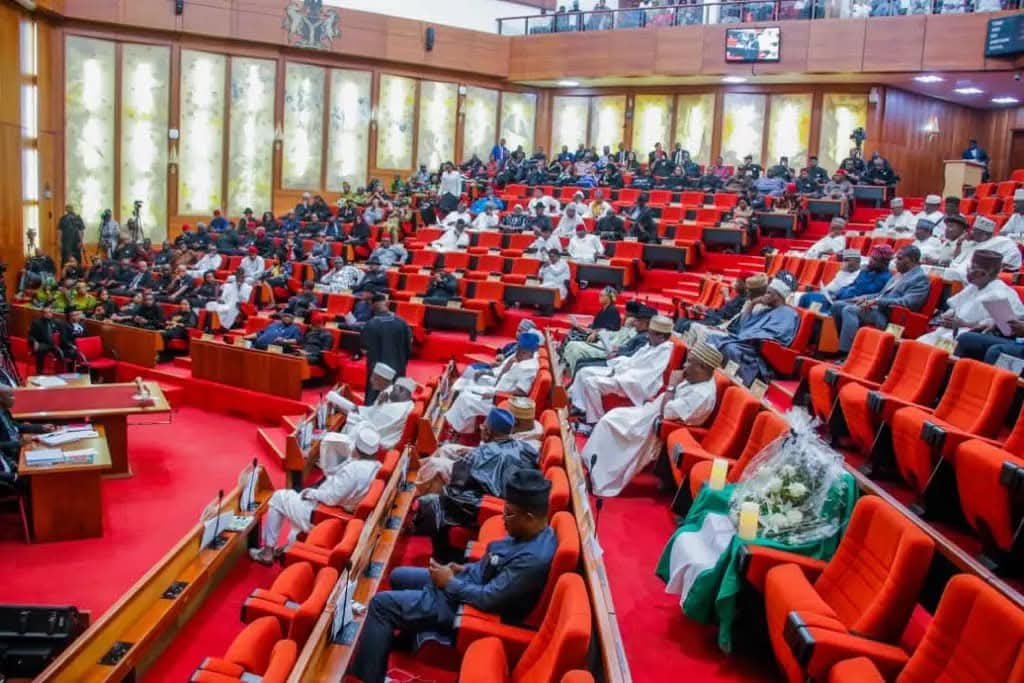
Senate in Session
Senate in Session
Share

In a decisive move to stem rising insecurity, the Senate has approved key amendments to the 2022 Terrorism (Prevention and Prohibition) Act, prescribing the death penalty for kidnappers and anyone who aids kidnapping operations.

During Wednesday’s plenary, senators across political lines overwhelmingly supported the bill sponsored by the Leader of the Senate, Senator Opeyemi Bamidele. The amendment seeks to classify kidnapping, hostage-taking, and related offences as acts of terrorism, granting law enforcement broader powers to dismantle criminal networks.

The bill has now been referred to the Committees on Judiciary, Human Rights and Legal Matters, National Security and Intelligence, and Interior for further scrutiny, with instructions to report back within two weeks.

Presenting the proposal, Bamidele said kidnapping had evolved from sporadic activity into organised violence affecting all regions of the country. He argued that the severity and scale of the crime now bear the hallmarks of terrorism, warranting the strongest punishment.

> “Kidnapping has instilled fear in communities, disrupted economic activities, ruined families, and claimed countless innocent lives,” he declared. “Our legal framework must reflect the magnitude of this threat.”

The amendment prescribes capital punishment not only for perpetrators but also for financiers, informants, logistics suppliers, harbourers, and anyone who knowingly supports kidnapping operations. Attempt, conspiracy, or incitement would attract the same penalty.

The Senate leader explained that reclassification under terrorism laws would enable intelligence-led operations, asset tracing, inter-agency cooperation, and disruption of funding channels.

Backing the proposal, Senator Adams Oshiomhole dismissed existing deradicalisation programmes as ineffective, arguing that some offenders return to crime after release.

> “Even Scriptures acknowledge that those who kill cannot be allowed to continue living,” Oshiomhole said. “If convicted for terrorism, the penalty should be death.”

Senator Orji Uzor Kalu lamented the suffering inflicted on Nigerians, citing cases of widows, traumatised families and victims of sexual assault.

> “Everyone involved in this criminal enterprise must face consequences,” he maintained.

Minority Leader Senator Abba Moro described kidnapping as a business venture for criminals and endorsed the bill as a necessary measure to deter offenders.

Also speaking, Senator Victor Umeh condemned the killing of victims after ransom payment and called for sanctions against facilitators, including complicit financial institutions.

The Senate President, Godswill Akpabio, welcomed the bipartisan support and mandated the lead committee to expedite consultations and present recommendations at a public hearing.

The proposed amendment marks one of the strongest legislative responses to Nigeria’s worsening kidnapping crisis, signalling a toughened stance on national security and criminal justice.

Defence and Security

Defence Minister Orders Operational Recalibration After Emergency Security Meeting

Published

on

Minister of Defence, General Christopher Musa in meeting with Service Chiefs
Share

Nigeria’s Minister of Defence, General Christopher Musa, has directed an immediate recalibration of military operations across multiple theatres following an emergency combat audit with the country’s Service Chiefs.

The high-level meeting, held at the Ministry of Defence Headquarters, reviewed the recent wave of brazen terrorist attacks and assessed the current military strategy against insurgents, bandits and other armed groups.

Speaking after the meeting, the defence minister said the Service Chiefs had been mandated to intensify and reorganise operations nationwide to dismantle the networks of terrorists and criminal gangs threatening national security.

He disclosed that commanders have been instructed to exercise direct, on-site leadership in various operational theatres to improve coordination and maintain sustained pressure on armed groups.

According to him, the meeting also carried out a comprehensive review of Nigeria’s national military strategy aimed at strengthening operational effectiveness and ensuring that ongoing missions deliver measurable results.

While noting that details of troop movements and tactical adjustments would remain classified for security reasons, Musa assured Nigerians that the armed forces are taking decisive steps to confront emerging threats.

He said the military has already recorded progress in recent operations, including the neutralisation of key terrorist commanders and the disruption of several insurgent networks.

The defence minister reaffirmed the government’s commitment to continuing military operations until terrorist and bandit groups are completely dismantled.

Musa assured citizens that the armed forces would maintain relentless pressure on criminal elements to restore stability and protect lives and property across the country.

Continue Reading

Defence and Security

Tinubu Swears in Tunji Disu as 23rd Inspector-General of Police

Published

on

Inspector General of Police, Olatunji Disu
Share

President Bola Ahmed Tinubu on Wednesday swore in Tunji Disu as the 23rd Inspector-General of Police (IGP), formalising his appointment as head of the Nigeria Police Force.

The swearing-in ceremony took place at the Presidential Villa, Abuja, ahead of the Federal Executive Council (FEC) meeting on March 4, 2026.

Disu’s inauguration followed his confirmation by the Nigeria Police Council on Monday, March 2. He succeeds Kayode Egbetokun, who recently resigned from office.

At the ceremony, President Tinubu also administered the oath of office to six commissioners of the Revenue Mobilisation Allocation and Fiscal Commission (RMAFC) and two commissioners of the Federal Civil Service Commission (FCSC).

Dignitaries in attendance included Vice President Kashim Shettima; Secretary to the Government of the Federation George Akume; Chief of Staff to the President Femi Gbajabiamila; National Security Adviser Nuhu Ribadu; and Head of the Civil Service of the Federation Esther Walson-Jack, among other senior government officials.

Born on April 13, 1966, in Lagos State, Disu joined the Nigeria Police Force on May 18, 1992, as a Cadet Assistant Superintendent of Police. Over the course of his career, he has served in several operational, investigative, and strategic command roles across the country.

Prior to his appointment as IGP, Disu served as Assistant Inspector-General of Police in charge of the Special Protection Unit and the Force Criminal Investigation Department (CID) Annex, Lagos.

He holds multiple qualifications in public administration, forensic investigation, criminology, security studies, legal psychology, and entrepreneurship, reflecting a career anchored on professional development and modern policing strategies.

Continue Reading

Defence and Security

Police Arrest Two Suspected Cultists, Recover Firearm at Ibadan Polytechnic

Published

on

Nigeria Police Force
Police Logo
Share

The Oyo State Police Command has arrested two suspected cultists and recovered a firearm on the campus of The Polytechnic, Ibadan following a tip-off from a concerned citizen.

The suspects, identified as 31-year-old Lawal Opeyemi, popularly known as “Aiki,” and 29-year-old Olaniyan Opeyemi, alias “Bojan,” both residents of the Apete area of Ibadan, were apprehended while allegedly planning an attack on a rival cult group within the institution.

The Police Public Relations Officer, DSP Alayande Olayinka, said a Good Samaritan alerted authorities to the presence of some young men reportedly moving around the campus with violent intentions. Operatives from the Sango Division responded swiftly, leading to the arrest of the two suspects.

Items recovered from them include a locally made double-barrelled pistol, two live cartridges, and a black bag containing charms.

During interrogation, the suspects allegedly confessed to involvement in cult activities and identified themselves as members of the Eiye Confraternity. Preliminary investigations suggest they may have been linked to previous cult-related clashes within the institution.

The Commissioner of Police in Oyo State, CP Femi Haruna, has directed that the suspects be transferred to the Command’s Anti-Cultism Unit for further investigation and possible prosecution.

He commended members of the public and officers involved for their prompt action and urged parents and guardians to discourage their wards from joining secret cult groups.

The Command reiterated its zero-tolerance stance on cultism and violent crimes, stressing that continued collaboration between the police and the community remains vital in maintaining security.

Continue Reading