Connect with us

Parliamentary News

55–15 Vote Seals Fate of Clause 60 as Senate Approves Electoral Reform Bill

Published

on

Senate Logo
Share

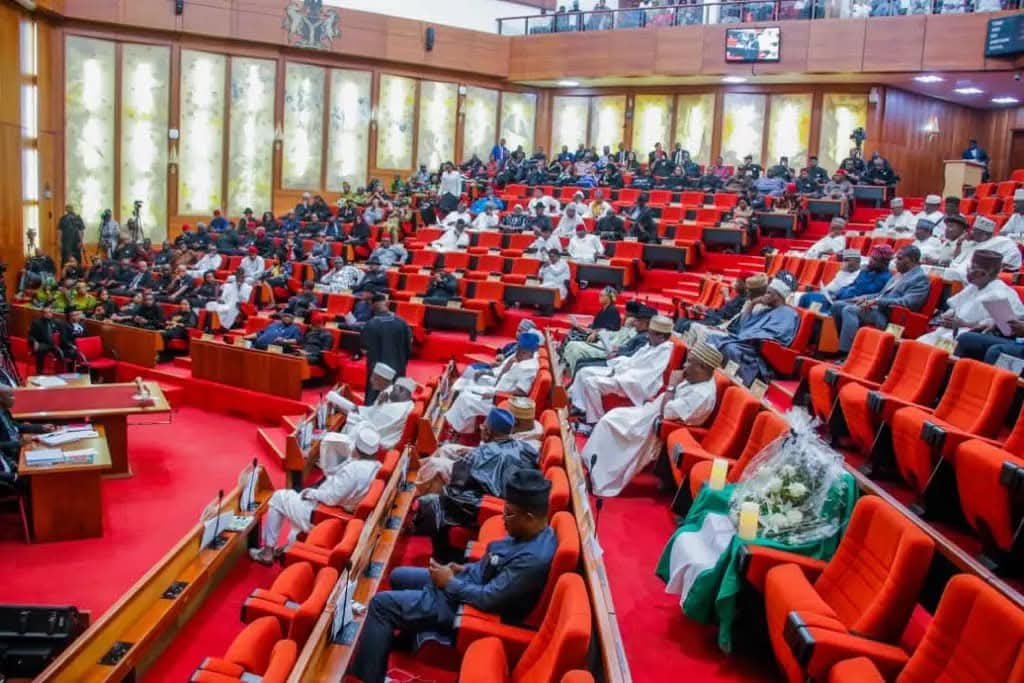
The Senate on Tuesday passed the Electoral Act, 2022 (Repeal and Re-Enactment) Bill, 2026, following a dramatic and at times rowdy plenary marked by sharp disagreements over Clause 60 and the fate of electronic transmission of election results.

The session opened on a tense note after Senator Enyinnaya Abaribe (ADC–Abia South) renewed his demand for a division on Clause 60, triggering procedural disputes and vocal exchanges across party lines.

Procedural Clash Over Division

Senate President Godswill Akpabio initially stated that he was under the impression the request for division had earlier been withdrawn. However, opposition senators immediately objected, insisting the matter remained unresolved.

Deputy Senate President Barau Jibrin, citing Order 52(6) of the Senate Standing Orders, argued that it would be procedurally out of order to revisit any provision already ruled upon by the presiding officer.

His intervention sparked further uproar, briefly escalating tensions in the chamber. At one point, Senator Sunday Karimi was seen confronting Abaribe before order was restored.

Senate Leader Opeyemi Bamidele then clarified the procedural position, reminding lawmakers that he had earlier sponsored a motion for rescission. According to him, that motion effectively nullified previous decisions on the bill, thereby validating Abaribe’s call for division.

Akpabio suggested that the renewed demand was aimed at publicly demonstrating Abaribe’s position on the contentious clause. Nevertheless, he sustained the point of order and invited the Abia South senator to formally move his motion.

The Core Dispute: Clause 60(3)

Rising under Order 72(1), Abaribe formally called for a division on Clause 60(3), particularly the proviso stating that where electronic transmission of results fails due to network challenges, the duly signed Form EC8A would serve as the primary basis for result collation.

Abaribe proposed deleting the provision permitting manual transmission in cases of electronic failure, arguing that allowing such a caveat could undermine public confidence in digital reforms to the electoral system.

The division was conducted in accordance with Senate procedure. Akpabio directed senators supporting the proviso to stand, followed by those opposing it.

When votes were counted:

55 senators voted in favour of retaining the proviso (manual transmission allowed where e-transmission fails).

15 senators voted against it.

The outcome affirmed the Senate’s decision to preserve the fallback mechanism for manual transmission in cases of network disruption.

Closed-Door Consultations and Clause-by-Clause Review

Earlier in the day, proceedings had briefly stalled during clause-by-clause consideration of the bill after a motion was moved and seconded to rescind previous amendments. The chamber subsequently resolved into the Committee of the Whole for detailed reconsideration and re-enactment.

As Senate President Akpabio read through the clauses, Abaribe’s point of order at Clause 60 drew immediate murmurs and prompted consultations at the presiding officer’s desk. The rising tension ultimately led to a closed-door session before plenary resumed.

Bill Passed Amid Divisions

Following the division vote and completion of clause-by-clause consideration, the Senate formally passed the Electoral Act, 2022 (Repeal and Re-Enactment) Bill, 2026.

The legislation retains electronic transmission of results as a permissible method but upholds Form EC8A as the legally binding primary record in instances where electronic transmission fails.

Tuesday’s proceedings underscored deep partisan sensitivities around electoral reforms, with Clause 60 emerging once again as a defining flashpoint in Nigeria’s ongoing debate over technology, transparency, and the integrity of the ballot.

Parliamentary News

Nigeria’s Senate Passes ₦68.3tn 2026 Budget, Boosting Spending on Infrastructure, Health

Published

on

Senate in Session
Share


Nigeria’s Senate has approved a ₦68.3 trillion budget for the 2026 fiscal year, marking a significant increase from the ₦58.47 trillion initially proposed by President Bola Ahmed Tinubu.

The upward revision of over ₦9 trillion follows a supplementary request by the presidency aimed at accommodating legacy commitments, particularly in the transportation and health sectors, alongside new provisions including additional funding for the judiciary.

The approval came after lawmakers adopted the joint report on the 2026 Appropriation Bill presented by the National Assembly, signaling legislative backing for an expanded fiscal framework amid ongoing economic pressures.

Spending Breakdown

According to details of the approved budget:

₦4.799 trillion is allocated to statutory transfers

₦15.809 trillion for debt servicing

₦15.427 trillion for recurrent (non-debt) expenditure

₦32.287 trillion for capital expenditure

The capital component remains the largest share, underscoring the government’s focus on infrastructure development and long-term economic growth.

Additional Allocations

Of the increased spending:

₦5.71 trillion is designated for the regularisation of outstanding capital obligations carried over from the 2025 budget

₦2 trillion is earmarked for previously omitted projects across the country

Sector-specific allocations include:

₦482.758 billion for health

₦478.600 billion for the Ministry of Finance Incorporated (MoFI)

₦268 billion for the judiciary, including ₦36 billion for the Supreme Court and ₦98.513 million for the Court of Appeal

In addition, ₦8.960 billion has been approved for feasibility studies on major road projects, notably the Calabar–Maiduguri and Maiduguri–Sokoto corridors.

Extension of 2025 Capital Budget

In a related move, the Senate approved an extension of the capital component of the 2025 budget, shifting its implementation deadline from March 31 to June 30, 2026. The extension is intended to allow for the completion of ongoing infrastructure projects and improve budget execution.

Economic Context

The expanded 2026 budget reflects the administration’s attempt to balance fiscal consolidation with growth-focused spending, even as debt servicing continues to account for a substantial portion of government expenditure. Analysts say the success of the budget will depend largely on revenue performance and effective implementation.

Continue Reading

Parliamentary News

Akpabio Declares Three Senate Seats Vacant, Orders By-Elections

Published

on

Godswill-Akpabio
Senate President Gods will Akpabio
Share

The President of the Senate, Godswill Akpabio, has declared three senatorial seats vacant following the deaths of members of the 10th Senate.

The affected constituencies are Enugu North Senatorial District, Nasarawa North Senatorial District, and Rivers South-East Senatorial District.

Akpabio made the announcement on Tuesday during plenary, stating that the vacancies arose due to the demise of the lawmakers, in line with constitutional provisions.

“Due to the tragedies that have befallen the 10th Senate, vacancies have been created for midterm elections by the Independent National Electoral Commission to ensure that we fill the vacancies created by the demise of our colleagues,” he said.

Citing the Constitution of the Federal Republic of Nigeria 1999 (as amended), the Senate President formally declared the seats vacant.

“I hereby declare vacant Enugu North Senatorial District. The seat is hereby declared vacant,” he said, extending the declaration to Nasarawa North and Rivers South-East senatorial districts.

Akpabio subsequently directed the Independent National Electoral Commission to conduct by-elections to fill the vacancies within the constitutionally stipulated timeframe.

“In line with the provisions of our Constitution, the Independent National Electoral Commission is accordingly mandated to conduct fresh polls to fill these vacant senatorial seats in the affected states within the time specified in the Constitution, which is about 30 days from this declaration,” he said.

The development sets the stage for fresh electoral contests in the affected districts as political parties prepare to field candidates for the vacant seats in the Senate.

Continue Reading

Parliamentary News

Tinubu at 74: N’Assembly Moves to Establish State Police with Accountability Safeguards — Bamidele

Published

on

Senator Michael Opeyemi Bamidele and Asiwaju Bola Tinubu
Senate Leader, Senator Michael Opeyemi Bamidele and President Bola Tinubu
Share

The Senate Leader, Opeyemi Bamidele, has disclosed that the National Assembly is working on a decentralised police system aimed at strengthening accountability and preventing abuse by the political class.

Bamidele, who also serves as Vice Chairman of the Senate Committee on the Review of the 1999 Constitution, said the proposed framework would devolve policing powers to sub-national authorities while ensuring justice, protecting human rights, and discouraging impunity. He noted that the initiative is being treated as a priority amid growing calls for improved security across Nigeria.

The lawmaker made this known in a statement marking the 74th birthday of President Bola Ahmed Tinubu, whom he commended for supporting reforms to tackle insecurity. He said the President had backed the decentralised policing model as part of broader efforts to safeguard lives and property nationwide.

Bamidele added that the proposed system would be guided by global best practices and strong accountability mechanisms. According to him, the Presidency and the National Assembly are working together to deliver a more effective security structure for the country.

He also praised Tinubu’s leadership, citing economic and fiscal reforms, including increased foreign reserves and improved revenue for sub-national governments, as signs of progress under the current administration.

Continue Reading