By AbdulRahman Obaje
- Askmg Nigerians, Are You Better Than You Were Two Years Ago?, they assked
Nigerian youths brace up for the upcoming 2027 general election reiterating commitments to better Nigeria for all. The efforts further dump the idea of touting any political party if it does not put Nigeria first.
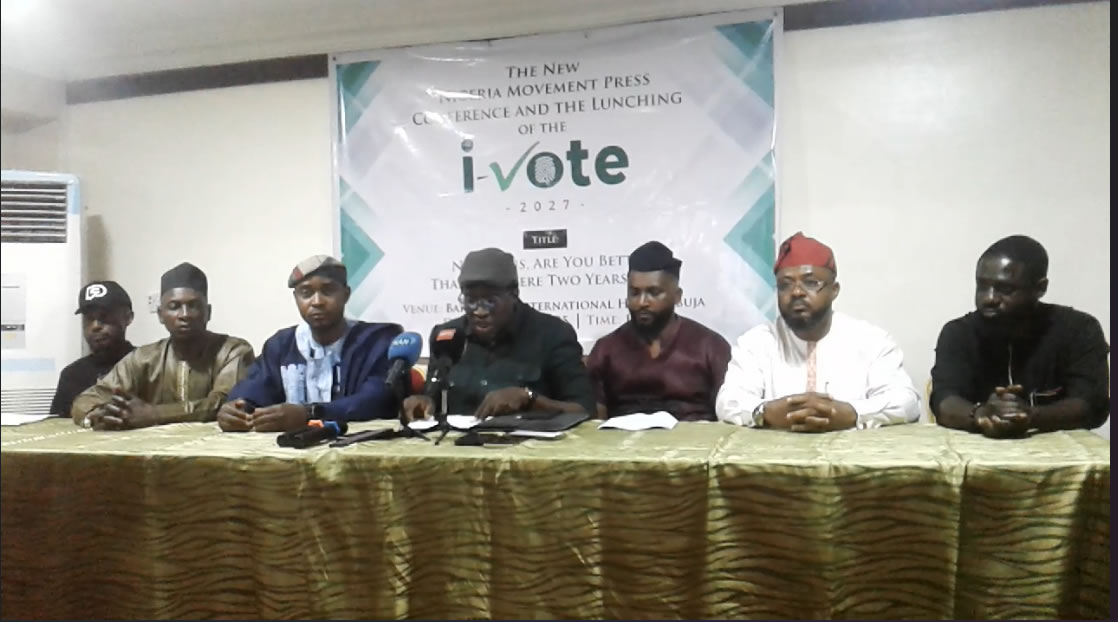
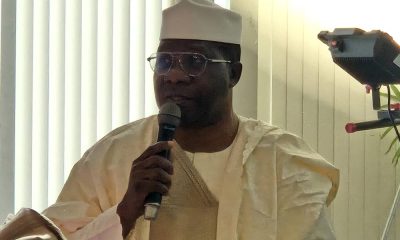
This is contained in a statement by Ishaya Inuwa Durkwa, Coordinator, The New Nigeria Movement tagged, “Nigerians, Are You Better Than You Were Two Years Ago”. during The New Nigeria Movement Press Conference and the Launching of the i-Vote 2027 in Nigeria, Thursday, July 10th. 2025.
While delivering his speech, Ishaya said, “But now, the young people are taking a position, and they will come from all the nooks and crannies of nigeria to register their commitment to joining forces to building a new nigeria where the welfare of Nigerians is considered over and above all, where coalition would not be about the names gatherings, it will not be about the faces in ADC, but about the issues bedeviling the nation.”
“Until Nigeria consistently and genuinely puts its people first, with selfless leaders, we will remain trapped in a disheartening cycle of unfulfilled promises. Genuine change is not merely about new faces in power. It is about a focus on serving the people. The true measure of a nation’s progress lies not in its statistical achievements but in the tangible improvement of the lives of its most vulnerable citizens.”
In his full statement, Ishaya said, “It gives me great pleasure to stand here this afternoon to talk about the Real Change that Nigerians deserve.
“You will agree with me that our nation is on standstill. Nothing is working at the moment and the Renewed Hope we were promised is now Hopeless.”
“Since the beginning of this year, a critical question has been resonating across Nigeria: “Am I better off today than I was yesterday?” For the vast majority of Nigerians, this is not a rhetorical exercise but a stark, lived reality, whispered in homes fractured by hunger and screamed in the silent desperation of stalled ambitions. From the bustling arteries of Lagos to the tranquil villages of Lafia, the answer, tragically, is a resounding no. Since the return to democratic governance in 1999, despite five presidents promising a brighter dawn, each new regime seems to bring less hope and more profound hardship.”
“The very essence of democracy, upon which its foundations were laid in 1999, promised something profoundly transformative: a demonstrably better life. This envisioned reality was not abstract; it meant the assurance of food on the table, consistent electricity, affordable healthcare, quality education, and jobs that could cover essential expenses and leave a little for life’s simple pleasures. Instead, Nigerians have largely received a relentless succession of economic experiments, a recurring drama surrounding fuel subsidies that consistently ends in public pain, a notoriously fragile national currency, and a poverty rate that has ballooned to alarming and unprecedented levels.”
in his Empirical Comparisons Of Key Economic Indicators Across Administrations, he said, “Empirical comparisons of key economic indicators across administrations reveal a consistently worsening pattern for the average citizen. A single litre of petrol now commands a price that, for many, exceeds a worker’s entire daily wage. In 1999, a litre of petrol cost approximately eleven naira. In 2025, that same litre costs well over seven hundred naira, a staggering sixty-threefold increase. The Nigerian naira, once trading at a relatively stable eighty to the United States dollar in 1999, now fluctuates precariously around one thousand four hundred and fifty to one thousand five hundred naira to the dollar, according to recent figures from financial markets. This represents an almost eighteenfold depreciation. As of July 2025, the naira trades around one thousand five hundred and twenty-eight naira to the dollar in the official window.”
he also said, “Inflation, a voracious and unseen predator, devours incomes with the efficiency of termites in a wooden hut, leaving behind only the husks of diminished purchasing power. While hovering in single digits in 1999, the latest figures for May 2025 indicate headline inflation hovering around twenty two point nine seven percent, with food inflation soaring to over forty percent. This means the cost of basic food items is increasing at an almost uncontrollable rate, eroding every gain. While the national minimum wage has nominally grown tenfold since 1999, now standing at thirty thousand naira, its real value has been devastatingly eroded by the relentless march of inflation. A nominal increase means little when purchasing power is decimated.”
“The poverty rate, a stark measure of human well-being, has regrettably risen again. As of the latest multidimensional poverty index report, over one hundred and thirty-three million Nigerians, representing approximately sixty-three percent of the population, are now living in multidimensional poverty, lacking access to basic services and decent living standards.”
“This is not merely an economic crisis that can be neatly categorized within macroeconomic models. It is a profound national trauma etched onto the faces of its citizens. The cost of essential staples like rice and garri, the burden of transport fares, the escalating burden of rent, the prohibitive expense of school fees, and even the price of a sachet of water have multiplied severalfold in a short span of time. An average family in Kogi or Kano, which in 2005 could budget approximately five thousand naira for a week’s meals, now requires over thirty thousand naira to feed the same household. Chillingly, for this increased expenditure, the quality and nutritional value of the food consumed is often worse, a tragic testament to compromised living standards.”
“The current economic strain has become an oppressive weight, crushing aspirations and fostering widespread despair. These are the vivid and heart-wrenching realities yhat comes with unolanned economic policies.
while accessing the last 2 years, he said, “President Bola Ahmed Tinubu and Vice President Kashim Shettima came into office in 2023 on the campaign theme of Renewed Hope. However, their administration’s immediate and simultaneous removal of the fuel subsidy and floating of the naira sent seismic shockwaves through the fragile economy. Within days, transport costs tripled, and the price of a common loaf of bread skyrocketed. Many families were forced to pull children out of school. Markets emptied, and small businesses closed in droves. The economy, already bruised, began to fracture under the pressure.”
The pressing question remains: how long must the poor wait for the promised benefits, and how much more suffering can be endured
“The government maintains that these drastic measures are necessary pains that will eventually lead to broader prosperity. This argument is not new, but Nigerians are profoundly tired of deferred dreams and promises of future abundance that never materialize. The pressing question remains: how long must the poor wait for the promised benefits, and how much more suffering can be endured?”
“True reform, the kind that genuinely uplifts a nation, fundamentally puts its people first. It is not about abstract macroeconomic numbers or accolades from multilateral financial institutions. It is, first and foremost, about the tangible impact on the lives of ordinary citizens. A truly people-oriented leadership would embody a different approach. It would push for social equity, prioritize local content development, and champion grassroots empowerment. Where the current approach removes subsidies without adequate cushioning, a people-oriented leadership would meticulously sequence reforms, implementing robust safety nets and palliative measures. Where the naira has been fully floated, a people-oriented leadership would carefully protect strategic sectors and essential commodities from volatile market forces. And crucially, where blame is cast upon the past, a people-oriented leadership would believe in co-creating the future with the people through inclusive dialogue and participatory governance.”
“The difference is crystal clear. One governs with an eye on the boardroom. The other governs for the marketplace, for the common man and woman, for the struggling family. As 2025 unfolds, the fundamental question persists, demanding an answer.”
“Their answer, spoken in the language of hunger and hardship, is tragically and unambiguously the same: no, we are not better off.”
“But now, the young people are taking a position, and they will come from all the nooks and crannies of nigeria to register their commitment to joining forces to building a new nigeria where the welfare of Nigerians is considered over and above all, where coalition would not be about the names gatherings, it will not be about the faces in ADC, but about the issues bedeviling the nation.”
“Until Nigeria consistently and genuinely puts its people first, with selfless leaders, we will remain trapped in a disheartening cycle of unfulfilled promises. Genuine change is not merely about new faces in power. It is about a focus on serving the people. The true measure of a nation’s progress lies not in its statistical achievements but in the tangible improvement of the lives of its most vulnerable citizens.”
“The time has come for Nigeria to break free from the unending cycle of recycled promises and empty political slogans. The way forward demands more than cosmetic reforms; it requires a complete shift in how we approach leadership, governance, and nation-building. This is why the ADC Coalition is a welcome development—it presents a timely opportunity for collaboration toward a shared national vision. However, for it to be truly transformative, we must go beyond familiar faces and entrenched structures. The coalition must neutralize personalities and instead amplify a new generation of leaders—especially young people and women—across all party organs and strategic decision-making platforms. Our future must not be built around the politics of name recognition but around the passion, competence, and sincerity of those who are ready to rebuild this nation from the ground up.”
“The Movement for a New Nigeria is not a campaign—it is a revolution of conscience. It is not powered by politicians, but by reformers—visionaries, grassroots organizers, policy thinkers, street educators, community mobilizers, and everyday Nigerians who are tired of waiting and ready to act. We will activate all our national structures to mobilize a people-driven movement unlike anything Nigeria has ever witnessed. This movement will transcend party lines and ethnic identities; it will be inclusive, intergenerational, and intentional. We will work with anyone—regardless of their background—who is genuinely committed to the transformation of our country. Our vision is simple but powerful: a Nigeria where leaders are accountable, where policies serve the people, and where every citizen—young, old, male, female—can live with dignity, opportunity, and hope.”
“To the Nigerian youth, to every woman who bears the burden of a failing system, and to every man and woman of good conscience: this is your moment. This is your call to action. The dream of a prosperous Nigeria is not dead—it is just waiting for people like you to rise. We must refuse to be spectators in our own story. Let us link arms, lend our voices, and build a nation where our children can dream without fear. There is hope for Nigeria—but only if we are bold enough to create it. Join the Movement for a New Nigeria. Today we lunch the I-VOTE Movement.”, he concluded.