Connect with us

Breaking

SON Commends FAO, NCC on review of food standards

Published

on

Share

The Standards Organisation of Nigeria (SON) has commended the Food and Agriculture Organisation of the United Nations (FAO) and the National Codex Committee (NCC) for critical role played in the elaboration of food Standards at the International level especially at the various committees of the Codex Alimentarius Commission where Standards are adopted at the National level.

The Director General, Standards Organisation of Nigeria (SON) Mallam Farouk Salim disclosed on Thursday while speaking at the awareness and advocacy workshop organized by the National Codex Committee (NCC) in collaboration with the Food and Agriculture Organization (FAO) of the United Nations (UN).

for high level policy and decision makers and public presentation of the 4th Edition of the revised National Codex Committee Procedural Manual in Abuja said the review was apt in order to keep abreast with the growth of Codex activities.

Represented by his Chief of Staff, Prof. Olobayo Kunle, SON Director General said NCC has also contributed to the review of the Food safety policy and Food safety Bill in Nigeria.

“The National Codex Committee Procedural Manual was first prepared in line with CAC procedural manual published in 2002, with further revisions in 2007 and 2012 to guide the activities and improve functions of all the stakeholders involved for effective operations.

“The review of the NCC Procedural Manual was necessary to keep abreast with the growth of Codex activities over time, incorporate major changes, improve and strengthen Codex structure in Nigeria

“The National Codex Committee (NCC) Nigeria successfully applied for the Codex Trust Fund (CTF) 2 support to build strong, solid and sustainable national capacity to engage in Codex activities through the organization of annual awareness and advocacy workshops with political decision-makers, targeted competent authorities and other stakeholders to disseminate more information on Codex.

“The overall objective of the activity is to sensitize public decision-makers and competent authorities on the need to engage more in the national codex and to regularly provide all the support to increase its actions in favour of food safety at national level” he said.

The Food and Agriculture Organisation of the United Nations (FAO) Representative to Nigeria, Fred Kafeero said since the inception of CAC, FAO has worked with World Health Organisation in the development of international food standards, guidelines, and codes of practices to protect the health of consumers and ensure fair trade practices in the food trade using the principles of risk analysis and scientific advice provided by joint FAO/WHO expert bodies and consultations.

Represented by the FAO Assistant Representative Administration, David Fehintola said its country office in Nigeria with support from the regional office for Africa has continued to partner the Government and the National Codex Committee towards creating effective and efficient policies and strategies to eliminate hunger, food insecurity and malnutrition in the country.

He said FAO believe that ensuring the supply of safe, quality and nutritious foods is as important as ensuring the availability of foods and food standardization as “Poor quality foods do not ensure food security” he said.

The FAO Representative to Nigeria said the agency has been supporting the National Codex Committee (NCC) in Nigeria, which has members from all the MDAs and the Private sector through the execution of the Codex Trust Fund 2 activities with a focus on the implementation of the Codex Strategic Plan 2020-2025.

“We, at FAO believe that it is vital that the NCC commits itself to the core values of the Codex Alimentarius Commission (CAC) in its Inclusiveness, Collaboration, Consensus Building and Transparency in all its work.

“FAO in its support through the CTF2 project endeavors to ensure the participation of all Codex members in the country in standard setting process to ensure these core values are met.

“A lot has been achieved this year in terms of capacity building of codex members, advocacy, sensitization and public awareness as well as in the review, finalization and dissemination of the NCC procedural manual” he said.

 

Continue Reading
Click to comment

Leave a Reply

Your email address will not be published. Required fields are marked *

Breaking

INEC Brings Forward 2027 Polls, Fixes January 16 for Presidential Election

Published

on

INEC
Share

The Independent National Electoral Commission (INEC) has rescheduled Nigeria’s 2027 general elections, fixing January 16, 2027, for the presidential and National Assembly polls.

The commission also announced that February 6, 2027, will now hold the governorship and State Houses of Assembly elections across the country.

The new timetable was disclosed on Thursday by Mohammed Haruna, National Commissioner and Chairman of the Information and Voter Education Committee, in an official statement.

Why the Shift?

INEC had earlier slated the presidential and National Assembly elections for February 20, 2027, while governorship and state assembly polls were scheduled for March 6, 2027.

However, the commission said it was compelled to adjust the schedule following the repeal of the Electoral Act, 2022 and the enactment of the Electoral Act, 2026, which introduced new legal and administrative frameworks guiding the conduct of elections.

According to the commission, aligning the electoral calendar with the provisions of the new law became necessary to ensure compliance, adequate preparation, and seamless implementation of reforms embedded in the 2026 legislation.

Implications for Political Parties

The revised dates effectively shorten the timeline for political parties, aspirants, and stakeholders preparing for the 2027 race. Parties are now expected to recalibrate their primary elections, campaign strategies, and logistics to meet the updated electoral window.

Political observers say the earlier schedule may also intensify early mobilization efforts, fundraising drives, and coalition talks among major contenders ahead of what is expected to be a fiercely contested general election.

INEC Assures Readiness

INEC reiterated its commitment to conducting free, fair, and credible elections under the new legal framework. The commission urged political actors and the electorate to take note of the revised timetable and cooperate to ensure a smooth electoral process.

With the 2027 general election cycle officially recalibrated, attention now shifts to how political parties and key stakeholders will navigate the compressed timeline under the new Electoral Act regime.

Continue Reading

Breaking

Ibom Air Passenger Who Slapped Crew Lands in Kirikiri!

Published

on

Ibom Air
Share

In a dramatic twist to an in–flight scandal, Comfort Emmanson — the passenger accused of assaulting airline staff during an Uyo–Lagos Ibom Air flight — has traded her trip for prison bars.

The incident, which shocked fellow passengers, has now culminated in her being charged to court and remanded at the notorious Kirikiri Correctional Centre in Lagos.

Tunde Moshood, Special Adviser on Media and Communications to Aviation Minister Festus Keyamo, SAN, broke the news on Monday via his official X handle.

“The more reason the flying public should be more careful… the unruly passenger on the Uyo–Lagos bound Ibom Air, Miss Comfort Emmanson, has been charged to court and she’s now cooling off in Kirikiri,” Moshood revealed.

Witnesses say the altercation left crew members shaken, sparking renewed calls for stricter penalties for in-flight misconduct.


Continue Reading

Breaking

NASS Passes ₦54.99trn 2025 Budget

Published

on

National Assembly Complex Abuja.
Share

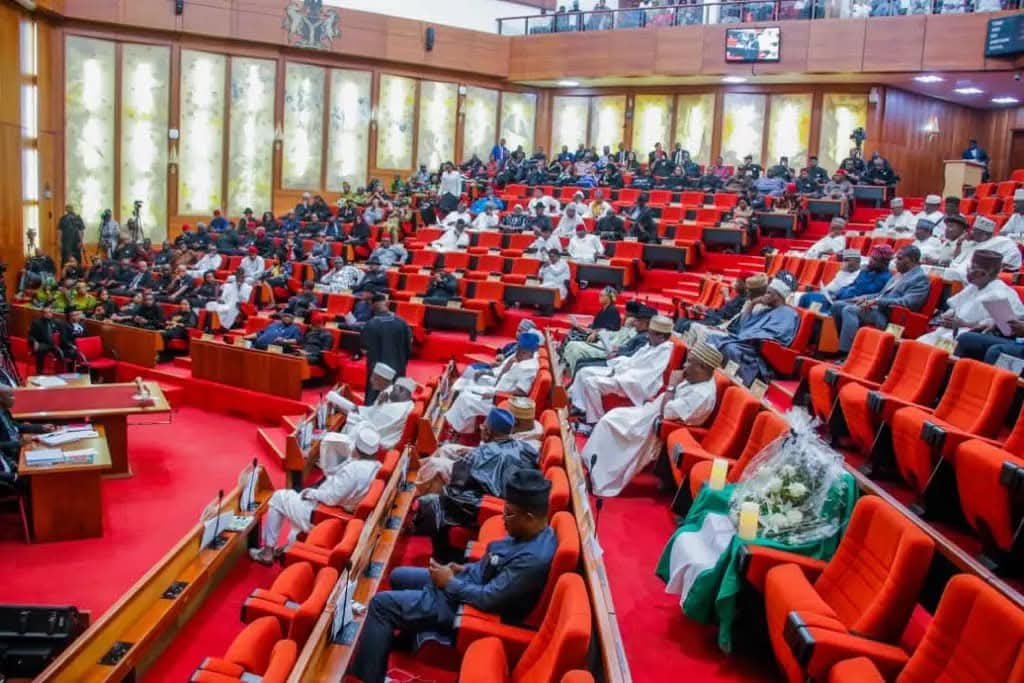
The National Assembly on Thursday passed the ₦54.99trn 2025 Appropriation Bill.

The bill was passed separately by the Senate and the House of Representatives.

A breakdown of the budget showed N3.645trn for statutory transfers, N14.317trn for debt servicing, N13.64trn for recurrent expenditure and N23.963trn capital expenditure (development fund), with fiscal deficit put at N13.08trn.

The Deficit-to-Gross domestic product (GDP) Ratio was put at 1.52%.

Last Week, President Bola Tinubu increased the 2025 fiscal year budget from an initial N49.7trn to N54.2trn, seeking approval from the Senate and the House of Representatives.

The Chairman of the House Committee on Appropriations, Abubakar Bichi, while presenting the bill for consideration, stated that the committee met with the Presidential Economic Planning team to further discuss revenue projections and expenditure for the 2025 Appropriation Bill.

According to him, the 2025 Appropriation Bill was presented late, compared to that of 2024.

He urged the executive to present subsequent budgets to the National Assembly not later than three months before the next financial year, to maintain the January to December budget cycle.

Continue Reading