Connect with us

Business & Economy

FAAC: FG, States, LGCs Share N1.35trn July Revenue

Published

on

FAAC
FCCA
Share

Federal Government, States and Local Government Councils – have shared a total sum of N1,358.075 billion as of July 2024 Federation Accounts Revenue.

Of the N1,358.075 billion total distributable revenue, the Federal Government received a total sum of N431.079 billion, and the State Government received a total sum of N473.477 billion.

The Local Government Councils received a total sum of N343.703 billion, and a total sum of N109.816 billion (13% of mineral revenue) was shared with the benefiting States as derivation revenue.

The N1,358.075 billion total distributable revenue comprised distributable statutory revenue of N161.593 billion, distributable Value Added Tax (VAT) revenue of N582.307 billion and Electronic Money Transfer Levy (EMTL) revenue of N18.818 billion.

Also included in the total distributable revenue was Exchange Difference revenue of N581.710 billion and Solid Mineral revenue of N13.647 billion.

The revenue distribution was announced at the August 2024 meeting of the Federation Accounts Allocation Committee (FAAC) in Abuja on Friday, August 16, 2024.

A communique issued by FAAC indicated that total revenue of N2,613.791 billion was available in July 2024. The total deduction for the cost of collection was N99.756 billion, while total transfers, interventions and refunds were N1,155.960 billion.

According to the communique, gross statutory revenue of N1,387.150 billion was received for July 2024. This was lower than the sum of N1,432.667 billion received in June 2024 by N45.517 billion.

Gross revenue of N625.329 billion was available from VAT in July 2024. This was higher than the N562.685 billion available in June 2024 by N62.644 billion.

On the N161.593 billion distributable statutory revenue, the communiqué stated that the Federal Government received N58.545 billion and the State Governments received N29.695 billion.

The Local Government Councils received N22.894 billion, and the sum of N50.459 billion (13% of mineral revenue) was shared with the benefiting states as derivation revenue.

From the N582.307 billion distributable VAT revenue, the Federal Government received N87.346 billion, the State Governments received N291.154 billion and the Local Government Councils received N203.807 billion

In a statement issued by Bawa Mokwa, the Director of Press and Public Relations in the Office of the Accountant General of the Federation, a total sum of N2.823 billion was received by the Federal Government from the N18.818 billion Electronic Money Transfer Levy (EMTL). The State Governments received N9.409 billion and the Local Government Councils received N6.586 billion.

On the N581.710 billion Exchange Difference revenue, the communique stated that the Federal Government received N276.110 billion and the State Governments received N140.047 billion.

The Local Government Councils received N107.970 billion, while the sum of N57.583 billion (13% of mineral revenue) was shared with the benefiting States as derivation revenue.

From the N13.647 billion Solid Mineral revenue, the Federal Government received N6.255 billion and the State Governments received N3.172 billion.

The Local Government Councils received N2.446 billion, while the sum of N1.774 billion (13% of mineral revenue) was shared with the benefiting States as derivation revenue.

As presented in the communiqué, in July 2024, Oil and Gas Royalty, Petroleum Profit Tax (PPT), VAT, Import Duty, EMTL and CET Levies increased significantly.

Furthermore, Companies Income Tax (CIT) recorded a decrease while Excise Duties increased only marginally.

The balance in the ECA was $473,754.57


Continue Reading
Click to comment

Leave a Reply

Your email address will not be published. Required fields are marked *

Business & Economy

States’ Foreign Debt Service Jumps 26% to N455bn, Squeezing FAAC Allocations

Published

on

FAAC Logo
Share


Nigeria’s 36 states paid a combined N455.38bn to service foreign loans in 2025, marking a 25.77 per cent increase from the N362.08bn recorded in 2024, according to Federation Accounts Allocation Committee (FAAC) data released by the National Bureau of Statistics and analysed by The PUNCH.

The N93.30bn year-on-year rise underscores growing fiscal pressure on subnational governments, as a larger share of their monthly FAAC inflows is now automatically deducted at source to meet external debt obligations.

Tighter Fiscal Space

Foreign debt service in the FAAC framework operates as a first-line charge, meaning deductions are made before states access their allocations. While this structure safeguards creditors and ensures repayment discipline, it also narrows states’ discretionary spending space—particularly in periods of revenue volatility.

The 2025 monthly pattern reflected a “step-down” structure rather than sharp fluctuations. Deductions stood at N40.09bn in January before easing to N39.10bn in February. The N39.10bn level persisted from March through July, suggesting predictable repayment schedules.

A second adjustment occurred in August, when total deductions declined to N36.14bn—a 7.56 per cent drop from July—and remained at that level through December.

This contrasts with 2024, when debt service figures swung sharply in the first quarter—rising from N9.88bn in January to N40.41bn in March—before stabilising in the latter part of the year.

Top 10 States Account for 69%

Debt servicing obligations remain highly concentrated. The top 10 states accounted for 68.57 per cent of total foreign debt deductions in 2025.

Lagos led with N92.80bn, representing 20.38 per cent of the national total and a 28.33 per cent increase from 2024.

Rivers followed at N48.58bn, more than doubling its 2024 figure with a 110.02 per cent jump.

Kaduna ranked third at N47.93bn, up 5.13 per cent year-on-year.

Ogun posted one of the sharpest increases, rising 110.22 per cent to N25.20bn.

Cross River recorded N21.01bn, up 22.86 per cent.

Other major contributors included Oyo (N20.17bn), Edo (N18.70bn), Bauchi (N16.85bn), Kano (N10.63bn), and Ebonyi (N10.37bn), with Ebonyi posting a 53.09 per cent rise.

Regional Breakdown

By geopolitical zone, the South-West carried the heaviest burden at N162.77bn, accounting for 35.74 per cent of total foreign debt service, largely driven by Lagos and Ogun.

The South-South followed with N100.37bn (22.04 per cent), buoyed by Rivers, Edo, Cross River, and Delta.

The North-West recorded N81.97bn (18.00 per cent), with Kaduna and Kano as key contributors.

The North-East accounted for N42.42bn (9.32 per cent), while the South-East posted N40.20bn (8.83 per cent). The North-Central had the lowest at N27.65bn (6.07 per cent).

Sustainability Concerns Mount

The Nigeria Extractive Industries Transparency Initiative (NEITI) warned that several states with heavy debt burdens rank lower in FAAC allocations, raising red flags over fiscal sustainability.

Economists caution that without stronger internally generated revenue (IGR), rising debt service obligations could crowd out spending on salaries, infrastructure, and social services.

Teslim Shitta-Bey, Director and Chief Economist at Proshare Nigeria LLC, argued that borrowing should not be the default option. He advocated for longer-term debt instruments structured more like equity and called for the creation of a comprehensive national asset register to unlock value from dormant assets.

He also criticised the underutilisation of revenue bonds, urging states to prioritise them over general obligation bonds.

Similarly, macroeconomic analyst Dayo Adenubi emphasised the need to expand consumption to boost Value Added Tax receipts, strengthen property and transport-related tax enforcement, and reinforce the social contract to enhance compliance.

With debt service now absorbing a significant portion of subnational revenues, analysts say fiscal reforms and revenue diversification are becoming increasingly urgent for Nigeria’s states.


Source: Punch

Continue Reading

Business & Economy

Dangote Refinery Cuts Petrol Ex-Depot Price to N774 Per Litre

Published

on

Aliko Dangote
Share

Dangote Petroleum Refinery has reduced the ex-depot price of Premium Motor Spirit (PMS) by N25 per litre, bringing the gantry price down from N799 to N774 per litre.

The refinery communicated the price adjustment to marketers on Tuesday, stating that the new rate takes immediate effect.

In a notice issued by its Group Commercial Operations Department, Dangote Petroleum Refinery and Petrochemicals FZE said: “This is to notify you of a change in our PMS gantry price from N799 per litre to N774 per litre.”

Industry pricing platform petroleumprice.ng confirmed on Tuesday that the revised price had been reflected.

The refinery also announced the end of its PMS lifting incentive. According to the notice, the bonus scheme closed at 12:00 a.m. on February 10, 2026, while credits for volumes lifted between February 2 and February 10, within previously communicated thresholds, will be posted to marketers’ account statements.

The price reduction comes amid continued adjustments in Nigeria’s deregulated downstream petroleum sector. PMS prices remained volatile throughout 2025 following the removal of petrol subsidies, with ex-depot prices fluctuating between about N700 and over N800 per litre, largely influenced by exchange rate movements, global crude oil prices and import dependence.

Large-scale domestic supply from the Dangote refinery, which commenced toward the end of 2025, helped moderate prices in some regions by reducing reliance on imported fuel. In early 2026, the refinery had raised its PMS gantry price to N799 per litre after selling at N699 during the festive period.

The latest reduction to N774 per litre suggests easing cost pressures and improving operational efficiency, as well as increased competition from imported cargoes and expected output from modular refineries.

With a processing capacity of 650,000 barrels per day, Dangote Petroleum Refinery is Africa’s largest single-train refinery and a key component of Nigeria’s strategy to cut fuel imports and conserve foreign exchange. Since beginning domestic PMS supply, the refinery has played an increasingly influential role in shaping ex-depot pricing in the downstream market.

Continue Reading

Business & Economy

Tinubu Tables ₦58.18trn 2026 Budget, Projects Sustained Economic Stability

Published

on

President Bola Ahmed Tinubu
Share

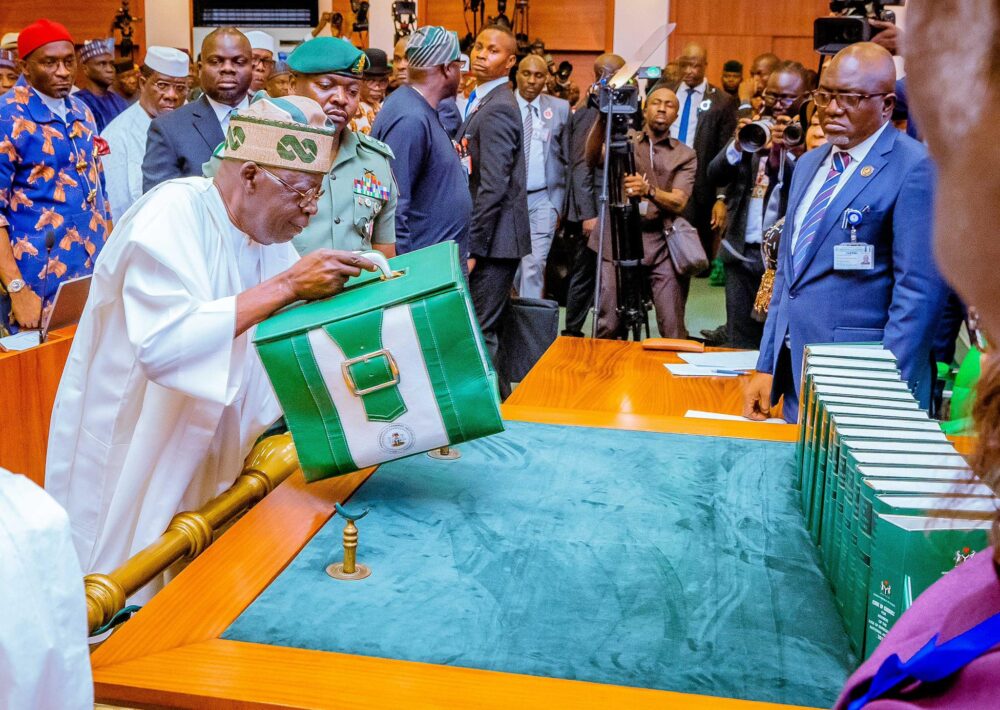
President Bola Tinubu on Friday presented a ₦58.18 trillion 2026 Appropriation Bill to a joint session of the National Assembly of Nigeria, declaring that Nigeria’s economy is showing measurable signs of stabilisation following years of structural pressure.

Tagged “Budget of Consolidation, Renewed Resilience and Shared Prosperity,” the 2026 fiscal plan is aimed at locking in recent macroeconomic gains while translating economic recovery into improved living standards for citizens.

According to the President, Nigeria’s economy expanded by 3.98 per cent in Q3 2025, while inflation moderated significantly, falling to 14.45 per cent in November 2025 from 24.23 per cent in March 2025.

“With stabilising food and energy prices, tighter monetary conditions, and improving supply responses, we expect the disinflationary trend to persist into 2026, barring major supply shocks,” Tinubu said during the presentation on December 19, 2025.

The President highlighted additional positive indicators, including improved crude oil production, rising non-oil revenues, renewed investor confidence, and external reserves climbing to a seven-year high of approximately $47 billion.

Under the proposal, the Federal Government projects ₦34.33 trillion in revenue against planned expenditure of ₦58.18 trillion, resulting in a budget deficit of ₦23.85 trillion, equivalent to 4.28 per cent of GDP. Tinubu emphasised that the fiscal framework is built on realism, prudence, and growth-driven assumptions.

He further assured lawmakers of tighter discipline in budget implementation, stressing that fiscal spending in 2026 would be more outcome-focused.

“Every naira spent or borrowed must deliver measurable public value,” the President said.

Continue Reading