
Agriculture
Buhari Unveils 13 Sky-high Abuja Rice Pyramids

By Raphael Awesome
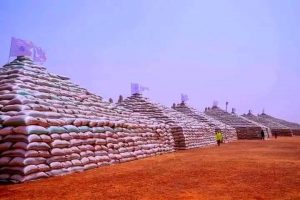
 Abuja – President Muhammadu Buhari on Tuesday unveiled 13 sky-high pyramids consisting of one million bags of paddy rice.
Unveiling the FCT Mega Rice Pyramids at the International Trade Fair Complex, Abuja, Buhari said the event showed that the country was making steady and assured progress towards self-sufficiency in food production.
The president expressed the commitment of his administration towards implementing home-grown policies targeted at securing food for all Nigerians.
Buhari, said that the unveiling of the pyramids is a testament to the fact that the Anchor Borrowers’ Programme of the Central Bank of Nigeria (CBN) has started yielding fruitful results.
He said: “Fellow Nigerians, our gathering here today, is no doubt a testament to the fact that the Anchor Borrowers’ Programme is working.
“Indeed, these sky-high pyramids for which we are gathered here to commission are part of our commitment at achieving national food security and economic diversification through home-grown policies targeted at securing food for all Nigerians.
“As a critical policy of the government, the Anchor Borrowers’ Programme is expected to catalyse the agricultural productive base of the nation,”.
The President said the Anchor Borrowers’ Programme was designed to encourage investments in agriculture and empower smallholder farmers as drivers of transformation in the agricultural sector.
He further said that the Programme had continued to receive commendations, since its introduction, as it has become one of the reference points in the administration’s agricultural revolution effort.
According to him, the Anchor Borrowers’ Programme has so far supported over 4.8 million smallholder farmers across the country for the production of 23 agricultural commodities including maize, rice, oil palm, cocoa, cotton, cassava, tomato and livestock.
“In fact, the Programme speaks loudly in its giant strides as it has increased access to finance by our rural farmers, who before now were virtually excluded from the financial system.
“Today rice production in Nigeria has increased to over 7.5 Million Metric tons annually. Prior to the introduction of ABP, the average production in Nigeria between 1999 and 2015 was less than four metric tons annually,’’ he said.
 On his part, the Governor of the Central Bank of Nigeria, Godwin Emefiele, said the intervention by the bank in the Nigerian agricultural sector led to the massive reduction in imported rice from Thailand to 58,000 metric tons at the end of 2021 as against 1.3 million metric tons imported in 2014.
Emefiele said that Anchor Borrowers’ Programme (ABP) was started in November 2015 to provide aid to farmers and influence the value chain of various commodities in Nigeria, adding that ABP has also catalyzed the rural economy and has built a sustainable framework for financing smallholder farmers in Nigeria.
He said: “The Programme has developed an ecosystem among all nodes of the agricultural value chain and these linkages can be better optimized through synergy among all stakeholders.
“We are delighted that these efforts have yielded fruits in not just increasing the availability of rice, but also in moderating prices, reducing imports and increasing job creation in the country. For example, Thailand alone exported 1.3 million metric tons of rice to Nigeria in 2014.
“The ABP was launched in 2015 to curtail these imports, and since then, we have seen incremental reductions in rice imports from Thailand. By 2016, rice imports from Thailand had fallen to only 58,000 metric tons. As of the end of 2021, they only exported 2,160 metric tons to Nigeria, thereby saving us foreign exchange and helping preserve jobs in Nigeria.”
The Apex Bank Governor disclosed that beyond increasing national output from about 5.4 million metric tons in 2015 to over 9 million metric tons in 2021, significant improvement of productivity per hectare of the smallholder farmer from about 2.4 metric tons per hectare in 2015 to between about 5 metric tons per hectare in 2021 was also recorded.
 Speaking on the sidelines, Mr Ado Hassan, Secretary of the Kano State chapter of Rice Farmers Association of Nigeria (RIFAN) said the country will commence exportation of rice in the near future to engender the twin benefits of food security and economic diversification.
He dispelled insinuations that the rice pyramids on display were not solely rice, stating that the commodity was brought in by rice farmers in virtually all states of the country.
“The rice here is from all over the country. RIFAN has always been real, it is not possible to deceive 200 million Nigerians with a project like this.
“For the fact that Nigeria has not imported even a grain of rice in the last four years is enough proof that we are already self-sufficient in the commodity. The cultivation of rice is a reality and it will continue to happen,” he said.
Hassan disclosed that Nigeria has become the highest rice-growing country in Africa due to the support of the Federal Government and the intervention of the CBN.




FG Suspends 20 NSCDC Officers Over Deaths Of 37 Suspected Illegal Miners
Share The Federal Government has suspended 20 officers of the Nigeria Security and Civil Defence Corps (NSCDC) over the reported...


NYSC Sets September 30 for 2026 Batch ‘C’ Stream One Orientation
Share The National Youth Service Corps (NYSC) has announced Wednesday, September 30, 2026, as the commencement date for the 2026...


Obi Challenges UNN: “Release My Academic Records for Public Scrutiny”
Share Presidential candidate of the New Nigeria Development Coalition (NDC), Peter Obi, has challenged the University of Nigeria, Nsukka (UNN),...


NDLEA Busts Mexican Drug Kingpin, Dismantles Industrial-Scale Meth Lab in Ebonyi
Share The National Drug Law Enforcement Agency (NDLEA) has arrested a suspected Mexican drug kingpin, Arturo Carrera Loaiza, allegedly linked...

Wike Backs Tinubu for 2027, Says PDP Will Contest Other Elections
Share Minister of the Federal Capital Territory (FCT), Nyesom Wike, has reaffirmed his support for President Bola Ahmed Tinubu’s re-election...