Connect with us

International

Thousands of Migrants Stranded In Niger Due To Border Closures

Published

on

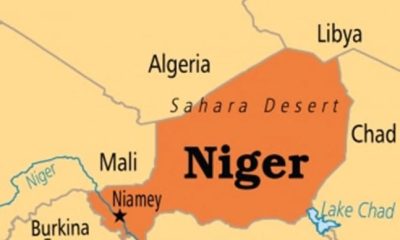
Niger Map
Share


Over 7,000 migrants are stranded in Niger, unable to be repatriated since the coup by the junta in July and the closing of airspace and land borders.

Niger is an important route both for Africans trying to reach Libya as a jumping-off spot to cross the Mediterranean to Europe and those who are returning to their homes with help from the United Nations.

UN officials estimate about 1,800 are living on Niger’s streets because centres run by the International Organization for Migration, IOM, are too crowded to take in more. The centres hold about 5,000 people trying to get home.

The UN agency had been assisting approximately 1,250 people a month to return to their countries this year, after failing to cross the Mediterranean into Europe.

But the closure of borders and airspace, according to Paola Pace, acting interim chief of mission for the agency in Niger, has forced it to temporarily suspend returns and its centres are now jammed at 14% over capacity,

“This situation poses challenges for migrants as migrants staying in these centres may experience heightened stress and uncertainty with limited prospects for voluntary return and already crowded facilities,” she said.

Pace expressed worries the stall in the transiting of Africans seeking to get home could increase exploitation of vulnerable people by traffickers and smugglers who normally focus on individuals trying to migrate to Europe.

The shelters are helping people who are making their way home, rather than would-be migrants heading to Europe — a northern flow that has seen more than 100,000 cross the central Mediterranean to Italy so far this year, according to Italy’s interior ministry.

COOPI, an Italian aid group that provides shelter for migrants in Niger’s northern town of Assamakka, near the border with Algeria, said since the coup in Niger, an additional 1,300 people have entered its centre, trying to return home.

COOPI assists the UN in hosting people, but has warned that it would run out of food and water if the borders don’t open soon.

Not only are migrants unable to leave but aid groups are also unable to bring in food and medical supplies.

Morena Zucchelli, head of mission for COOPI in Niger, said it had only enough food stocks to last until the end of August, while its funding would run out at the end of September, creating humanitarian crisis.

“If the situation doesn’t change … we can’t guarantee things will continue running,” she said.
Before the coup, Niger worked with the European Union in trying to slow the flow of migrants north to Libya and Algeria.

The EU had been scheduled to provide more than $200 million to Niger to help it address security, socio-economic and migration challenges.

Anitta Hipper, a spokeswoman for the European Commission, could not say yesterday whether cooperation on migration had been suspended, saying only that the EU would continue to “monitor and evaluate the situation.”

Sahr John Yambasu is one of the migrants who, after three months of crossing the desert and watching other migrants die at sea in his failed attempt to reach Europe, gave up on getting across the Mediterranean and decided to go back home but got trapped due to the border closure.

The 29-year-old from Sierra Leone reached Niger in June on his return journey, but United Nations officials said he had to wait for packed migrant centres to empty out before he could be repatriated.

Then mutinous soldiers toppled Niger’s president a few weeks later, bringing regional tensions and the shuttering of the borders.

Momo Kmulbah is another of those trying to get back home in Liberia. He says many of them have nowhere to turn for help, and that UN officials have told him to be patient.

The 36-year-old has been sleeping on the pavement in Niger’s capital, Niamey, with his two daughters and wife since June and now begs for food.

Continue Reading
Click to comment

Leave a Reply

Your email address will not be published. Required fields are marked *

International

Nigeria Urges South Africa to Act Against Attacks on Nigerians

Published

on

Nigeria and South Africa Flags
Share


The Federal Government of Nigeria has called on South Africa to take firm and immediate action to stop ongoing violence targeting Nigerians and other foreign nationals in the country.

This appeal was made during a meeting in Abuja between Dunoma Ahmed, Permanent Secretary of the Ministry of Foreign Affairs, and Lesoli Machele.

Speaking to journalists, the ministry’s spokesperson, Kimiebi Ebienfa, said the meeting was convened in response to recent xenophobic attacks and protests in parts of South Africa. According to him, some protesters have been calling for foreigners—especially black immigrants—to leave the country.

Ebienfa described circulating videos and reports from South Africa as disturbing, noting that they contradict the long-standing friendly relationship between both nations.

He also revealed that Nigeria’s High Commission in Pretoria and Consulate in Johannesburg are closely monitoring the situation and sending regular updates to the government.

The Nigerian government further expressed concern over the reported deaths of two Nigerians, Amaramiro Emmanuel and Ekpenyong Andrew, allegedly linked to encounters with South African security agencies. Authorities say the circumstances surrounding their deaths have raised serious questions about the conduct of security personnel.

While acknowledging statements by South African officials condemning violence, looting, and extrajudicial actions, Nigeria emphasized the need for these commitments to be backed by concrete action on the ground.

The Federal Government also called for the urgent activation of an existing memorandum of understanding (MoU) between both countries. The agreement is designed to enable early warning systems, improve communication, and help prevent escalation of threats against Nigerians living in South Africa.

Nigeria urged South Africa to take decisive steps to restore confidence among Nigerians residing there and ensure they can live safely and with dignity.

Ebienfa also mentioned that the government is aware of a recent protest by a group of Nigerians at the South African High Commission in Abuja. He appealed for calm and reassured that Nigeria remains committed to protecting diplomatic missions in line with international obligations.

Continue Reading

International

Trump Says Middle East War Could End ‘Very Soon’ as Markets Rally

Published

on

Donald Trump
US President, Donald Trump
Share


United States President Donald Trump has said the ongoing Middle East conflict could end within weeks, expressing confidence that the war may be concluded “very soon.”

Speaking at the White House, Trump told reporters that U.S. forces could withdraw from Iran within “two weeks, maybe three,” adding, “we’re finishing the job.” He also indicated that a diplomatic agreement could still be reached before any final military outcome.

Earlier, Iranian President Masoud Pezeshkian said Tehran possesses “the necessary will” to end the conflict, provided key conditions are met, including guarantees against future aggression.

The remarks from both leaders raised hopes for a resolution to the month-long crisis, prompting a surge in global financial markets. On Wall Street, the Nasdaq Composite rose 3.8 percent, while the S&P 500 gained nearly three percent.

Asian markets also posted strong gains, with major indices in Seoul, Tokyo, and Taipei rising sharply, alongside advances in Hong Kong, Shanghai, Sydney, Singapore, Manila, and Jakarta.

Despite the optimism, oil markets remained volatile amid concerns over the strategic Strait of Hormuz, through which roughly 20 percent of global oil and gas supplies pass. Trump stated that the United States would not intervene to reopen the strait if it were blocked, suggesting other nations should take responsibility.

Meanwhile, Israeli Prime Minister Benjamin Netanyahu signaled continued military operations, stating that Israel would press on with its campaign against what he described as a “terror regime.”

The economic fallout from the conflict has intensified, with U.S. gasoline prices surpassing $4 per gallon for the first time in four years and inflation pressures rising in Europe. Analysts warn that sustained high oil prices—currently above $100 per barrel—could further strain global economic growth.

Additional tensions emerged following reports that the United Arab Emirates is considering supporting efforts to reopen the Strait of Hormuz, potentially under a United Nations mandate, which could mark a significant escalation.

As diplomatic signals remain mixed, analysts caution that uncertainty surrounding the conflict and global energy supplies is likely to persist in the near term.

Continue Reading

International

UK Announces Tight Security, Road Closures Ahead of President Tinubu’s State Visit to Windsor Castle

Published

on

President Bola Tinubu with King Charles
Share

Authorities in the United Kingdom have announced road closures and temporary airspace restrictions ahead of the arrival of Nigerian President Bola Ahmed Tinubu for a state visit hosted by Charles III.

President Tinubu is expected to begin the visit on Wednesday, March 18, accompanied by Nigeria’s First Lady, Oluremi Tinubu. An official reception for the Nigerian leader is scheduled to take place at Windsor Castle.

In a statement issued on Wednesday, Thames Valley Police said it is working closely with the Royal Borough of Windsor and Maidenhead, the Royal Household, and other security partners to ensure the visit proceeds smoothly and securely.

As part of the heightened security arrangements, authorities confirmed that the permanent airspace restrictions over Windsor Castle will be extended on March 18 from 7:00 a.m. to 11:59 p.m.

Chief Superintendent Adrian Hall of the police force’s Joint Operations Unit said the airspace limitations form only one aspect of a comprehensive security operation planned for the high-profile diplomatic engagement.

“The air restrictions are just one part of our robust security operation for the state visit of Nigerian President Tinubu next week, with many measures you will see and others you will not,” Hall said.

He added that the police have extensive experience managing security during royal events in Windsor, noting that significant planning and preparation have gone into the operation.

Hall also warned that the authorities would strictly enforce the restrictions, stressing that any violation would constitute a criminal offence under the Air Navigation Order and could lead to arrest.

Security deployment during the visit will include specialised police units such as search teams, mounted officers, road policing personnel, and armed officers. These units will operate alongside neighbourhood policing teams and resources from the Project Servator.

Officials said additional safety measures would include Windsor’s extensive closed-circuit television network and hostile vehicle mitigation barriers positioned around key locations.

Authorities have urged members of the public to remain vigilant and report any suspicious activity by contacting police through 101 or speaking directly with officers on duty. Emergencies should be reported through the 999 service.

Meanwhile, road closures and parking restrictions are set to take effect from Tuesday, March 17, with temporary traffic disruptions expected in and around Windsor during the visit.

Thames Valley Police added that it is working in coordination with the Civil Aviation Authority and National Air Traffic Services to enforce the temporary flight restrictions. Individuals with legitimate reasons to operate drones during the restricted period have been advised to seek prior clearance from the police.

Continue Reading