Connect with us

Judiciary

Osun 2022: Oyetola appeals court ruling nullifying his candidacy

Published

on

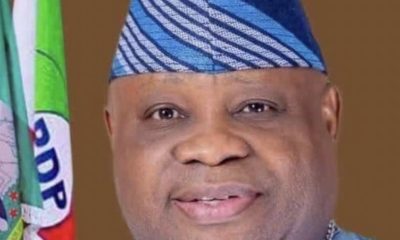
Former Osun State Governor Gboyega Oyetola
Osun State Governor Adegboyega Oyetola
Share


…seeks stay of execution on judgement

Governor Adegboyega Oyetola of Osun has appealed the Federal High Court judgement that nullified his nomination as the candidate of the All Progressives Congress (APC) for the July 16, 2022 governorship election in the State.

This is as the Governor and his deputy have also filed an application before the Federal High Court in Abuja, seeking to stay execution of the court judgment pending the final determination of the appeal.

Justice Emeka Nwite of the FHC, Abuja, had while delivering ruling in the suit filed by the Peoples Democratic Party, PDP, invalidated the candidacy of Oyetola and his deputy, Benedict Alabi, on the grounds that Governor Mai Mala Buni of Yobe, who submitted their names to the Independent National Electoral Commission (INEC) violated the provisions of Section 183 of the Constitution of the Federal Republic of Nigeria and Section 82(3) of the Electoral Act, 2022.

Oyetola and Alabi in an appeal filed by the APC through their counsels, Dr Abiodun Layonu (SAN) and Abdulfatai Oyedele, listed 19 grounds of appeal against the lower court judgment.

According to them, the decision of the Federal High Court was against the weight of evidence and constitutes a grave miscarriage of justice. They therefore asked the Court of Appeal to set aside the ruling of the lower court and affirm their nominations as valid and lawful.

In the appeal, the governor and his deputy argued that all the actions taken by Governor Buni in respect of their nominations were valid and legally cognizable as it was in compliance with the provisions of the Electoral Act 2022 and the 1999 Constitution of Nigeria.

The appellants noted that the setting up of the defunct Caretaker Committee/Extra-ordinary Planning Committee (CCEPC) by the National Executive Committee (NEC) of the party did not violate provision of the Constitution and Section 82(3) of the Electoral Act 2022.

The APC further argued that the PDP lacked the locus to commence the legal action against Governor Oyetola as the issue of nomination of candidate was an internal affair of political parties, hence does not concern the PDP.

“By the provision of Section 84(14) of the Electoral Act 2022, it is only an aspirant that participated in the primary election that can complain that the provision of the Electoral Act and the guidelines of the political party have not been complied with in the selection or nomination of candidate of a political party for an election.

“The issue of nomination and sponsorship of candidates of a political party is strictly an internal affair of a political party which is not justiciable. The 1st respondent (the PDP) therefore lacks the locus standi to bring any cause of action that relates to internal affairs of the appellant (APC),” it said.

Another ground of appeal filed by the appellant was that the suit initiated by the PDP had been caught by the Issue of Estoppel which indicates that where an issue has been decided by a competent court, the court will not allow it to be re-litigated by different parties.

“The principal issue raised by the 1st Respondent (PDP) before the trial court is whether the 3rd and 4th Defendants (Oyetola and his deputy) were validly nominated and sponsored for the Gubernatorial Election held in Osun on the 16th of July, 2022.

“This same issue involving the same parties have been laid to rest in the case of JEGEDE V. INEC (2021) 14 NWLR (1797) 409 and Plaintiff suit as presently constituted is a duplication, repetition and remake of what has been settled and decided by the Supreme Court in the said case.

“The provisions of Sections 180 and 183 of the Constitution upon which the decision of the Supreme Court in JEGEDE V. INEC was based is still very extant.”

The appellant therefore held that the suit filed by the PDP was an abuse of Court process and that the trial court lacked the jurisdiction to adjudicate upon it.

The APC also argued that the suit filed by the PDP was statute-barred as the party failed to file the case within the time frame stipulated by the Constitution, hence, the court lacks the jurisdiction to adjudicate upon it.

“The law stipulates that every pre-election matter must be filed within 14 days from the date of occurrence of the event, decision and act complained of in the suit. The period within which to file action elapsed on the 31st of March, 2022, and the PDP filed the suit on 7 April.

“Therefore, the court lacks the jurisdiction to adjudicate upon the 1st respondent’s suit as the action was statute barred. The act complained of came into existence on or before 18th March, 2022 and not 25th March, 2022 as claimed by the 1st respondent.”

Continue Reading
Click to comment

Leave a Reply

Your email address will not be published. Required fields are marked *

Judiciary

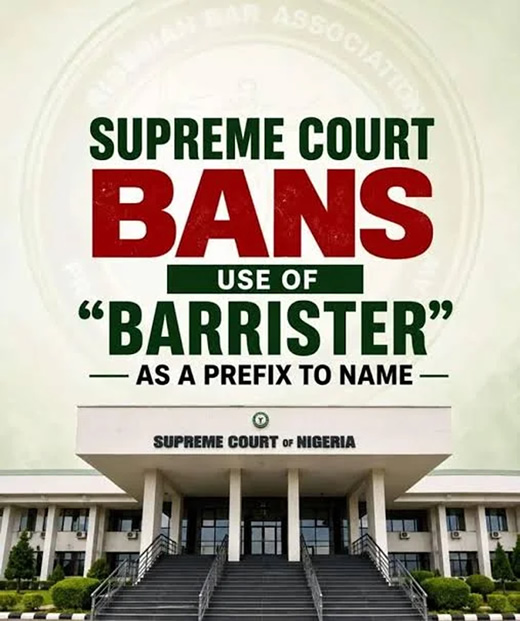
Supreme Court Bans Use of ‘Barrister’ as Title in Official Correspondence

Published

on

Share

The Supreme Court of Nigeria has directed all litigation staff, legal practitioners, court registrars and lawyers attached to the apex court to discontinue the use of the title “Barrister” as a prefix to their names in all official engagements.

The directive was contained in a memorandum dated July 13, 2026, signed by the Chief Registrar of the Supreme Court, Kabir Akanbi.

Addressed to litigation staff, legal practitioners, court registrars and lawyers, the circular said the measure was part of efforts to uphold professional standards within the apex court.

The directive ordered all affected officers to immediately discontinue the use of the title in official correspondence, records, documents, identity materials and other official engagements connected with the Supreme Court.

The Chief Registrar also instructed Heads of Departments and Unit Heads to ensure strict compliance with the directive by all personnel under their supervision.

The memo did not state the reasons behind the policy beyond the need to uphold professional standards within the nation’s highest court.

The Supreme Court’s order comes weeks after the Council of Legal Education warned prospective lawyers against wearing wigs and gowns or presenting themselves as qualified legal practitioners before they are formally called to the Nigerian Bar.

The council said such conduct undermined the dignity of the legal profession and warned that violators could face disciplinary measures. It also reminded candidates that the use of legal regalia is governed by the Rules of Professional Conduct and is reserved for duly qualified legal practitioners.

The development has sparked discussions within legal circles, where the title “Barrister” is commonly used by legal practitioners after being called to the Nigerian Bar.

Legal analysts however say the CJN’s directive reinforces the distinction between qualification and title, and seeks to align courtroom decorum at the Supreme Court with global best practice, where “Barrister” is not used as a formal prefix.

The Supreme Court did not indicate any sanctions for non-compliance, but heads of departments have been tasked with enforcing the new rule.

Continue Reading

Judiciary

Gbajabiamila Sues PFIPC’s Adeniyi Adeyemi for N15bn Over Alleged Defamatory Claims

Published

on

Femi Gbajabiamila and Adeniyi Adeyemi
Share


The Chief of Staff to President Bola Tinubu, Femi Gbajabiamila, has instituted a N15 billion defamation suit against Adeniyi Adeyemi, Director-General of the controversial Presidential Foreign Intervention Promotion Council (PFIPC), over allegations bordering on bribery, murder and abuse of office.

The suit, filed before a High Court of the Federal Capital Territory (FCT), Abuja, seeks N10 billion in general damages, N5 billion in aggravated damages, N200 million as the cost of the action, and an order compelling Adeyemi to publish a full retraction and unconditional apology in five national newspapers and across all platforms where the allegations were circulated.

The legal action follows a pre-action notice issued on July 7, in which Gbajabiamila, through his counsel, Senior Advocate of Nigeria (SAN) Kemi Pinheiro, demanded that Adeyemi withdraw the allegations and apologise within 72 hours.

The letter also directed Adeyemi to remove all videos and publications in which he accused the Chief of Staff of collecting a N400 million bribe through a proxy in connection with appointments into the PFIPC—an entity the Presidency has publicly disowned as non-existent.

Adeyemi had further alleged that Gbajabiamila orchestrated efforts to deploy security agencies against him and linked the presidential aide to the death of Babatunde Tanimola, whom he described as an intermediary between himself and the Chief of Staff.

In the statement of claim before the court, Gbajabiamila categorically denied the allegations, describing them as “false, baseless, malicious, reckless and entirely devoid of factual or evidential foundation.”

He maintained that he had never met, spoken with, or communicated with Adeyemi in any capacity and had never authorised any individual to act as his representative in soliciting or receiving money on his behalf.

According to the court documents, despite receiving the cease-and-desist letter, Adeyemi failed to retract the allegations. Instead, he reportedly granted an interview to social media personality Martins Vincent Otse, popularly known as VeryDarkMan, during which he admitted that he had never personally met Gbajabiamila and that his alleged dealings were conducted through the late Babatunde Tanimola.

The suit also cited another interview granted by Adeyemi on Channels Television’s Politics Today, aired on July 13 and anchored by Seun Okinbaloye, where he allegedly reiterated the substance of his earlier claims without issuing any retraction.

Gbajabiamila is asking the court to declare that the statements made and published by Adeyemi are false, malicious and defamatory.

In addition to the monetary claims, the Chief of Staff is seeking an order directing Adeyemi to publish a full retraction and unconditional apology in at least five national newspapers within seven days of the court’s judgment.

He is also requesting that the apology remain published across all relevant social media and electronic platforms for 30 consecutive days, alongside an order compelling the removal of every publication, video and recording containing the alleged defamatory statements.

Furthermore, the suit seeks a perpetual injunction restraining Adeyemi, his agents, privies or associates from making or publishing any further defamatory statements against Gbajabiamila, as well as 10 per cent post-judgment interest on the monetary awards until full payment is made.

Continue Reading

Judiciary

Appeal Court Upholds INEC Timelines for 2027 Elections, Sets Aside High Court Judgment

Published

on

INEC
INEC symbol
Share


The Court of Appeal sitting in Abuja has overturned the Federal High Court judgment that nullified the timelines issued by the Independent National Electoral Commission (INEC) for the conduct of political party primaries and the submission of candidates for the 2027 general elections.

In a unanimous judgment delivered on Thursday, the three-member appellate panel held that INEC acted within the powers conferred on it by the Electoral Act, 2026, in issuing the timetable and schedule of activities for the 2027 elections. The court consequently affirmed the validity of the electoral guidelines released by the commission.

The appellate court’s decision effectively restores INEC’s timetable, providing legal certainty for political parties preparing for the forthcoming elections and reaffirming the commission’s authority to regulate the electoral process within the framework of the law.

The ruling overturns an earlier decision delivered in May by the Federal High Court in Abuja, which had declared the timelines invalid. The lower court had held that INEC lacked the statutory authority to abridge or alter timelines stipulated under the Electoral Act, 2026, particularly those relating to the conduct of party primaries and the nomination of candidates.

With Thursday’s judgment, the Court of Appeal has resolved the legal dispute in favour of the electoral umpire, paving the way for political parties to continue preparations in line with INEC’s approved timetable for the 2027 general elections. The judgment is expected to provide greater certainty for stakeholders and reinforce the commission’s role in administering Nigeria’s electoral process.

Continue Reading