Connect with us

News

Anti-graft war must be won against all odds, says Senate President 

Published

on

Senate-President-Lawan
Share

…As Witness Protection bill scales second reading 
 
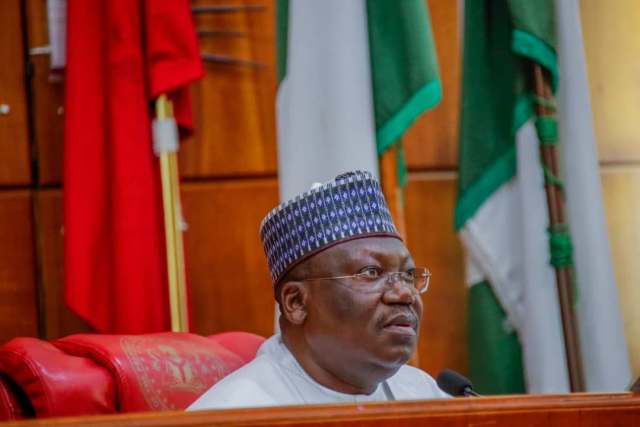
President of the Senate, Ahmad Lawan, has said that the war against corruption by the President Muhammadu Buhari-led government must be won irrespective of temporary setbacks.

Lawan stated this in his remarks after a bill seeking to establish the Witness Protection and Management Framework scaled second reading during plenary on Tuesday.

According to him, the fight against corruption is one that must be vigorously pursued by government to ensure the eventual elimination of graft, given that same is capable of hindering Nigeria’s development.

He added that the Witness Protection bill, if passed and signed into law, would be an incentive that encourages witnesses to testify in corruption cases since their protection is guaranteed under the law.
 
Lawan said, “Distinguished colleagues, almost every administration in this country would work against corruption that has bedeviled the development of this country.

“The witness protection bill that we are debating today is a way forward to encourage witnesses to testify against corruption. And by protecting them properly, that will incentivise such witnesses.

“The war against corruption is a must, and it must be won. It is not about the quantum of funds or resources that we have, but how we are able to put to use even our scarce resources.

“So, this is a very important bill, and I’m sure all of us would lend our support.”

Sponsor of the bill for an Act to establish the Witness Protection and Management Framework, Senator Suleiman Abdu Kwari, said the bill was first read on February 23, 2021.

According to the lawmaker, it was also listed among the bills of interest and international significance, contained in the recent Executive Communication from President Muhammadu Buhari, which was read on the floor of the Senate on the 19th of January 2022.

“Empirical evidence show that one of the major causes of the inability to successfully prosecute criminal cases in our courts is the lack of witnesses.

“Many of them face intimidation and threats just as prosecutors most times do not have the funds and management framework to safely bring witnesses to testify in court.

“The passage of this bill into law will fill this gap as well as fulfill some of our Country’s international commitments to various conventions and protocols, like the United Nations Convention Against Corruption (UNCAC) amongst others”, Senator Kwari said.

He further recalled  that the Witness Protection and Management Bill and Whistle Blower Bill were initially considered as co-joined in a single bill by the 8th National Assembly and passed in 2017.

He added that following a technical stakeholders roundtable comprising of representatives of relevant criminal justice system operators, it was resolved that both bills be unbundled in order to allow Law Enforcement Agencies (LEAS) currently running witness protection programs continue in that wise.

“This necessitates the separation of the two bills and accordingly paves the way for witness protection programmes across the broad spectrum of Law Enforcement Agencies, thereby discouraging duplicity and multiplicity of agencies”, he said.

Section 1 of the bill provides for the establishment of a legal and institutional framework to protect witnesses and related persons, with responsibilities for carrying out all administrative duties relating to witnesses and related persons.

The bill under the section ensures that the relevant agency takes responsibility for entering into a witness protection agreement, regulate the procedure while harmonizing existing laws and policies on witness protection and management.

The Bill in Section 2 also specifies offences and laws in which the bill apply, and comprise terrorism, money laundering (prevention and prohibition), economic and financial crimes, corrupt practices and other related offences, drugs and narcotics and their trafficking, trafficking in persons, Criminal and Penal Code offences.

It further provides for customs and excise management, any legislation dealing with proceeds of crimes, confiscation and forfeiture of assets, and to all justice sector institutions and authorities, including the courts, law enforcement as well as security agencies, and other relevant regulatory institutions towards the protection of witnesses in the course of the investigation, detection and prosecution of offences.

Part 2 sets standard for establishing and managing the witness program, while Section 3 mandates all public institutions having responsibility under their laws of investigating and/or prosecuting offences under any law, to establish a witness protection and management program.

The section further provides for rights, duties, privileges and obligations of other bodies such as courts, lawyers, parents/guardian in relation to witness protection and management.

In addition, Part 3 provides for protections such as allowing a witness to establish a new identity or restore a former witness’s original identity by an application from a relevant agency made to the Court, for a new entry in the birth, marriage or death registry and issuance of a certificate as the case may be.

Part 4 mandates relevant agencies, to designate a Witness Protection office at each of their branch offices to enable the adoption and management of the Witness Protection Program.

On the other hand, Part 5 of the bill provide for the establishment of a Witness Protection Fund to be managed and controlled by relevant agencies.

According to the bill, such funds include moneys appropriated by the National Assembly for payment into the Protection Fund, which shall amount to at least fifty per cent of the total estimated expenditure of the Protection Fund, moneys approved by the President for Witness Protection Programs, moneys accruing to the Protection Fund from any fund or account established by an Act for the lodgment of proceeds of confiscation and forfeited assets.

Other sources include a percentage of the total amount recovered by the Government as direct result of information provided by a protected person, subventions, grants, aid and donations from Federal or State Government, etc.

Part 6 criminalizes certain acts relating to false or misleading and unlawful disclosures, false representation and unauthorized access to a witness.

Part 7 under Miscellaneous provides for legal proceedings such as 30 days pre-action notice, non-compellability of witness, restriction on execution against property of the relevant agency, indemnity of officers of the relevant agency including powers of the Attorney General of the Federation to make regulations in respect of the bill.

The bill after consideration was referred by the Senate President, Ahmad Lawan, to the Committees on Judiciary, Human Rights and Legal Matters; and Anti-Corruption and Financial Crimes.

The Joint Committee is expected to report back in four weeks.

Meanwhile, a bill seeking to establish the Federal Polytechnic Shagamu also scaled second reading in the Senate.

The bill sponsored by Senator Olalekan Mustapha (Ogun East) was referred by the Senate President after consideration to the Committee on Tertiary Institutions and TETFUND for further inputs.

The Committee was also given four weeks to report back to the chamber in plenary.


Continue Reading
Click to comment

Leave a Reply

Your email address will not be published. Required fields are marked *

News

Bamidele: 2026 Electoral Act Reflects Stakeholders’ Consensus, Not Legislative Imposition

Published

on

Senate Leader, Senator Michael Opeyemi Bamidele
Share

The Leader of the Senate, Opeyemi Bamidele, has stated that the provisions of the 2026 Electoral Act were the outcome of broad consultations with stakeholders rather than unilateral decisions by the National Assembly.

In an Easter message issued on Sunday through his Directorate of Media and Public Affairs, Bamidele explained that the new electoral law aligns with global best practices and was not designed to serve any political interest. He urged political actors to adhere to the rules collectively established to ensure stability, peace, and order within Nigeria’s democratic system.

His remarks come amid criticisms from opposition parties, particularly the African Democratic Congress (ADC), which alleged that certain provisions—such as Sections 77 and 84 of the Act—were introduced to weaken their chances ahead of the 2027 general elections. However, Bamidele dismissed the claims, insisting that all sections of the law were products of consensus involving civil society groups, development partners, and other stakeholders.

He defended the requirement for political parties to submit a digital register of members to the Independent National Electoral Commission (INEC), describing it as a transparency measure aimed at preventing undue influence by individuals outside party structures. According to him, the reform is essential for strengthening internal democracy and ensuring that party decisions reflect the will of legitimate members.

Bamidele also justified the restriction of candidate nomination processes to either direct primaries or consensus arrangements, noting that the move is intended to eliminate the delegate system, which he said had been susceptible to manipulation by wealthy individuals. He added that the new system empowers party members and reinforces majority rule in line with democratic principles.

Beyond electoral matters, the Senate leader condemned recent violent attacks in Plateau and Kaduna states, describing them as unacceptable acts against innocent citizens. He assured that the National Assembly is collaborating with federal and state authorities to tackle insecurity and prevent further loss of lives.

He disclosed that ongoing legislative efforts, including amendments to the Terrorism (Prevention and Prohibition) Act, are aimed at introducing stricter penalties for kidnappers, their sponsors, and collaborators. Bamidele expressed confidence that these measures would help restore security and stability across the country.

Reflecting on Easter, Bamidele called on Nigerians, especially political leaders, to embrace the values of sacrifice, tolerance, and unity exemplified by the resurrection of Jesus Christ, urging a collective commitment to nation-building.

Continue Reading

News

FG to Deploy AI Cameras to Tackle Insecurity in Plateau — Tinubu

Published

on

President Bola Tinubu
President Bola Ahmed Tinubu
Share


President Bola Tinubu has announced that the Federal Government will deploy over 5,000 artificial intelligence-enabled digital cameras across Plateau State to help security agencies combat rising insecurity.

The President made this known on Thursday during a visit to Jos, following the March 29 gun attacks in Angwan Rukuba, Jos North Local Government Area, which claimed several lives. He assured residents that such incidents would not recur, pledging decisive action to bring perpetrators to justice.

Tinubu directed security chiefs, including the Minister of Defence, Chief of Army Staff, and Inspector General of Police, to track down those responsible for the killings. He also tasked the Minister of Communications and Digital Economy, Bosun Tijjani, with overseeing the immediate installation of the surveillance system, starting in Jos and later expanding across the state.

Expressing sympathy to affected families, the President said no compensation could replace lost lives but promised government support and justice. He also directed the Ministry of Humanitarian Affairs to compile data on victims to ensure fair distribution of relief.

Plateau State Governor Caleb Mutfwang described the incident as a temporary setback, noting that the state had previously enjoyed relative peace. He expressed confidence in ongoing security efforts and thanked the Federal Government for approving the recruitment of 1,000 forest guards to strengthen local security.

Stakeholders at the meeting, including former governors and political leaders, called for greater collaboration and dialogue among Plateau indigenes, stressing that lasting peace would require collective responsibility.

Continue Reading

News

El-Rufai Returned to ICPC Custody After Court Appearance in Kaduna

Published

on

Former Kaduna State Governor,Nasir El -Rufai
Share

Former Kaduna State governor, Nasir El-Rufai, has been returned to the custody of the Independent Corrupt Practices and Other Related Offences Commission (ICPC) following court proceedings in Kaduna.

El-Rufai, who had earlier left custody on March 27, 2026, due to the death of his mother, was re-arraigned on Tuesday.

He first appeared before the Kaduna State High Court over a separate charge filed by the ICPC. However, proceedings were stalled due to the absence of the second defendant, prompting the court to adjourn the case until April 10, 2026.

Following the adjournment, El-Rufai was taken to the Federal High Court in Kaduna, where his application for bail was scheduled to be heard.

The court had earlier fixed March 31, 2026, for the hearing of his bail application.

Continue Reading