Connect with us

Business & Economy

NNPC Limited Will Guarantee National Energy Security – Buhari

Published

on

President Muhammadu Buhari
Share


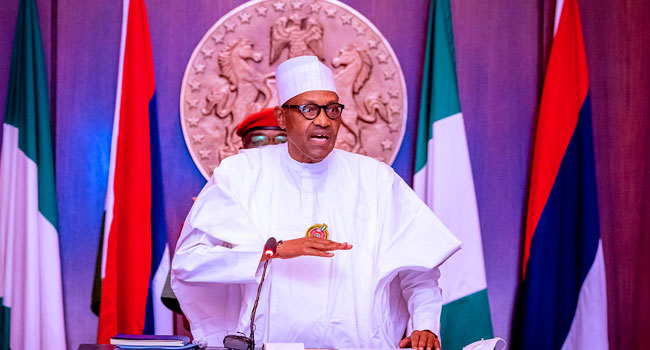
President Muhammadu Buhari has unveiled the Nigerian National Petroleum Company Limited, assuring that the new company will guarantee energy security in the country.

Buhari, who was accompanied by the Senate President, Ahmad Lawan, Speaker of the House of Representatives, Femi Gbajabiamila among other dignitaries at the State House Conference Centre in Abuja, described the NNPC Limited as the largest national oil company in Africa.

He said the new enterprise would also support sustainable growth across other sectors of the economy as it delivers energy to the world.

“We are transforming our petroleum industry, to strengthen its capacity and market relevance for the present and future global energy priorities,” the President was quoted as saying in a statement by his spokesman, Femi Adesina.

According to the President, NNPC Limited will sustainably deliver value to its over 200 million shareholders and the global energy community; operate without relying on government funding and be free from institutional regulations such as the Treasury Single Account (TSA).

The President, therefore, assured stakeholders in the industry that Africa’s largest NOC will adhere to its fundamental corporate values of Integrity, Excellence and Sustainability while operating as a commercial, independent and viable NOC at par with its peers around the world.

He added that the company would focus on becoming a dynamic global energy company of choice to deliver energy for today, for tomorrow, and for the day days after tomorrow.

“Our country places high premium in creating the right atmosphere that supports investment and growth to boost our economy and continue to play an important role in sustaining global energy requirements.

“We are transforming our petroleum industry, to strengthen its capacity and market relevance for the present and future global energy priorities.

“By chance of history, I was privileged to lead the creation of the Nigerian National Petroleum Corporation on the 1st July 1977.

44 years later, I was again privileged to sign the Petroleum Industry Act (PIA) in 2021, heralding the long-awaited reform of our petroleum sector.

“The provisions of PIA 2021, have given the Nigerian petroleum industry a new impetus, with an improved fiscal framework, transparent governance, enhanced regulation and the creation of a commercially-driven and independent National Oil Company that will operate without relying on government funding and free from institutional regulations such as the Treasury Single Account, Public Procurement and Fiscal Responsibility Acts.

“It will, of course, conduct itself under the best international business practice in transparency, governance and commercial viability.

“Coincidentally, I, on the 1st of July 2022 authorized the transfer of assets from the Nigerian National Petroleum Corporation to its successor company, the Nigerian National Petroleum Company Limited, and steered the implementation leading to the unveiling of Africa’s largest National Oil Company today,” he stated.

He thanked the leadership and members of the National Assembly for demonstrating uncommon courage and patriotism in the passage of PIA that culminated in the creation of NNPCL.

In his remarks, the Minister of State for Petroleum Resources, Timipre Sylva, said with the signing of the PIA, which assures international and local oil companies of adequate protection for their investments, the nation’s petroleum industry is no longer rudderless.

Sylva described the unveiling of NNPC Limited as a new dawn in the quest for the growth and development of the Nigerian Oil and Gas Industry, opening new vintages for partnerships.

He thanked the President for his unparalleled leadership, steadfastness, and unalloyed support for ensuring that the country’s oil and gas industry is on a sound footing.

The Group Chief Executive Officer of NNPC Limited, Mele Kyari, stated that the company had adopted a strategic initiative to achieve the mandate of energy security for the country by rolling out a comprehensive expansion plan to grow its fuel retail presence from 547 to over 1500 outlets within the next six months.

Continue Reading
Click to comment

Leave a Reply

Your email address will not be published. Required fields are marked *

Business & Economy

Nigeria, UK Move to Close £1.2bn Trade Data Gap with Digital Customs Pact

Published

on

UK and Nigeria Flags
Share


Nigeria and the United Kingdom have agreed to deepen customs cooperation through a new digital data-sharing framework aimed at resolving a £1.2 billion discrepancy in bilateral trade figures, a longstanding issue affecting transparency and efficiency between both economies.

The agreement was reached during a high-level meeting in London on March 18, 2026, held on the sidelines of President Bola Tinubu’s state visit under the Nigeria–UK Enhanced Trade and Investment Partnership (ETIP).

According to the Nigeria Customs Service (NCS), the talks brought together Comptroller-General Adewale Adeniyi and Ms. Megan Shaw, Head of International Customs and Border Engagement at His Majesty’s Revenue and Customs (HMRC), with discussions focused on customs modernisation, trade data transparency, and operational collaboration.

At the centre of the engagement is a significant mismatch in trade statistics. Nigeria recorded about £504 million worth of imports from the UK in 2024, while UK data shows exports to Nigeria at approximately £1.7 billion over the same period — leaving a gap of roughly £1.2 billion.

Both sides described the discrepancy as structural and agreed on coordinated measures to address it. Chief among these is the proposed implementation of a pre-arrival data exchange system, which will connect digital customs platforms in both countries to improve data accuracy, strengthen risk management, and enhance compliance monitoring.

Adeniyi emphasised that stronger customs collaboration is vital for economic growth and sustainable trade, noting that customs authorities play a key role in ensuring secure and transparent cross-border trade flows.

The meeting also highlighted advancements in customs technology, with the UK showcasing artificial intelligence-driven tools, digital verification systems, and real-time analytics designed to improve cargo processing, risk assessment, and border security.

In addition to addressing the data gap, both countries agreed on several strategic initiatives, including the development of a Customs Mutual Administrative Assistance Framework, technical cooperation on capacity building, and the establishment of a joint engagement mechanism under ETIP.

The NCS said the outcomes of the meeting would enhance operational efficiency, boost trade facilitation, and support Nigeria’s broader economic reform agenda, positioning the country for improved competitiveness in global trade.

Continue Reading

Business & Economy

Nigeria’s “Shockproof” Economy: Cardoso Signals New Era of Stability to London Investors

Published

on

CBN Governor, Yemi Cardoso
Share

Central Bank of Nigeria (CBN) Governor Olayemi Cardoso issued a bullish assessment of the nation’s financial health yesterday, declaring that aggressive institutional reforms and disciplined monetary policy have built a “stronger capacity” to withstand global economic volatility.

Speaking at the Africa Capital Forum—held on the sidelines of President Bola Ahmed Tinubu’s state visit to the United Kingdom—Cardoso painted a picture of a Nigerian economy transitioning from a period of emergency stabilization to one of sustained investment.

A Fortress Against Volatility

The Governor’s address focused heavily on the “de-risking” of the Nigerian financial system. By emphasizing a shift toward a predictable policy framework, Cardoso aimed to reassure international stakeholders that the days of opaque, discretionary decision-making are ending.

“We are reviewing our policies with a view to developing meaningful policies and establishing a predictable policy framework to minimise discretion,” Cardoso stated, noting that consistency is the primary tool for reducing investor uncertainty.

The Governor highlighted several critical milestones achieved under the current administration’s reform agenda:

Banking Recapitalization: The CBN reported that over 30 banks have already met new capital requirements.

Notably, 28% of the newly raised funds originated from foreign investors—a metric Cardoso cited as a clear vote of international confidence.

FX Transparency: A new foreign exchange manual has been deployed, stripping away previous restrictions to boost liquidity and simplify operations for multinational businesses.

Remittance Surge: Increased diaspora remittances have bolstered foreign exchange reserves, providing a crucial buffer against external shocks.

Fiscal-Monetary Synergy: In a departure from previous friction, Cardoso noted that the inclusion of fiscal authorities on the CBN Board and the Monetary Policy Committee (MPC) has synchronized the nation’s broader economic strategy.

The Digital Frontier: “Vision for Nigeria”

Looking ahead, the Governor announced the completion of a new Payments System Vision. This initiative aims to cement Nigeria’s status as the continental leader in digital payments and cross-border transactions, specifically targeting the removal of regulatory hurdles for the nation’s burgeoning fintech sector.


Continue Reading

Business & Economy

Tinubu Swears in Taiwo Oyedele as Minister of State for Finance

Published

on

President Bola Ahmed Tinubu and Taiwo Oyedele
Share

President Bola Ahmed Tinubu on Monday swore in Taiwo Oyedele as Minister of State for Finance, praising his experience, dedication, and professionalism in public service.

Speaking shortly after the brief ceremony at the Presidential Villa in Abuja, the president described the appointment as a vote of confidence in Oyedele’s competence and commitment to national development.

Tinubu commended the new minister for his role in coordinating the work of the Presidential Committee on Fiscal Policy and Tax Reforms, noting that his expertise and deep knowledge of tax policy had been instrumental in shaping reforms aimed at simplifying Nigeria’s tax system, expanding the revenue base, and improving the business environment.

“We are very proud of your knowledge, your simplicity, ambition, and excellence,” the president said, while also acknowledging the support of Oyedele’s wife, whom he praised for standing by him despite the demands of public service.

Tinubu said Oyedele’s dedication, patience, and determination to serve the country made him well suited for the role, adding that the position carries significant responsibility at a time when Nigeria is pursuing economic stability and growth.

According to the president, the new minister’s efforts in reforming Nigeria’s tax framework have helped address policies he described as outdated and inconsistent with progressive economic thinking.

Oyedele, who hails from Ikaram in Akoko area of Ondo State, is an economist, accountant, and public policy expert.

He obtained a Higher National Diploma in Accountancy and Finance from Yaba College of Technology and later earned a Bachelor of Science degree in Applied Accounting from Oxford Brookes University.

He has also completed executive education programmes at London School of Economics, Yale University, Gordon Institute of Business Science, and Harvard Kennedy School.

Before his appointment, Oyedele spent 22 years at PricewaterhouseCoopers, where he joined in 2001 and rose to become Fiscal Policy Partner and Africa Tax Leader.

He also serves as a professor at Babcock University in Ogun State and as a visiting scholar at Lagos Business School.

Continue Reading