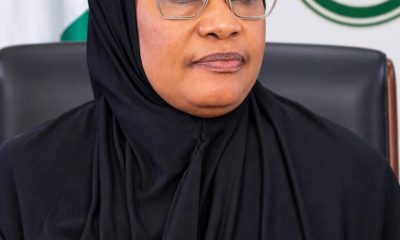
Ambassador Mariam Katagum, Minister of State for Industry, Trade and Investment, has said that certification of Halal would give Nigeria Products a boost in the local and international markets
The Minister stated this on Monday in Abuja when she inaugurated a 14-man technical committee on the development of a roadmap and operational framework for Halal certification in Nigeria.
Amb. Katagum, said that at the moment the global consumer base of Halal products is estimated to be about 1.9 billion Muslims across 112 countries, and that the Halal market is estimated to be worth trillions of US Dollars.
She further said Muslim population in Nigeria is estimated at about 52 per cent of the nation’s population and adherents of Islam were usually selective in making Halal choices when it comes to lifestyle and product consumptions.
She said aside from the Islamic population, there is huge number of people around the world that also prefer to consume Halal products based on healthy lifestyle choices, adding that countries around the world have made it easier for such consumers to make easy selections at supermarkets, shops and Nigeria should not be left out.
She said: “Halal market is a huge and profitable segment of the economy and cannot afford to ignore the importance of assuring our local and international consumers that our food and beverage products are Halal certified and comply with Islamic Law. Such certifications would give Nigeria products a boost in local and international markets.
“Also, Halal certification significantly enhances the marketability of products outside the country and the document is an important requirement on importing countries”.
The Minister acknowledged that the Halal concept was at its embryonic stage in Nigeria, and has largely been uncoordinated, with lack of synergy between relevant institutions and the situation has led to absence of uniformity in instituting Halal standards in the country, as well as the inability of Nigeria to tap into the Halal global market.
She also noted that there is huge potential in the Halal sub-sector with the global Halal market estimated to be about 2.6 trillion US dollars and countries like Morocco and Malaysia are already benefiting from the Halal economy with Morocco exporting to over 23 countries and Malaysia earning about $7 billion in exports.
Amb. Katagum, pointed out that Nigeria has not been able to take advantage of the huge market to boost foreign earnings, increase investment and adopt the concept to contribute to the growth and development of the economy, hence the Ministry proactively decided to establish a committee to address the issue by studying the various models being used by other successful countries and developing a tailor-made Strategic Plan and Operational Framework for Nigeria.
The Minister of State expressed optimism that “the success of the committee would stimulate Investment across Nigeria’s agricultural sector; lead to increased productivity; chart a sustainable course towards food security; generate employment and create wealth for the Nation and its people”.
The Minister disclosed that members of the Technical Committee were carefully selected from key Ministries, Departments and Agencies (MDAs) and the Organized Private Sector (OPS) involved in the Halal Value-chain and is being chaired by Mr. Nour Sani Hanga from Halal Standard Development Trust (HASDAT) and co- chaired by the Director Commodity and Export Department in the Ministry, Mr. Suleman Adebayo Audu.
The Terms of Reference to guide the work of the Technical Committee included to develop a workplace for the Technical Committee; develop the operational and strategic framework for Nigeria’s Halal certification process; identify all existing Halal certification bodies and ensure uniformity in their modus operandi; identify international Linkages and partnerships for the development of the Nigerian Halal industry; develop advocacy and Sensitization strategies for the Halal industry in Nigeria; advise on how to ensure and promote collaboration and synergy among stakeholders in both the public and private sectors on Halal; and to consider any other matter that will develop and promote Halal in Nigeria.
Dr. Evelyn Ngige, Permanent Secretary in the ministry has earlier said that the inauguration of the Technical Committee signified the Ministry’s commitment towards ensuring that Nigeria benefits from the Halal Industry which is in line with the economic diversification agenda of the present administration to develop the non-oil sector.
Ngige who was represented by the Director, Commodity and Export Department in the Ministry, Mr. Suleman Adebayo Audu, expressed the Ministry’s commitment towards providing relevant support required in ensuring that the national assignment given to the Committee is accomplished without hindrance.
On his part, Chairman of the Committee, Mr. Nour Hanga, thanked the Ministry for taking the lead in the effort to develop a robust Halal industry in Nigeria.
He added that with the crop of professionals in the Committee coupled with the expected necessary support from the Ministry, the Committee would deliver on its mandates.