Connect with us

Parliamentary News

Senate Demands Immediate Suspension of Terrorists’ Rehabilitation Programme, Seeks Stronger Action Against Rising Insecurity

Published

on

Senate symbol
Share


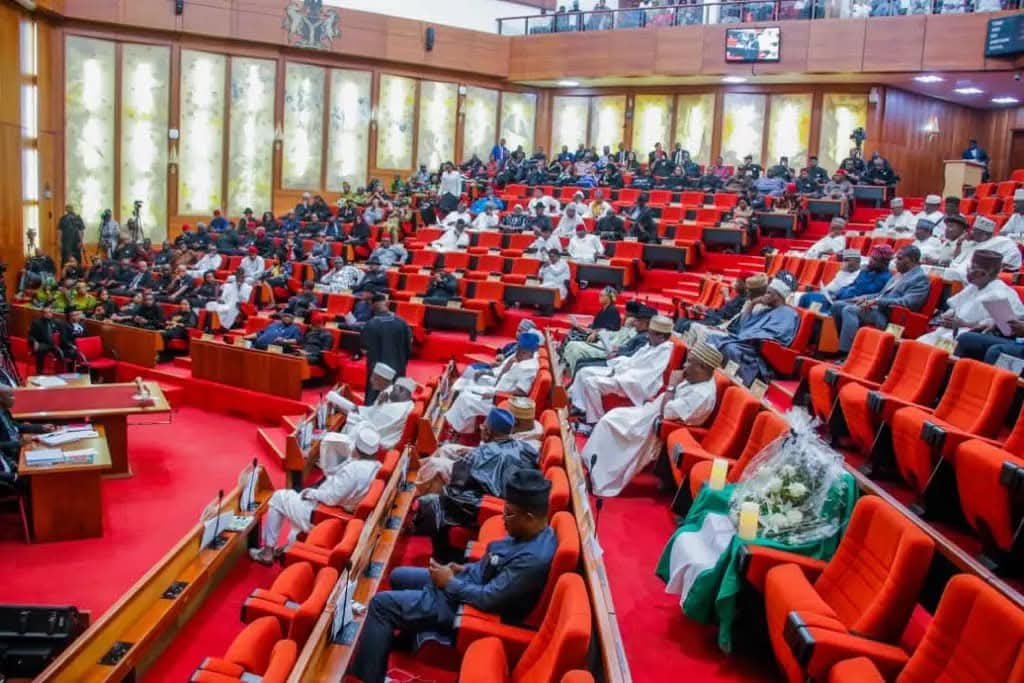
The Senate on Tuesday called on the Federal Government to immediately suspend the rehabilitation and reintegration programme for former Boko Haram members, insisting that terrorists and other violent criminals should be arrested and prosecuted rather than reintegrated into society.

The resolution followed the adoption of a motion sponsored by Senator Abdulaziz Yar’Adua on the increasing attacks, kidnappings and killings of serving and retired military personnel across the country, a development lawmakers described as a serious threat to Nigeria’s national security and the authority of the state.

As part of its resolutions, the upper legislative chamber directed its committees on defence, national security and intelligence to intensify oversight of security agencies and ensure that the nation’s security chiefs are held accountable for addressing the worsening security situation.

The Senate also resolved that a high-powered delegation, led by the President of the Senate, Senator Godswill Akpabio, should meet with President Bola Tinubu to discuss the escalating security crisis and explore urgent measures to restore peace and public confidence.

Presenting the motion, Senator Yar’Adua expressed concern over what he described as a disturbing trend in which serving and retired military officers have increasingly become targets of terrorists, kidnappers and other criminal groups across different parts of the country.

He said the attacks have resulted in the deaths of distinguished military officers, prolonged captivity of victims, payment of huge ransoms, emotional trauma for affected families and significant economic losses to the nation.

The lawmaker cited several high-profile incidents, beginning with the abduction of retired Colonel Rabiu Garba Yandoto and his two children along the Gusau–Tsafe Road in Zamfara State on January 1, 2023.

He also recalled the kidnapping and subsequent killing of retired Major General Richard Chukwudi Duru in Imo State in September 2023 despite the payment of a $50,000 ransom.

Senator Yar’Adua further highlighted the murder of retired Brigadier General Uwem Udokwere, who was killed by armed intruders at his residence in the Lokogoma area of Abuja in June 2024.

He also referenced the abduction of former Director-General of the National Youth Service Corps (NYSC), Brigadier General Maharazu Tsiga (retd), who spent 56 days in captivity before regaining his freedom in April 2025.

Other incidents listed included the abduction and death of retired Major Joe Ajayi in Kogi State in May 2025, the kidnapping and subsequent rescue of retired Colonel Joseph Ajanaku in Plateau State in January 2026, and the abduction and death in captivity of former Director of Defence Information, Major General Rabe Abubakar (retd), who was kidnapped alongside his wife in Katsina State on May 30, 2026.

According to Senator Yar’Adua, the killing of Major General Abubakar and several other retired military officers while in the custody of terrorists represents a painful national tragedy and highlights the persistent security challenges confronting the country.

He warned that the growing pattern of attacks on serving and retired military personnel reflects a dangerous shift in Nigeria’s security environment, particularly because many of the victims previously occupied strategic operational, intelligence and command positions within the nation’s armed forces.

Following deliberations, the Senate unanimously resolved to urge the Federal Government to suspend the rehabilitation and reintegration programme for terrorists, intensify efforts to arrest and prosecute perpetrators of violent crimes, strengthen the nation’s security architecture through more effective oversight of security agencies, and engage directly with the Presidency on urgent measures to address the country’s deteriorating security situation.

Parliamentary News

Senate Approves ₦403.1bn Police Trust Fund Budgets for 2025, 2026 as Tinubu Seeks Criminal Justice Reform

Published

on

Senate President Gods will Akpabio and with Senate Leader Opeyemi Bamidele and Other Senators
Share


The Senate has approved a total of ₦403.1 billion for the Nigerian Police Trust Fund (NPTF) covering the 2025 and 2026 fiscal years, in a move aimed at strengthening policing, enhancing national security and supporting the fight against terrorism, kidnapping and other violent crimes across the country.

The approval followed the consideration of the reports of the relevant Senate committee during plenary, with lawmakers endorsing ₦170.1 billion for the Police Trust Fund’s 2025 budget and ₦233 billion for the 2026 fiscal year.

According to the approved estimates, the 2026 budget provides for personnel costs, capital projects and overhead expenditures designed to improve the operational effectiveness of the Nigeria Police Force (NPF). The funding is expected to support the procurement of critical security equipment, construction and rehabilitation of infrastructure, personnel training, logistics and other operational requirements.

Lawmakers expressed confidence that the intervention would significantly enhance the capacity of the Police to respond to the nation’s growing security challenges, including terrorism, banditry, kidnapping and other forms of criminality. They stressed the need for sustained investment in security institutions to guarantee the protection of lives and property across the country.

The approval comes at a time when Nigerians have continued to demand stronger security measures in response to the increasing wave of violent crimes in several parts of the country.

Meanwhile, President Bola Tinubu has transmitted to the Senate a bill seeking a comprehensive reform of Nigeria’s criminal justice system through the repeal and reenactment of the Administration of Criminal Justice Act (ACJA), 2015.

The proposed legislation seeks to replace the existing law with the Administration of Criminal Justice Act, 2026, with the objective of addressing procedural deficiencies and improving the efficiency of the country’s criminal justice framework.

A major innovation contained in the bill is the establishment of a Criminal Justice Monitoring Council, which will be responsible for supervising the implementation of the law in courts within the Federal Capital Territory (FCT) and other federal courts across the country.

In his communication read during plenary, President Tinubu explained that the proposed legislation is intended to eliminate long-standing procedural bottlenecks that have slowed the administration of justice while strengthening the overall criminal justice process.

The President further stated that the bill would align Nigeria’s criminal justice system with modern global practices through the adoption of technology, the introduction of innovative judicial procedures and improved implementation mechanisms by relevant institutions.

Following the first reading of the executive bill, the Senate referred it to the Committee on Judiciary, Human Rights and Legal Matters for further legislative scrutiny and report back to the chamber for subsequent consideration.


Continue Reading

Parliamentary News

STATE POLICE: SENATE BUILDS SAFEGUARDS AGAINST GOVERNORS’ ABUSE OF POWER, DEFINES FEDERAL OVERSIGHT

Published

on

Senate Leader, Senator Michael Opeyemi Bamidele
Share

…National Assembly to set minimum standards for recruitment, discipline, accountability 

The Senate on Wednesday took a significant step toward restructuring Nigeria’s security architecture by adopting a comprehensive framework designed to prevent the abuse of state police powers by governors, as lawmakers considered a constitutional amendment bill seeking to establish state police across the federation.

The proposed legislation, which forms part of the ongoing review of the 1999 Constitution, contains extensive safeguards aimed at ensuring that state police services are not manipulated for partisan, ethnic, religious, sectional, or personal interests.

Leading debate on the Constitution of the Federal Republic of Nigeria Alteration (State Police) Bill, 2026, Senate Leader Senator Opeyemi Bamidele described the proposal as a carefully balanced reform intended to address Nigeria’s growing security challenges while preserving national unity, constitutional rights, and democratic accountability.

According to Bamidele, the bill seeks to create a decentralised policing structure capable of responding more effectively to local security threats without undermining federal authority or creating opportunities for political abuse.

He explained that the proposed constitutional amendment, submitted to the National Assembly by President Bola Ahmed Tinubu, would retain the Nigeria Police Force as the country’s federal policing institution while allowing states that choose to do so to establish and operate their own police services.

National Standards to Guide State Police Operations

One of the major highlights of the proposal is the constitutional empowerment of the National Assembly to prescribe minimum operational and professional standards that every state police service must comply with.

Under the framework, the federal legislature will establish nationwide benchmarks covering recruitment procedures, training requirements, personnel vetting, promotions, disciplinary mechanisms, use-of-force regulations, firearms management, complaints handling, accountability systems, data administration, and professional conduct.

The Senate believes these standards will help guarantee uniform professionalism across all state police formations while preventing the emergence of poorly regulated or politically controlled security outfits.

Bamidele noted that the proposal was carefully designed to strike a balance between local policing autonomy and national cohesion.

“The bill seeks to balance local policing autonomy with national cohesion, accountability with operational effectiveness, and federal oversight with state responsibility,” he said.

Clear Division of Security Responsibilities

To avoid jurisdictional conflicts, the bill establishes a clear separation of responsibilities between federal and state policing institutions.

According to the proposal, state police services will be responsible for enforcing state laws, maintaining public safety and order, preventing and detecting crimes within their territorial jurisdictions, protecting lives and property, and carrying out other local policing duties.

Conversely, the Nigeria Police Force will continue to exercise exclusive authority over matters relating to national security and federal interests.

These include protection of federal institutions, counter-terrorism operations, organised crime investigations, cybercrime enforcement, border security, arms trafficking, interstate criminal activities, and other threats with nationwide implications.

The framework is intended to create a complementary relationship between both policing structures rather than a competing security system.

Conditions for Federal Intervention

Addressing concerns that state police services could become ineffective or be exploited by political actors, Bamidele outlined specific constitutional conditions under which the federal police may intervene in state security affairs.

He stated that federal intervention would only be permissible in clearly defined situations, including:

Complete breakdown of public order within a state;

Inability of a state police service to function effectively;

Serious violations of constitutionally guaranteed fundamental rights;

Established cases of electoral intimidation or voter suppression; and

Situations where national security is under threat.

The Senate Leader stressed that such intervention would not be automatic or arbitrary.

According to him, any deployment of federal policing authority into a state jurisdiction must first receive written authorisation from the President and Commander-in-Chief of the Armed Forces.

In addition, such intervention would be limited in scope and duration, subjected to Senate oversight, and remain open to judicial review, thereby creating multiple layers of accountability.

Senate Rallies Support for Security Reform

The proposal attracted broad bipartisan support during debate.

Chairman of the Senate Committee on Power, Senator Enyinnaya Abaribe, disclosed that he was initially opposed to the concept of state police but had reconsidered his position in light of Nigeria’s worsening security challenges.

According to Abaribe, the realities of insecurity across the country now make decentralised policing an urgent necessity.

Similarly, former Governor of Sokoto State and Chairman of the Senate Committee on Housing, Senator Aminu Waziri Tambuwal, reiterated his longstanding support for state police, arguing that the reform represents a practical response to persistent security threats confronting communities nationwide.

Adding his voice, Chief Whip of the Senate, Senator Tahir Monguno, urged lawmakers to support the constitutional amendment, describing it as a critical mechanism for strengthening security governance at the subnational level.

Towards a New Security Architecture

The debate marks one of the most consequential discussions in Nigeria’s constitutional reform process, as policymakers seek solutions to escalating security concerns ranging from terrorism and banditry to kidnapping, communal conflicts, and organised criminal activities.

Supporters of the bill argue that state police will enhance intelligence gathering, improve community-based policing, accelerate emergency responses, and strengthen law enforcement presence in areas currently underserved by federal security agencies.

With the Senate now advancing deliberations on the proposal, attention will increasingly focus on how lawmakers balance the demand for local security control with the need to safeguard democratic institutions, human rights, and national stability.

If eventually passed and ratified, the amendment could usher in the most far-reaching transformation of Nigeria’s policing structure since independence, fundamentally reshaping the relationship between federal and state governments in the management of internal security.


Continue Reading

Parliamentary News

Akpabio Urges Full Senate Attendance Ahead of Crucial State Police Constitutional Vote

Published

on

Senate President Godswill Akpabio
Share


President of the Senate, Godswill Akpabio, has called on all senators to be present at Wednesday’s plenary session as the National Assembly prepares to consider and vote on a proposed constitutional amendment bill seeking to establish state police across Nigeria.

Speaking during an emergency Senate session on Tuesday, Akpabio described the State Police Bill as a landmark reform capable of reshaping Nigeria’s security architecture and improving security management at the grassroots level.

He stressed that the proposed amendment is of national importance and requires the active participation of lawmakers, noting that constitutional amendments demand broad support from members of the Senate.

According to him, the establishment of state police would mark a historic shift in Nigeria’s policing structure.

“Since 1960, Nigeria has not had the courage to decentralise policing, and this is the first time,” Akpabio said.

“As we struggle to become senators, let us also remember the responsibilities of being a senator. It is not enough for us to look for tickets. And when we get them, we don’t come to the chambers.”

The Senate President explained that the constitutional amendment would provide the legal framework for the creation of state police services, while safeguards against abuse would be incorporated through subsequent legislation and regulatory mechanisms.

He noted that the reform would strengthen community policing by encouraging collaboration among local governments, traditional rulers, village heads, youth groups and other stakeholders in addressing security challenges within their communities.

Akpabio argued that local communities often possess valuable information about criminal activities in their areas and that decentralised policing would enhance intelligence gathering and enable quicker responses to security threats.

To ensure swift consideration of the proposal, he directed the Senate Committee on Constitution Review to submit its report on the State Police Bill on Wednesday for immediate legislative action.

Also speaking during the session, Senate Leader Opeyemi Bamidele underscored the importance of full attendance by senators, explaining that constitutional amendments require the support of at least two-thirds of the members of the Senate.

“We need a minimum of two-thirds of distinguished senators to be able to vote on constitutional alteration. That means it is important for all of us to be here,” Bamidele said.

He described the State Police Bill as a national issue that goes beyond political affiliations and regional interests, urging senators to encourage their absent colleagues to attend the crucial sitting.

The Senate subsequently adjourned plenary until 11:00 a.m. on Wednesday, June 24, 2026, when lawmakers are expected to debate and vote on the proposed constitutional amendment aimed at establishing state police across the country.

Continue Reading