Connect with us

Parliamentary News

Nigeria’s Senate Passes ₦68.3tn 2026 Budget, Boosting Spending on Infrastructure, Health

Published

on

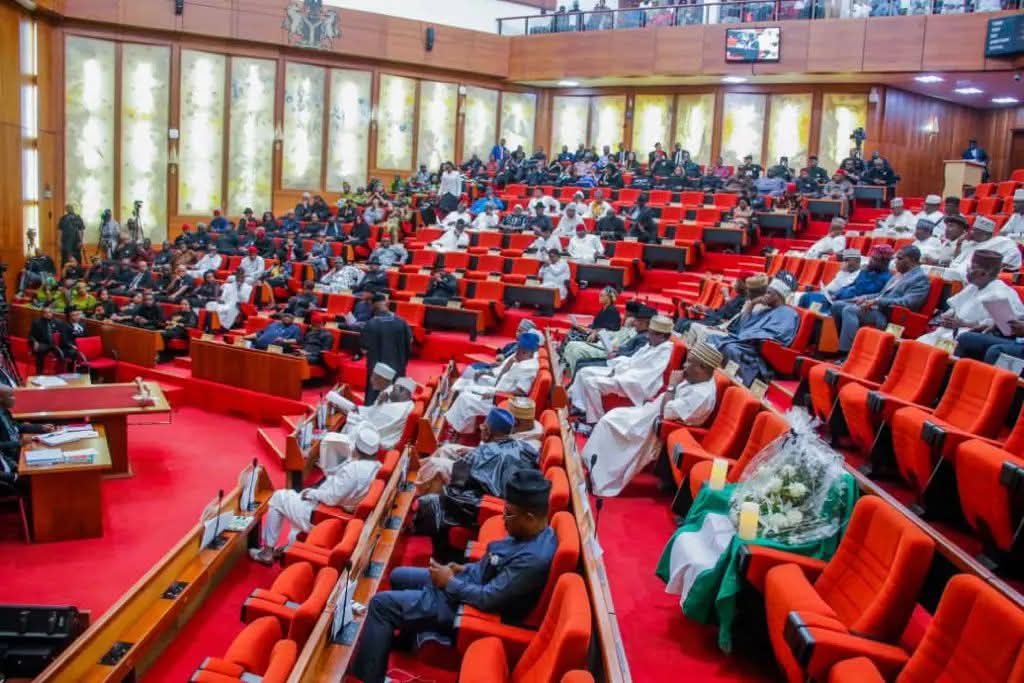
Senate in Session
Share


Nigeria’s Senate has approved a ₦68.3 trillion budget for the 2026 fiscal year, marking a significant increase from the ₦58.47 trillion initially proposed by President Bola Ahmed Tinubu.

The upward revision of over ₦9 trillion follows a supplementary request by the presidency aimed at accommodating legacy commitments, particularly in the transportation and health sectors, alongside new provisions including additional funding for the judiciary.

The approval came after lawmakers adopted the joint report on the 2026 Appropriation Bill presented by the National Assembly, signaling legislative backing for an expanded fiscal framework amid ongoing economic pressures.

Spending Breakdown

According to details of the approved budget:

₦4.799 trillion is allocated to statutory transfers

₦15.809 trillion for debt servicing

₦15.427 trillion for recurrent (non-debt) expenditure

₦32.287 trillion for capital expenditure

The capital component remains the largest share, underscoring the government’s focus on infrastructure development and long-term economic growth.

Additional Allocations

Of the increased spending:

₦5.71 trillion is designated for the regularisation of outstanding capital obligations carried over from the 2025 budget

₦2 trillion is earmarked for previously omitted projects across the country

Sector-specific allocations include:

₦482.758 billion for health

₦478.600 billion for the Ministry of Finance Incorporated (MoFI)

₦268 billion for the judiciary, including ₦36 billion for the Supreme Court and ₦98.513 million for the Court of Appeal

In addition, ₦8.960 billion has been approved for feasibility studies on major road projects, notably the Calabar–Maiduguri and Maiduguri–Sokoto corridors.

Extension of 2025 Capital Budget

In a related move, the Senate approved an extension of the capital component of the 2025 budget, shifting its implementation deadline from March 31 to June 30, 2026. The extension is intended to allow for the completion of ongoing infrastructure projects and improve budget execution.

Economic Context

The expanded 2026 budget reflects the administration’s attempt to balance fiscal consolidation with growth-focused spending, even as debt servicing continues to account for a substantial portion of government expenditure. Analysts say the success of the budget will depend largely on revenue performance and effective implementation.

Continue Reading
Click to comment

Leave a Reply

Your email address will not be published. Required fields are marked *

Parliamentary News

Akpabio Declares Three Senate Seats Vacant, Orders By-Elections

Published

on

Godswill-Akpabio
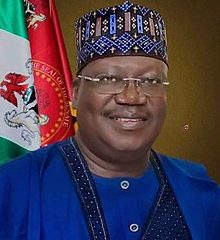
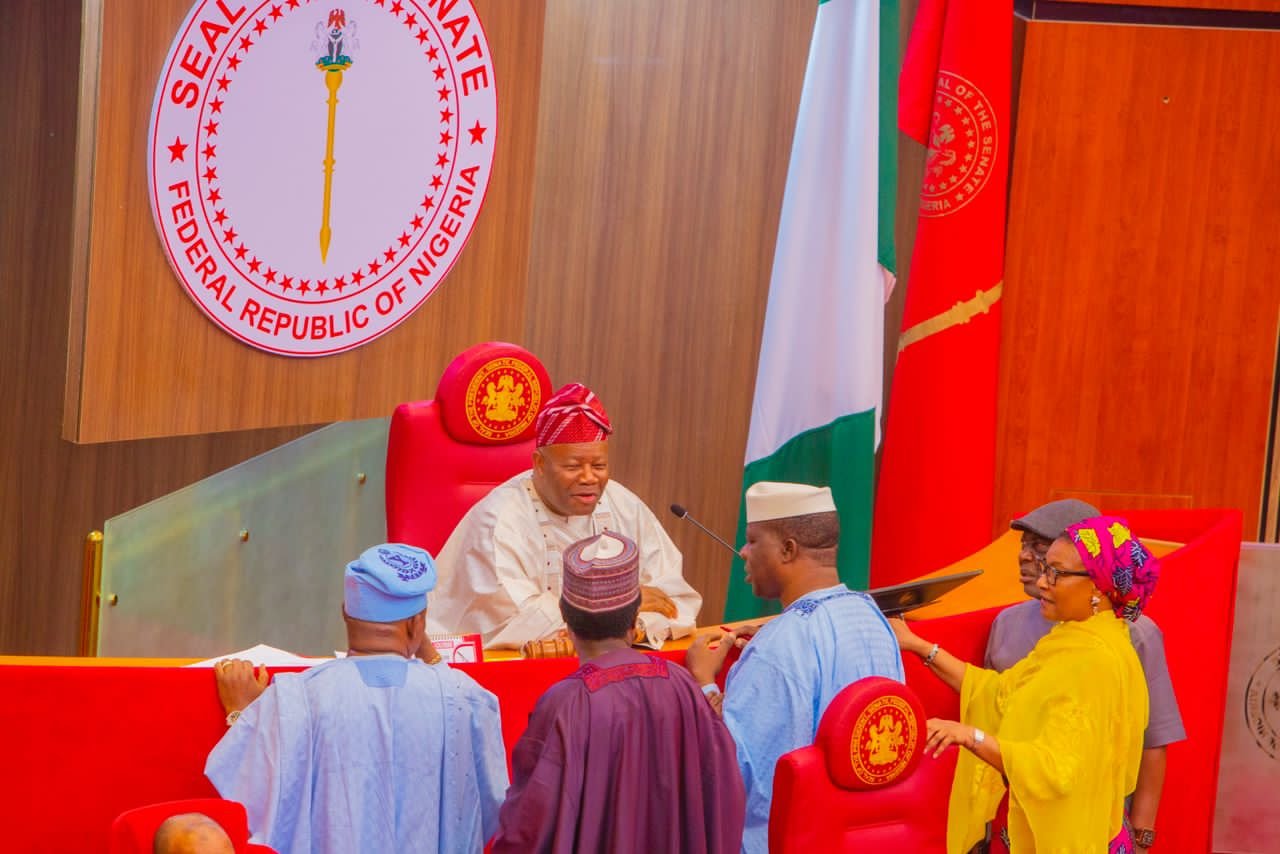
Senate President Gods will Akpabio
Share

The President of the Senate, Godswill Akpabio, has declared three senatorial seats vacant following the deaths of members of the 10th Senate.

The affected constituencies are Enugu North Senatorial District, Nasarawa North Senatorial District, and Rivers South-East Senatorial District.

Akpabio made the announcement on Tuesday during plenary, stating that the vacancies arose due to the demise of the lawmakers, in line with constitutional provisions.

“Due to the tragedies that have befallen the 10th Senate, vacancies have been created for midterm elections by the Independent National Electoral Commission to ensure that we fill the vacancies created by the demise of our colleagues,” he said.

Citing the Constitution of the Federal Republic of Nigeria 1999 (as amended), the Senate President formally declared the seats vacant.

“I hereby declare vacant Enugu North Senatorial District. The seat is hereby declared vacant,” he said, extending the declaration to Nasarawa North and Rivers South-East senatorial districts.

Akpabio subsequently directed the Independent National Electoral Commission to conduct by-elections to fill the vacancies within the constitutionally stipulated timeframe.

“In line with the provisions of our Constitution, the Independent National Electoral Commission is accordingly mandated to conduct fresh polls to fill these vacant senatorial seats in the affected states within the time specified in the Constitution, which is about 30 days from this declaration,” he said.

The development sets the stage for fresh electoral contests in the affected districts as political parties prepare to field candidates for the vacant seats in the Senate.

Continue Reading

Parliamentary News

Tinubu at 74: N’Assembly Moves to Establish State Police with Accountability Safeguards — Bamidele

Published

on

Senator Michael Opeyemi Bamidele and Asiwaju Bola Tinubu
Senate Leader, Senator Michael Opeyemi Bamidele and President Bola Tinubu
Share

The Senate Leader, Opeyemi Bamidele, has disclosed that the National Assembly is working on a decentralised police system aimed at strengthening accountability and preventing abuse by the political class.

Bamidele, who also serves as Vice Chairman of the Senate Committee on the Review of the 1999 Constitution, said the proposed framework would devolve policing powers to sub-national authorities while ensuring justice, protecting human rights, and discouraging impunity. He noted that the initiative is being treated as a priority amid growing calls for improved security across Nigeria.

The lawmaker made this known in a statement marking the 74th birthday of President Bola Ahmed Tinubu, whom he commended for supporting reforms to tackle insecurity. He said the President had backed the decentralised policing model as part of broader efforts to safeguard lives and property nationwide.

Bamidele added that the proposed system would be guided by global best practices and strong accountability mechanisms. According to him, the Presidency and the National Assembly are working together to deliver a more effective security structure for the country.

He also praised Tinubu’s leadership, citing economic and fiscal reforms, including increased foreign reserves and improved revenue for sub-national governments, as signs of progress under the current administration.

Continue Reading

Parliamentary News

National Assembly Unveils Sweeping Reforms in Electoral Act 2026 Ahead of 2027 Polls

Published

on

Senate Leader, Senator Michael Opeyemi Bamidele
Share

The National Assembly has rolled out far-reaching reforms under the Electoral Act 2026, describing the new legal framework as a decisive step toward strengthening transparency, accountability and institutional independence in Nigeria’s electoral system ahead of the 2027 general election.

The reforms, which culminated in the signing of the Electoral Bill 2026 into law by Bola Ahmed Tinubu within 24 hours of its transmission, followed two years of consultations involving the legislature, the Independent National Electoral Commission (INEC), the Office of the Attorney-General of the Federation (OAGF), civil society organisations (CSOs) and development partners.

Leader of the Senate, Senator Opeyemi Bamidele, in a statement issued by his Directorate of Media and Public Affairs on Sunday, outlined the key provisions of the Act and defended the speed of presidential assent, insisting that the law was the product of broad-based stakeholder engagement rather than unilateral legislative action.

Two Years of Stakeholder Engagement

According to Bamidele, the making of the Electoral Act 2026 was “a collective work” shaped by sustained input from critical institutions and civic actors.

The National Assembly harmonised different versions of the bill passed by both chambers — particularly on the contentious Clause 60(3) — before transmitting it to the president. Lawmakers said the urgency was necessary to avert any constitutional crisis that could jeopardise preparations for the 2027 elections.

While some CSOs raised concerns about the swift assent, the presidency maintained that democracy thrives on dialogue and consensus-building, noting that most stakeholders had already participated extensively in shaping the legislation.

Financial Autonomy for INEC

A cornerstone of the reform is the creation of a dedicated fund for INEC under Section 3 of the Act. The provision is designed to guarantee the commission’s financial autonomy, operational stability and administrative continuity.

Under the new law, election funds must be released at least six months before a general election. The commission is also empowered to review questionable result declarations made under duress or procedural violations, strengthening its corrective authority.

Lawmakers believe this financial restructuring will insulate INEC from bureaucratic bottlenecks and enhance its institutional independence.

Mandatory Electronic Accreditation and Transmission

The Act entrenches the use of technology in election management.

BVAS for Accreditation

Section 47 mandates presiding officers to deploy the Bimodal Voter Accreditation System (BVAS) or any technological device prescribed by INEC to verify and authenticate voters.

The provision removes ambiguity around voter accreditation and makes technological verification compulsory.

Electronic Transmission to IReV

Section 60(3) mandates the electronic transmission of election results from polling units to INEC’s Result Viewing Portal (IReV). Any presiding officer who willfully frustrates electronic transmission faces six months’ imprisonment or a ₦500,000 fine, or both.

However, Bamidele clarified that IReV remains a transparency portal, not a collation platform. Where electronic transmission fails due to communication breakdown, results may be transmitted using Form EC8A as prescribed by INEC.

Tougher Sanctions and Accountability Measures

The new law stiffens penalties for electoral malpractice:

Two-year imprisonment for Resident Electoral Commissioners (RECs) who withhold certified documents beyond 24 hours after payment (Section 74).

Court-declared winners can be sworn in with a Certified True Copy of judgment if INEC fails to issue a certificate of return (Section 72).

Two-year imprisonment or fines between ₦500,000 and ₦2 million for vote buying, impersonation and result manipulation (Section 125).

₦10 million fine for political parties that fail to submit accurate audited returns (Section 93).

These provisions are aimed at reinforcing accountability across the electoral value chain.

Overhaul of Party Primaries

The Act phases out indirect primaries, retaining only direct and consensus primaries under Section 84. Lawmakers say this will broaden participation among party members and curb excessive monetisation of delegate-based contests.

Crucially, Section 77 mandates political parties to:

Maintain a digital membership register;

Issue membership cards;

Submit the register to INEC at least 21 days before primaries, congresses or conventions.

Any party that fails to comply risks disqualification from fielding candidates.

According to Bamidele, these measures will “deepen internal democracy and reduce the monetisation of politics.”

Revised Campaign Spending Limits

The Act also reviews upward the campaign expenditure ceilings:

Presidential: ₦10 billion (up from ₦5 billion)

Governorship: ₦3 billion (up from ₦1 billion)

Senate: ₦500 million

House of Representatives: ₦250 million

State Assembly: ₦100 million

Area Council: ₦60 million

Councillorship: ₦10 million

Lawmakers argue that the revision reflects inflationary realities while maintaining regulatory oversight.

Inclusion and Electoral Access

The Act introduces additional social safeguards:

Separation of queues for men and women in areas where cultural norms require it (Section 49);

Enhanced support mechanisms for persons with visual impairment (Section 54).

A Consolidation of Electoral Governance

Describing the legislation as a consolidation and refinement of Nigeria’s electoral governance framework, Bamidele said the Act is structured around four pillars:

Financial and operational independence of INEC;

Technological integration with safeguards;

Transparency in collation and declaration;

Stricter penalties and stronger regulation of political parties.

With the Electoral Act 2026 now in force, attention shifts to its implementation. For lawmakers and stakeholders alike, the true test will be whether the reforms translate into more credible, transparent and dispute-resistant elections in 2027 and beyond.

Continue Reading