Connect with us

Business & Economy

Senate receives Buhari’s request to approve $4.054bn, €710m, $125m external borrowing

Published

on

Senate Chamber
Nigerian Senate
Share

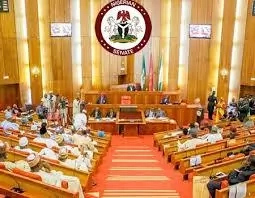
The Senate has received a formal request from President Muhammadu Buhari to consider and approve an external loan to fund projects captured under the 2018-2021 borrowing plan.

The letter dated 24th August, 2021 was read during plenary by the Senate President, Ahmad Lawan.

Buhari in the letter explained that the projects listed in the 2018-2021 Federal Government Borrowing Plan are to be financed through sovereign loans from the World Bank, French Development Agency (AFD), China-Exim Bank, International Fund for Agricultural Development (IFAD), Credit Suisse Group and Standard Chatered/China Export and Credit (SINOSURE) in the total sum of USD4,054,476,863.00; Euro 710,000,000.00 and Grant Component of USD125,000,000.00.

He explained that the amount would be used to fund Federal and States Government projects cut across key sectors such as Infrastructure, Health, Agriculture and Food Security, Energy, Education and Human Capital Development and COVID-19 Response efforts.

According to the President, the projects which are spread across the six geo-political zones of the country would bring about employment generation and poverty reduction, as well as protection of the most vulnerable and very poor segments of the Nigerian society.

The letter reads: “I write in respect of the above subject and to submit the attached addendum to the proposed 2018-2021 Federal Government External Borrowing (Rolling) Plan for the consideration and concurrent approval of the Senate for same to become effective.

“The Senate President may wish to recall that I earlier transmitted a request on the proposed 2018-2020 Federal Government External Borrowing Plan for the concurrent approval of the Senate in May, 2021.

“However, in view of other emerging needs and to ensure that all critical projects approved by FEC as at June 2021 are incorporated, I hereby forward and addendum to the proposed Borrowing Plan.

“The Projects listed in the addendum to the 2018-2021 Federal Government External Borrowing Plan are to be financed through sovereign loans from the World Bank, French Development Agency (AFD), China-Exim Bank, International Fund for Agricultural Development (IFAD), Credit Suisse Group and Standard Chatered/China Export and Credit (SINOSURE) in the total sum of USD4,054,476,863.00; Euro 710,000,000.00 and Grant Component of USD125,000,000.00.

“The Senate is kindly invited to note that the projects and programmes in the Borrowing Plan were selected based on positive, technical and economic evaluations and the contribution they would make to the socio-economic development of the country including employment generation and poverty reduction as well as protection of the most vulnerable and very poor segments of the Nigerian society.

“The Senate may also wish to note that all the listed projects in the addendum form part of the 2018-2021 External Borrowing Plan and cover both the Federal and States Government projects and are geared towards the realization of the Nigeria Economic Sustainability Plan that cut across key sectors such as Infrastructure, Health, Agriculture and Food Security, Energy, Education and Human Capital Development and COVID-19 Response efforts.

“A summary of some key projects in each of the six geo-political zones and a summary on the expected impacts on the socio-economic development of each of the six (6) geo-political zones are attached herewith as Annex II and III.

“Given the importance attached to the timely delivery of the projects listed in the proposed Borrowing Plan and the benefits both the Federal and State Governments stand to gain from the implementation of same, I hereby wish to request for the kind consideration and concurrent approval of the Senate for projects listed in the addendum to the 2018-2021 Federal Government External Borrowing Plan to enable the projects become effective.”


Continue Reading
Click to comment

Leave a Reply

Your email address will not be published. Required fields are marked *

Business & Economy

Dangote Refinery Cuts Petrol Ex-Depot Price to N774 Per Litre

Published

on

Aliko Dangote
Share

Dangote Petroleum Refinery has reduced the ex-depot price of Premium Motor Spirit (PMS) by N25 per litre, bringing the gantry price down from N799 to N774 per litre.

The refinery communicated the price adjustment to marketers on Tuesday, stating that the new rate takes immediate effect.

In a notice issued by its Group Commercial Operations Department, Dangote Petroleum Refinery and Petrochemicals FZE said: “This is to notify you of a change in our PMS gantry price from N799 per litre to N774 per litre.”

Industry pricing platform petroleumprice.ng confirmed on Tuesday that the revised price had been reflected.

The refinery also announced the end of its PMS lifting incentive. According to the notice, the bonus scheme closed at 12:00 a.m. on February 10, 2026, while credits for volumes lifted between February 2 and February 10, within previously communicated thresholds, will be posted to marketers’ account statements.

The price reduction comes amid continued adjustments in Nigeria’s deregulated downstream petroleum sector. PMS prices remained volatile throughout 2025 following the removal of petrol subsidies, with ex-depot prices fluctuating between about N700 and over N800 per litre, largely influenced by exchange rate movements, global crude oil prices and import dependence.

Large-scale domestic supply from the Dangote refinery, which commenced toward the end of 2025, helped moderate prices in some regions by reducing reliance on imported fuel. In early 2026, the refinery had raised its PMS gantry price to N799 per litre after selling at N699 during the festive period.

The latest reduction to N774 per litre suggests easing cost pressures and improving operational efficiency, as well as increased competition from imported cargoes and expected output from modular refineries.

With a processing capacity of 650,000 barrels per day, Dangote Petroleum Refinery is Africa’s largest single-train refinery and a key component of Nigeria’s strategy to cut fuel imports and conserve foreign exchange. Since beginning domestic PMS supply, the refinery has played an increasingly influential role in shaping ex-depot pricing in the downstream market.

Continue Reading

Business & Economy

Tinubu Tables ₦58.18trn 2026 Budget, Projects Sustained Economic Stability

Published

on

President Bola Ahmed Tinubu
Share

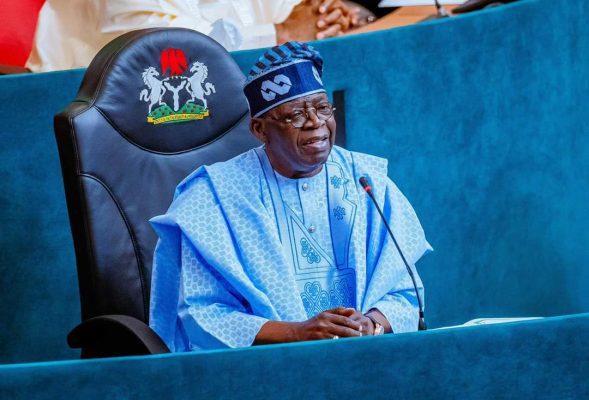
President Bola Tinubu on Friday presented a ₦58.18 trillion 2026 Appropriation Bill to a joint session of the National Assembly of Nigeria, declaring that Nigeria’s economy is showing measurable signs of stabilisation following years of structural pressure.

Tagged “Budget of Consolidation, Renewed Resilience and Shared Prosperity,” the 2026 fiscal plan is aimed at locking in recent macroeconomic gains while translating economic recovery into improved living standards for citizens.

According to the President, Nigeria’s economy expanded by 3.98 per cent in Q3 2025, while inflation moderated significantly, falling to 14.45 per cent in November 2025 from 24.23 per cent in March 2025.

“With stabilising food and energy prices, tighter monetary conditions, and improving supply responses, we expect the disinflationary trend to persist into 2026, barring major supply shocks,” Tinubu said during the presentation on December 19, 2025.

The President highlighted additional positive indicators, including improved crude oil production, rising non-oil revenues, renewed investor confidence, and external reserves climbing to a seven-year high of approximately $47 billion.

Under the proposal, the Federal Government projects ₦34.33 trillion in revenue against planned expenditure of ₦58.18 trillion, resulting in a budget deficit of ₦23.85 trillion, equivalent to 4.28 per cent of GDP. Tinubu emphasised that the fiscal framework is built on realism, prudence, and growth-driven assumptions.

He further assured lawmakers of tighter discipline in budget implementation, stressing that fiscal spending in 2026 would be more outcome-focused.

“Every naira spent or borrowed must deliver measurable public value,” the President said.

Continue Reading

Business & Economy

CBN Governor Reassures U.S. Investors on Nigeria’s Economic Reforms, Stability

Published

on

CBN Governor, Yemi Cardoso
Share

The Governor of the Central Bank of Nigeria (CBN), Mr. Olayemi Cardoso, has reassured United States investors of Nigeria’s commitment to macroeconomic stability and market-driven reforms, amid global economic uncertainty.

Cardoso gave the assurance during high-level engagements with U.S. business leaders and institutional investors in Washington, D.C., including the U.S.–Nigeria Executive Business Roundtable.

Speaking at the forum, the CBN governor said Nigeria remains focused on rules-based economic management, transparent markets, and predictable policy frameworks to restore investor confidence and drive sustainable economic growth.

He highlighted recent reforms in the foreign exchange market, the adoption of orthodox monetary policy measures, ongoing banking sector reforms, and the modernisation of the payments system. According to him, the reforms are aimed at stabilising the economy and supporting private-sector-led development.

The roundtable, convened by the U.S. Chamber of Commerce’s U.S.-Africa Business Center, focused on macroeconomic stabilisation, regulatory clarity, and opportunities to scale bankable projects across key sectors of the Nigerian economy. Discussions also emphasised efforts to deepen commercial and investment ties between Nigeria and the United States.

Commenting on the outcome of the engagement, President of the U.S.-Africa Business Center, Ms. Kendra Gaither, said investors are increasingly prioritising policy credibility and consistency.

She noted that clarity of rules, credible reforms, and disciplined economic management are critical factors driving investor interest, adding that Nigeria’s evolving message of discipline and opportunity is important in a global economy seeking stability and predictability.

Continue Reading