Connect with us

News

Senate passes bill to establish Electoral Offences Commission 

Published

on

SENATE-PRESIDENT
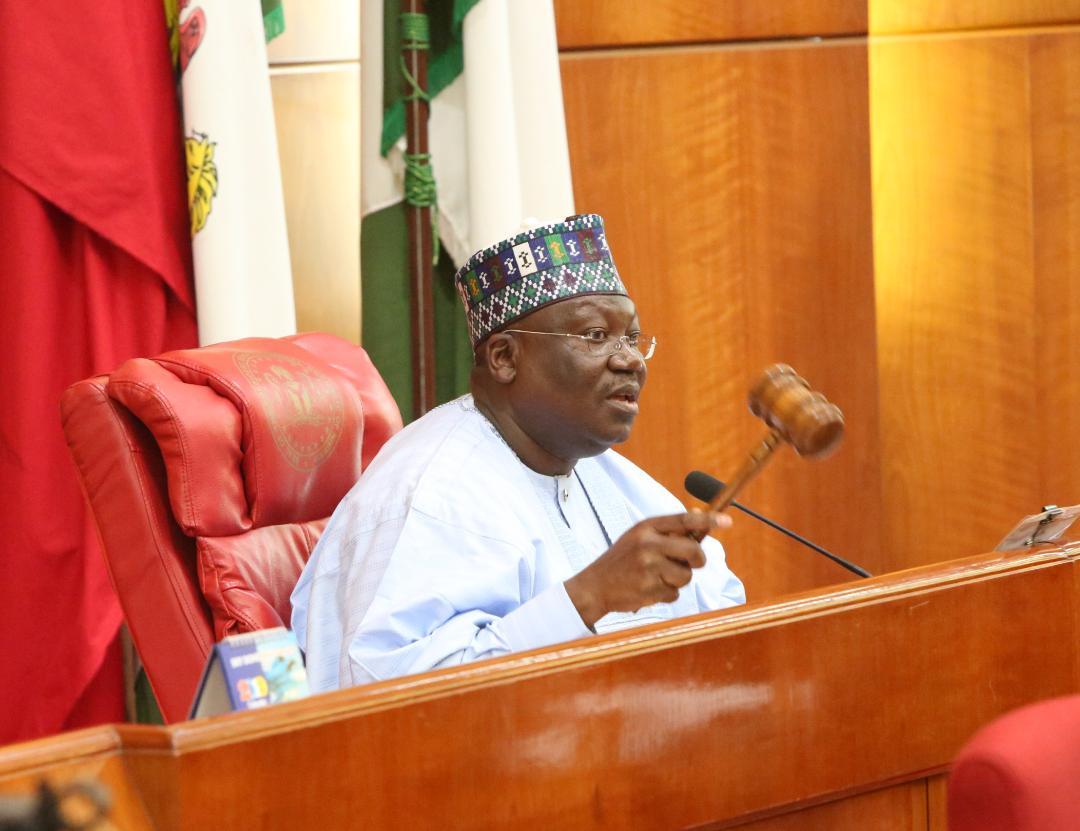
Senate President, Ahmad Lawan
Share

…Okays 20yrs jail term for candidates caught snatching ballot materials 


The Senate on Tuesday passed a bill seeking to establish the Electoral Offences Commission.
The passage of the bill followed the consideration of a report by the Committee on Independent National Electoral Commission (INEC).
Chairman of the Committee, Senator Kabiru Gaya (APC, Kano South), in his presentation, said the bill became imperative in view of INEC’s inability to prosecute electoral offenders in accordance with the provisions of a section 149 and 150(2) of the Electoral Act (as Amended).
“By the foregoing statistics, it is unrealistic to expect INEC to conduct free, fair and credible election and simultaneously prosecute Offences arising from the same elections.
“Indeed, INEC has at several occasions admitted that it lacks the wherewithal to cleanse the system.
“Its failure to prosecute even one percent 870,000 and over 900,000 alleged electoral Offences in 2011 and 2015 general elections respectively is an affirmation of the necessity for a paradigm shift on how we deal with electoral offences”, the lawmaker said.
According to him, as a result of electoral flaws in the system, the Justice Uwais Electoral Committee; Sheik Nurudeen Lemu Committee; and Constitution and Electoral Reform Committee were constituted.
He recalled that the Committees in their final reports recommended that for INEC to function efficiently, some of the functions currently performed by it should be assigned to other agencies.
Accordingly, the Senate during consideration of the INEC Committee report, approved the establishment of the National Electoral Offences Commission.
The Commission’s membership consists of the Chairman, Secretary  and representatives from the Justice, Interior, Defence, and Information Ministries.
The function of the Commission includes  investigating electoral Offences created in any laws relating to elections in Nigeria; prosecution of electoral offenders; and maintaining records of all persons investigated and prosecuted.
Others are to liaise with the Attorney-General of the Federation and government security and law enforcement bodies and agencies in the discharge of its duties; liaise with other bodies within and outside Nigeria involved in the investigation or prosecution of electoral Offences; and adopting measures to prevent, minimize and eradicate electoral Offences throughout the federation.
The Senate in Clause 12 of the bill approved at least five years imprisonment or a fine of at least N10 million naira or both, for any officer or executives of any association or political party that engages in electoral fraud that contravenes the provisions of clauses 221, 225(1)(2)(3) and (4) and 227 of the 1999 Constitution as amended.
The upper chamber adopted the Committee’s recommendation of fifteen years imprisonment for any person involved ballot box snatching, supplying voter’s card to persons without due authority, unauthorized printing of voters’ register, illegal printing of ballot paper or electoral document, and importation of any device or mechanism by which ballot paper or results of elections may be extracted, affected or manipulated, and voting at an election when he is not entitled to vote.
It also approved ten years imprisonment for any person who sells voter’s card, or in possession of any voter’s card bearing the name of another person, or prepares and prints a document or paper purporting to be a register of voters or a voter’s card.
The Senate also gave its nod to a term of at least ten years upon conviction for any  election official who willfully prevents any person from voting at the polling station, willfully rejects or refuses to count any ballot paper validly cast,  willfully counts any ballot paper not validly cast, gives false evidence or withholds evidence, and announces or declares a false result at an election.
The upper chamber in Clause 20(2) approved at least fifteen years imprisonment for any judicial officer or officer of a court or tribunal who corruptly perverts electoral justice, during or after an election.
It also gave at least fifteen years jail term or N30 million naira fine for any security personnel or election official engaged by the Independent National Electoral Commission or State Electoral Commission who attempts to influence the outcome of an election.
In addition, any person found to disturb the public peace on Election Day by playing musical instruments, singing or holding an assembly where a polling station is located shall be guilty of breaching electoral peace and liable to six months imprisonment or a fine of at least N100,000 or both.
Also, any person acting for himself or on behalf of any organization or political party or candidate or his agent with the intention of prejudicing the result of an election, damage or defame, in any manner, the character of any candidate in an election or his family member by making, saying, printing, airing or publishing  in the print or electronic media false accusation on any matter shall be guilty of serious corrupt practice and liable on conviction to a term of at least ten years or a fine of ten million naira or both.
Any person soliciting or giving votes for or against any political party or candidate at an election, or found to affix campaign materials on any private house, public buildings or structures, or prints posters and banners without the name and address of the political party to which the candidate or person belongs contravenes sub-clause (1) to (5) and guilty of an offence and liable to at least five years or a fine of at least ten million naira, or both.
The National Electoral Offences Commission Bill, 2021, prohibits any campaign against national interest.
It provides a twenty years jail term without option of fine for any person who propagates information that undermines the independence, sovereignty, territorial integrity, or unity of the federation.
Also, any candidate or agent who damages or snatches ballot boxes, ballot papers or election materials before, during and after an election without the permission of election official in charge of the polling station attracts at least twenty years imprisonment or a fine of at least forty million naira.
The Senate approved at least fifteen years imprisonment for any person who conveys voters to and from the poll; and three years imprisonment for any employee who directly or indirectly exerts undue influence on a voter in his employ.
The upper chamber approved three years and not more than five years imprisonment for any person who provide false information in any material particular to a public officer.
It also gave the nod for at least ten years imprisonment or at least twenty million naira fine or both for any person who uses hate speech to stir up ethnic, religious or racial hatred, social or political insecurity or violence against anyone or group of persons.

Continue Reading
Click to comment

Leave a Reply

Your email address will not be published. Required fields are marked *

News

Benue Lawmaker Rejects FG’s Pilot Ranching Plan, Urges Enforcement of State Anti-Open Grazing Law

Published

on

Share
Hon. Arc. Dr. Asema Achado, Member of the House of Representatives for Gwer East/Gwer West Federal Constituency, has rejected the Federal Government’s proposed pilot National Ranching Programme in Benue State, urging the state government and citizens to resist any arrangement that undermines the state’s Open Grazing Prohibition and Ranches Establishment Law, 2017. The Minister of Livestock Development, Alhaji Idi Maiha, had announced that Benue, Plateau, Nasarawa, Kaduna, Adamawa and the Federal Capital Territory were selected for the pilot phase, with rollout already commencing at the Wase Grazing Reserve in Plateau State. In a statement on Wednesday, Achado said while ranching remains a viable and modern approach to livestock production, Benue already has a comprehensive legal framework that must be respected. “Any federal intervention must respect the constitutional powers of the state and the provisions of the Open Grazing Prohibition and Ranches Establishment Law, 2017,” he said. He noted that the law was enacted to protect lives and property, promote peaceful coexistence, safeguard agricultural production and encourage modern livestock management. It prohibits open grazing and uncontrolled movement of livestock while providing for the establishment and regulation of ranches. Citing the Land Use Act, 1978, and the 1999 Constitution, Achado said land management is vested in the Governor as trustee, and states have legislative competence on agriculture and land use under Part II of the Second Schedule, particularly items 17, 18 and 20. He therefore urged Governor Hyacinth Alia to “firmly protect Benue’s land, agricultural interests and existing legal regime,” stressing that “no ranching initiative should become a disguised mechanism for the acquisition or occupation of ancestral lands.” The lawmaker recalled that previous attempts to introduce similar schemes, including the RUGA initiative under the former administration, were strongly rejected by Benue people over concerns of land ownership, security and the protection of farming communities. He also cited the May 2025 positions of the Tiv and Idoma Traditional Councils calling for the removal of armed herders from the state and the protection of farming activities, warning that insecurity in Benue directly threatens food production and national food security. Achado further referenced judicial pronouncements, including Attorney-General of Benue State & Anor v. Attorney-General of the Federation & 2 Ors (FHC/MKD/CS/56/2019), as affirming the validity of the state’s anti-open grazing legislation. While rejecting the pilot as currently conceived, Achado acknowledged that the 2017 law could be strengthened. He proposed amendments to address gaps such as longer and clearer ranching lease provisions, financial and infrastructural support for low-capital livestock farmers, livestock identification and tracking mechanisms, and broader stakeholder consultation. He called on the Benue State Government to engage the Federal Government on a law-based partnership to support implementation of the state’s existing ranching framework, and to deploy federal security agencies to support enforcement pending the establishment of a State Police structure. “I reaffirm my commitment to protecting the constitutional rights, security, land and agricultural interests of the people of Benue State, while supporting sustainable and peaceful livestock production that respects the law of the State and promotes peaceful coexistence,” Achado said.

Continue Reading

News

Police Nab Lagos Pastor for Allegedly Defiling Church Member’s 2 Daughters

Published

on

Nigerian Police Logo
Share

The Police Command in Lagos State has detained a pastor for allegedly defiling two daughters of a church member in the Isolo area of the state.

It was gathered that the suspect, who is the General Overseer and founder of the church, was apprehended following a petition dated July 28, by the father of the victims.

Following the petition, the Commissioner of Police in the state, Mr Fatai Tijani, directed the State Criminal Investigation Department (SCID), Yaba, to conduct a thorough investigation into the case.

A police source told NAN on Wednesday, that the case was reported through a petition dated July 28, by the victims’ father, an adherent of the church, against the suspect.

The source said the suspect allegedly began having sexual intercourse with the petitioner’s eldest daughter when she was 13 years old.

”The pastor allegedly began having sexual intercourse with her at the church when she was 13 years old, and continued until she turned 16 and gained admission into the university,” the source said.

The source added that the sexual escapades of the suspect was exposed after he allegedly sexually assaulted the petitioner’s younger daughter, aged 14, on two occasions.

“This he allegedly did through indoctrinating the naive minor with manipulative biblical injunctions, a gimmick he used on the elder sister.

”After the assaults, the younger daughter reported the suspect to her parents.

”It was after the suspect was exposed that the eldest daughter also opened up to her parents, alleging that the pastor had been having sexual intercourse with her since she was 13 years old.

“The investigation is being handled by the Gender Section of the SCID, Yaba, under the supervision of the Deputy Commissioner of Police in charge of the department, Mr Dayo Akinbisehin,” he said.

The source said the suspect was subsequently apprehended and had allegedly confessed to the offences.

”The investigation is ongoing and the suspect will be charged to court upon completion of the investigation,” the source added

Source: NAN

Continue Reading

News

Osun Police Summon Senator Fadahunsi Over Alleged Threat to Accord Party Members Ahead of Guber Poll

Published

on

Share

The Osun State Police Command has summoned the Senator representing Osun East, Francis Fadahunsi, over a viral video in which he was allegedly heard threatening members of the Accord Party ahead of Saturday’s governorship election.

The Command’s spokesperson, Abiodun Ojelabi, confirmed on Wednesday that the lawmaker had been summoned by the Commissioner of Police in charge of the election, Samuel Etaifo.

“I can confirm that he (Fadahunsi) has been summoned by the CP. We will make a statement available regarding it,” Ojelabi said in a telephone interview.

The controversy followed two separate videos that circulated on social media on Tuesday.

In one video, Senator Fadahunsi, speaking in Yoruba at the palace of the Owa Obokun of Ijesaland in Ilesa during a protest over the alleged killing of three APC members, said: “How many people have you seen the APC kill? We are here to tell you that until the day of the election, if we see any Accord member in Ilesa, we will kill them.”

In a second video, the APC candidate for Ifelodun/Boripe/Odo Otin Federal Constituency for the 2027 elections, Francis Eniade, was heard addressing a campaign rally. Speaking in Yoruba, he said: “I swear to God, anyone who is not an APC member should not come out on election day. Accord Party can’t vote in Odo-Otin. I am the one who said so.”

Reacting, Osun State Governor, Ademola Adeleke, described Senator Fadahunsi’s remarks as a “national security threat” and demanded his immediate arrest.

Addressing journalists in Osogbo, Governor Adeleke said: “The second issue has to do with the viral video of a serving Senator, Francis Fadahunsi, who today called for the killing of Accord Party leaders, supporters and their families. In the video, the Senator even threatened that where they cannot get Accord Party leaders, they should kill their wives and children.

“This is now beyond politics. This is now a national security threat that requires the attention of Mr President through the Office of the National Security Adviser.”

The governor said he had raised the matter with the Inspector General of Police, Olatunji Disu, and that the IGP confirmed the existence of the video and assured him of immediate action.

Senator Fadahunsi, in a statement personally signed by him, denied making a call for indiscriminate killings and accused political opponents of manipulating the video.

He said his attention had been drawn to an edited clip being circulated by Davido on TikTok and Pelumi Olajengbesi on other platforms.

“I made reference to one Rogba, who was killed in Esa-Oke by his co-cultists. The governor had referred to the deceased as his son and was also engaged in a disagreement with a sitting member of the House of Representatives on live television,” he stated.

“My statement was very clear: if the killings do not stop, we shall also retaliate. All those being killed are Nigerians and, indeed, sons and daughters of the same communities. I stated unequivocally that if our party members are killed again, we will not simply fold our arms and watch. We will defend our people, even if such an incident occurs on election day.

“Unfortunately, Davido and Olajengbesi took less than two minutes from a speech that lasted about 24 minutes and circulated it to achieve cheap political objectives. This is a clear case of deliberate misrepresentation and manipulation.”

Continue Reading