Connect with us

Judiciary

Osinbajo Wants Judges To Be Paid The Same Wages As Federal Lawmakers

Published

on

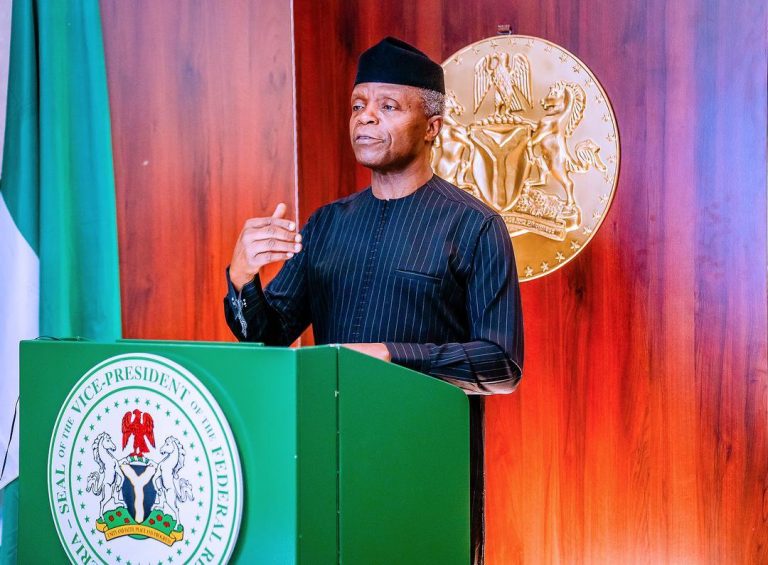
Vice President Yemi Osinbajo
Share

The Vice President of Nigeria, Professor Yemi Osinbajo has advocated a better payment structure and welfare package for workers in the country’s judiciary system.

Osinbajo who spoke on Tuesday at the Justice Sector Reform Summit 2022 said judges and other judicial workers should work under the best conditions due to the sensitive nature of their duties.

He argued that there is no justification for federal lawmakers to earn more than judges in the country.

Speaking against the background of the summit theme; ‘Devising Practical Solutions Towards Improved Performance, Enhanced Accountability And Independence In The Justice Sector,’ the Vice President was quoted by his spokesperson, Laolu Akande to have identified the establishment of a solely merit-based judicial selection and promotion process; a new approach to judicial budgeting and funding and the all-important question of judicial remuneration and welfare as some critical factors that must be addressed to guarantee a better judicial system in Nigeria.

Akande in a statement titled, ‘We Must Rediscover Attributes That Made Nigeria’s Judiciary High-Calibre In Africa – Osinbajo’ quoted the Vice President as saying: “Also, while we ask for the best from our judicial officers, we must equally ensure that the conditions under which they operate are not only befitting but are good enough to attract the best of minds in our profession. Judicial remuneration and welfare are critical.

“Why should a judge earn so much less than a federal legislator? There is no basis for it whatsoever. We should in fact benchmark without necessarily creating fresh new legislation because the Legislature doesn’t have any legislation about their own salaries.
“If we benchmark what a federal judicial officer/Court of Appeal Judge earns to what a House of Representatives member earns, you’d find a startling difference. If you benchmark a Supreme Court Justice to what a Senator earns, you’d notice the difference. If we start that quick process now, we would not have to go through the rigorous process of legislation. We would just benchmark the salaries even if we are going to call it allowances.
“The truth of the matter is that the responsibilities of the judge or justice of the Supreme Court/Court of Appeal are such they must be well remunerated. They are such that when they retire, they must be able to go to homes that they own in decent places where they live. That’s the way it should be. We shouldn’t have a situation where judges are anxious that when they retire, they won’t have homes to go to, because their salaries today can’t build anything decent. We must ensure that these are the conditions that are met.
“We must strengthen the processes of reviewing performance, incentivising excellence, and penalising misconduct.”

Continue Reading
Click to comment

Leave a Reply

Your email address will not be published. Required fields are marked *

Judiciary

Court Jails Two Chinese Nationals 46 Years Each for Cyberterrorism, Fraud

Published

on

Two Chinese nationals, Huang Haoyu and An Hongxu
Share

The Federal High Court sitting in Ikoyi, Lagos, on Wednesday sentenced two Chinese nationals, Huang Haoyu and An Hongxu, to 46 years’ imprisonment each for cyberterrorism and internet fraud.

The trial judge, Justice Daniel Osiagor, handed down the sentence after the defendants changed their initial not guilty pleas to guilty during the court proceedings.

Huang and Hongxu were arraigned alongside one Friday Audu on a seven-count charge bordering on cyberterrorism, internet fraud, and money laundering involving N3.4 billion and $2.56 million.

The convicts were among 792 suspected fraudsters arrested on December 19, 2024, during a coordinated operation by the Economic and Financial Crimes Commission (EFCC) tagged “Eagle Flush Operation.”

According to the prosecution, the syndicate orchestrated cryptocurrency, investment, and romance scams targeting unsuspecting victims. Investigations further revealed that Audu, allegedly acting on Huang’s instruction, incorporated Genting International Co. Ltd. to facilitate the fraudulent operations.

The court also heard that the defendants recruited Nigerian youths to impersonate foreign nationals online as part of the scheme to defraud victims.

Following their guilty pleas, the prosecution urged the court to impose the maximum penalty prescribed by law.

In his judgment, Justice Osiagor convicted and sentenced Huang and Hongxu to a cumulative term of 46 years’ imprisonment each, with an option of a N56 million fine. The court also ordered three days of community service and directed that the convicts be repatriated to China upon completion of their sentences.

Additionally, the court granted the prosecution’s application for the forfeiture of all items recovered during the EFCC investigation to the Federal Government.

The forfeited items include 1,596 mobile phones, 43 computer systems, hundreds of SIM cards, office equipment, generators, vehicles, and other electronic devices seized from four properties located in Victoria Island and Ikoyi, Lagos.

Meanwhile, the trial of the third defendant, Friday Audu, who maintained his not guilty plea, has been adjourned to April 29, 2026, for continuation of proceedings.

Continue Reading

Judiciary

Nnamdi Kanu Opts to Defend Himself as Legal Team Withdraws from Trial

Published

on

Nnamdi-Kanu
Nnamdi Kanu
Share

A dramatic twist unfolded on Thursday at the Federal High Court in Abuja as the detained leader of the Indigenous People of Biafra (IPOB), Nnamdi Kanu, announced that he would represent himself in court following the withdrawal of his entire legal team.

Lead counsel, Chief Kanu Agabi (SAN), informed the court that he and other Senior Advocates had stepped down from the case, stating that Kanu had decided to “take back his case.”

Confirming the development, Kanu told the presiding judge, “I will be representing myself for now. That might change later.” When asked if he wanted the court to assign a lawyer to him, he declined.

Speaking directly before the bench, Kanu argued that the court lacked jurisdiction to continue with the case against him. His submission formed part of an oral argument he personally presented—a rare occurrence in such a high-profile criminal trial.

The development marks a new phase in the long-running case, which has faced multiple adjournments and legal battles since Kanu’s arrest and extradition from Kenya to Nigeria in 2021.

Kanu faces charges bordering on treasonable felony and terrorism-related offences. Legal observers say his decision to conduct his own defence could significantly affect the direction and tempo of the trial in the coming weeks.

Continue Reading

Judiciary

Natasha Files Objections to FG’s Criminal Defamation Suit

Published

on

, Senator Natasha Akpoti-Uduaghan
Senator Natasha Akpoti-Uduaghan
Share

Senator Natasha Akpoti-Uduaghan has filed preliminary objections before the High Court of the Federal Capital Territory and the Federal High Court, contesting criminal defamation charges instituted against her by the Federal Government.

The senator described the case as an abuse of power and a calculated attempt at political persecution, alleging that the charges arose from petitions filed by Senate President Godswill Akpabio and former Kogi State Governor Yahaya Bello.

Her legal team, led by four Senior Advocates of Nigeria—Prof. Roland Otaru, SAN; Dr. E. West-Idahosa, SAN; J.J. Usman, SAN; and M.J. Numa, SAN—argued that the prosecutions are unconstitutional and aimed at silencing opposition voices rather than advancing public interest or national security.

The lawyers tendered exhibits indicating that the senator’s comments were part of legitimate public discourse and media commentary. They further contended that the Attorney-General of the Federation lacks the legal standing to prosecute defamation cases on behalf of private individuals.

According to the defence, defamation is a civil matter and criminalizing it amounts to intimidation, suppression of free speech, and misuse of the justice system.

Senator Akpoti-Uduaghan also accused authorities of selective justice, stating that while her own petitions over threats to her life were ignored, complaints from her political rivals were quickly acted upon. She maintained that this amounts to discriminatory prosecution in violation of Section 42 of the Constitution.

Her lawyers urged the courts to dismiss the cases at the preliminary stage, warning that allowing them to proceed would erode public confidence in the justice system and waste national resources.


Continue Reading