Connect with us

Business & Economy

Nigeria records 4,919 oil spills in 6 years — Minister

Published

on

Share

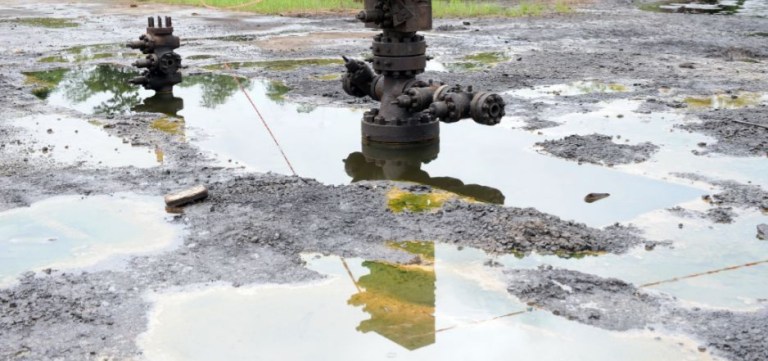
Minister of Environment Dr Mohammad Abubakar has disclosed that Nigeria l 4,919 oil spills between 2015 to March 2021 and lost 4.5 trillion barrels of oil to theft in four years.

Abubakar disclosed this at a Town Hall meeting in Abuja, organised by the Ministry of Information and Culture, on protecting oil and gas infrastructure.

“According to the National Oil Spill Detection Agency (NOSDRA) data, the total number of oil spills recorded from 2015 to March 2021 is 4,919, the number of oil spills cost by collation is 308.

“The operational maintenance is 106, while sabotage is 3,628 and yet to be determined 70, giving the total number of oil spills on the environment to 235,206 barrels of oil. This is very colossal to the environment.

“Nigeria also lost approximately 4.75 trillion on oil activities in the four years between 2015 and 2018, as estimated by the Nigeria Natural Resources Charter.

“Several statistics have emphasised Nigeria as the most notorious country in the world for oil spills, loosing roughly 400,000 barrels per day.

“The second country is followed by Mexico that has reported only 5,000 to 10,000 barrel only per day, thus a difference of about 3,900 per cent.

“Now the environmental effect, which is the major concern of the ministry of environment, is in the loss of revenue.

“Attack on oil facilities has become the innovation that replaced agitations in the Niger Delta region against  perceived poor governance and neglect of the area.

“The impacts of vandalism of oil facilities have not only caused pollution of the environment, but had consequences on the local people, the national economy and security,’’ he said.

Abubakar added that the activities that come with oil exploration and exploitation had similarly caused alterations to the environment and some of its effects had either been reduced or prevented.

The minister added that adequate mitigation measures had been taken, including enforcement of relevant laws, regulations and guidelines, such as the Environmental Impact Assessment (EIA) Act.

He said the EIA process ensured that measures were put in place to assist in the reduction of the negative effects and enhancement of the positive effects on the ecology, health and social wellbeing of communities in project areas.

“It is in the light of this fact that over 1,300 oil and gas projects in Nigeria have been subjected to EIA process under the supervision of the ministry’’.

Abubakar further added that the ministry held periodic interactive sessions with oil and gas operators, focused on the continued degradation of the environment, fatalities and loss of revenue, attributable to the regular and incessant vandalism of oil facilities, particularly pipelines.

The minister stressed that the effects of the destruction of oil and gas facilities had caused huge economic losses from pipelines to plant shut downs, as well as loss of biodiversity, habitat and ecological damage.

In addition, the destruction had also caused degradation of soil quality, which drastically reduces soil fertility, thereby, affecting crop yields and food security.

“Also, increase in air pollution and the attendant climate change issues, public health impacts on affected communities, social impacts and loss of livelihood, supremacy among militants, casualties, among others,’’ he said.

Oil pipeline vandalism over the years had been one of the major factors contributing significantly to environmental degradation in the Niger Delta region, which accounts for about 70 to 80 per cent of our oil and gas sector that drives the economy, the minister noted.

He added that the country’s oil and gas production accounts for a great deal of upstream and downstream industrial activities and production frontiers were increasingly moving into deep sea operations.

Similarly, the oil sector accounts for over 90 per cent of Nigeria’s total foreign exchange earnings with the bulk of it coming from the numerous producing fields, located on the land, swamp and offshore environment of the Niger Delta region, Abubakar also noted.

He, therefore, recommended increasing awareness creation on the negative consequences of vandalism of oil facilities and other illegal activities.

Such awareness should also be accompanied by increased sustainable community development programmes for host oil communities, to include skills acquisition, provision of infrastructure and basic amenities, among others, by oil companies and relevant government agencies, Abubakar said. (NAN)

Continue Reading
Click to comment

Leave a Reply

Your email address will not be published. Required fields are marked *

Business & Economy

Petrol Prices Rise to N1,040/Litre in Lagos, N1,080 in Abuja

Published

on

Petrol
Petrol station
Share

The pump price of Premium Motor Spirit (PMS), commonly known as petrol, has increased to as high as N1,040 per litre in Lagos and N1,080 per litre in Abuja, following a recent adjustment by fuel marketers.

The development comes a day after the Dangote Refinery raised its ex-gantry price of petrol to N995 per litre.

Checks on Saturday showed that several retail outlets across Lagos and Abuja had adjusted their prices upward.

At retail outlets operated by Nigerian National Petroleum Company Limited in Ilasa, Apple Junction, and Ago Palace Way in Lagos, petrol was sold at N1,040 per litre, representing an increase of N47 from the previous price of N993 per litre.

Similarly, Emadeb Energy and PM Petroleum filling stations located along the Oshodi/Apapa Expressway were dispensing petrol at N1,040 per litre.

At a Techno Oil Limited retail outlet in Festac Town, the product was priced at N1,050 per litre, while stations operated by MRS Oil Nigeria Plc sold petrol at N1,057 per litre.

In Abuja, petrol was sold at N1,050 per litre at Gegu Oil Nigeria along the Kubwa Expressway, while Empire Energy filling stations dispensed the product at N1,080 per litre.

However, an outlet operated by Ardova Plc sold petrol at N959 per litre.

The latest increase comes amid rising geopolitical tensions in the Middle East, which have contributed to volatility in global crude oil prices.

On Friday, crude oil prices surged to $91 per barrel as the conflict involving the United States, Israel, and Iran continued to escalate across the region.

Continue Reading

Business & Economy

FG Bans Roadside Tax Collections, Orders Dismantling of Checkpoints

Published

on

Coat of Arms
Share

The Federal Government has banned the collection of road taxes through roadside checkpoints and the use of tax stickers nationwide as part of sweeping tax reforms introduced in 2026.

The Joint Revenue Board (JRB) announced that all forms of roadside levies are now illegal, effectively ending a long-standing practice that required motorists to stop at checkpoints to make payments.

In a statement, the Board said the move is aimed at modernising tax administration, eliminating harassment of motorists, and improving transparency in revenue collection.

“This is a major win for motorists and a step toward transparent taxation,” the JRB stated, adding that security agencies have been directed to dismantle illegal checkpoints and ensure full compliance with the new law.

For years, motorists across the country were subjected to multiple levies under different designations, a situation that often created confusion and opened the door to alleged abuse and irregular collections.

Under the new framework, road tax stickers previously issued at state checkpoints are no longer valid, and motorists are not expected to make any payments related to road taxes on highways.

The government said the reform is designed to protect drivers from illegal collections, streamline tax administration under a centralised system, and promote voluntary compliance through a clearer and more accountable structure.

Security and enforcement agencies have been tasked with monitoring implementation to ensure that all roadside collections cease immediately.

Continue Reading

Business & Economy

Ogun to Establish 5,000-Herd Dairy, Cattle Ranches in Ipokia, Yewa South — Abiodun

Published

on

Ogun State logo
Share

Ogun State Governor, Dapo Abiodun, has announced plans to establish what he described as the largest dairy and cattle ranches in Nigeria in Ipokia and Yewa South Local Government Areas of the state, with an initial capacity of 5,000 herds of cattle.

Abiodun made the disclosure on Thursday at the All Progressives Congress (APC) strategic stakeholders’ meeting held in Abeokuta.

He said the projects would be sited in Ogun State at the instance of President Bola Tinubu, adding that construction work would commence soon.

According to the governor, the initiative is part of efforts to strengthen food security, boost local agricultural production, and deepen value chains across the state.

“The biggest dairy and cattle ranches will soon be established in Yewa South and Ipokia Local Government Areas. This is at the instance of Mr. President. These farms will start with 5,000 herds of cattle, and work will begin very soon,” Abiodun said.

The governor commended Tinubu for what he described as bold economic reforms, noting that the policies had stabilised the foreign exchange market, eliminated multiple exchange-rate regimes, and increased Nigeria’s foreign reserves to about $45 billion.

Abiodun also acknowledged what he called the President’s goodwill towards Ogun State, citing federal interventions such as the reconstruction of the Sagamu–Ijebu Ode Road, funding support for the Eba oil discovery, and the resuscitation of the OKLNG project.

“There is nothing I have asked Mr. President for Ogun State that he has not approved,” he said, adding that the President consistently directs investors to the state when they express interest in Nigeria.

The governor said the administration’s performance at the federal level had rekindled hope among Nigerians and strengthened public confidence in the ruling APC.

Highlighting achievements of his administration over the past six years and eight months, Abiodun said the state had recorded progress in education, infrastructure, job creation, youth and women empowerment, healthcare, agriculture, housing, technological innovation, industrial growth, and economic expansion.

He disclosed that over 1,700 kilometres of roads, including major highways, had been constructed across the state, more than 7,000 housing units delivered, and over 400 Primary Healthcare Centres upgraded and equipped.

Abiodun also stated that Ogun State was on the verge of becoming an oil-producing state.

He said the stakeholders’ meeting was convened to review progress and strategise ahead of emerging political challenges, urging party members to remain united as the state approaches another electioneering season.

“As we approach the upcoming congresses, they must unite us, not divide us. A united APC is an unbeatable APC,” he said.

Dignitaries at the meeting included former Governor Olusegun Osoba; Deputy Governor Noimot Salako-Oyedele; Speaker of the Ogun State House of Assembly, Oludaisi Elemide; Senators Solomon Adeola and Shuaib Salisu; and House of Representatives Chief Whip, Ibrahim Isiaka.

Also present were Minister of Communications and Digital Economy, Bosun Tijani; Minister of State for Health, Dr. Isiaka Salako; State APC Chairman, Yemi Sanusi; former deputy governors; lawmakers; local government chairmen; and other party stakeholders.

Continue Reading