Connect with us

Foreign

Nauru to Naoero, World Third Smallest Pacific Island Nation Changes Name

Published

on

Share

–Its international code shifts from NRU to NRO

The world’s third-smallest nation has changed its name from Nauru to Naoero; its international code shifts from NRU to NRO

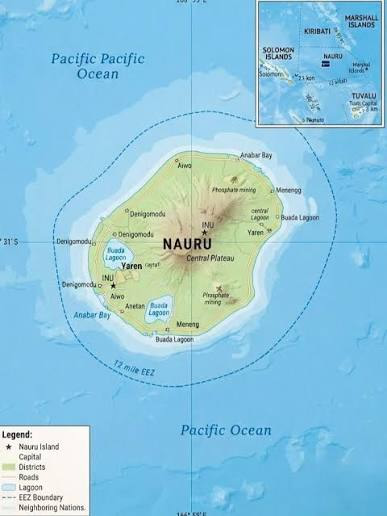
The Pacific island nation of Nauru has officially changed its name to the Republic of Naoero, a move its president says better reflects the country’s language, identity and heritage.

The shift also changes the country’s international code from NRU to NRO, while its people will now be referred to as dei-Naoero, as per reports.

The name is not new to the island itself. In the national language, the country has long been known as Naoero; the international version, “Nauru,” became common largely because foreign speakers struggled with the pronunciation.

The government says the updated name corrects that historical mismatch and restores a traditional identity that was never truly lost.

Why the name changed

President David Adeang first proposed the change in January, saying it would “more faithfully honor” the nation’s heritage, language and identity. Parliament later backed a constitutional amendment in two rounds of voting, and the government then said a public referendum would not be necessary after further discussion.

In the government’s view, the word Naoero already lives in the country’s culture and official symbols. Officials said it appears on the national coat of arms, is used in the community, and is allowed by the constitution, making a referendum unnecessary for what they described as a reclaiming of the nation’s true name.

What changes now
The most visible change is the country’s formal designation: the Republic of Naoero. Along with that, its ISO-style international code is shifting from NRU to NRO, and government aircraft and ships will also be renamed to match the new identity.

The government has already begun asking other countries and international institutions to recognize the change. The United Nations website now lists the country under its new name, and diplomatic websites in Australia, New Zealand, the United States and China have also begun using Naoero.

A small nation with a big history
Naoero is one of the world’s smallest countries by population, with about 12,000 residents. The tiny coral limestone atoll has had a complicated past: it was colonized by Germany, later administered by Australia, and became an independent republic in 1968.

Its modern history has been shaped by phosphate mining, which once brought major wealth but eventually collapsed and pushed the country close to economic ruin in the 1990s. Today, climate change has become its biggest existential challenge, as rising sea levels threaten the low-lying island.

That pressure has prompted the government to seek overseas investment, including through a paid citizenship program designed to help fund relocation efforts for people and infrastructure away from the encroaching ocean.

Part of a wider trend
Naoero’s move fits a broader pattern of countries redefining themselves by restoring native names or dropping colonial-era labels. Eswatini, for example, reverted from Swaziland in 2018, while Turkey asked the United Nations in 2022 to officially use Türkiye, the name long used domestically.

For many countries, these changes are about more than spelling. They are a way to signal sovereignty, cultural pride and a break from names imposed or simplified by outsiders. In Naoero’s case, officials say the change is a symbolic but meaningful step toward renewed national pride.

Why it matters
For a nation this small, a name change can carry outsized significance. It affects how the country is represented on maps, in diplomacy, in shipping, and in global databases, but it also sends a message about identity and self-definition.

The government says the old name became familiar internationally out of convenience, not choice. Reclaiming Naoero, then, is being framed not as a rebrand but as a return to what the nation has always called itself.

Continue Reading
Click to comment

Leave a Reply

Your email address will not be published. Required fields are marked *

Foreign

Why Traore Opens New Battlefield: The Fight Against Religious Extremists

Published

on

Share

Traore has opened a new front with Burkina Faso’s Muslim community over arrests. New legislation and arrests are driving a rift between Burkina Faso’s military government and Muslim scholars.

Captain Ibrahim Traore’s relationship with Muslim leaders has come under strain as his government tightens control over religious affairs.

Burkina Faso’s transitional leader Ibrahim Traore has announced plans to bring back students studying Islamic law in Arab countries

Once backed by influential Muslim scholars, Burkina Faso’s military leader is now facing a growing rift over arrests, new legislation and his campaign against what he describes as religious extremism.

Burkina Faso’s transitional leader, Captain Ibrahim Traore, has sharply escalated his confrontation with influential Muslim scholars, declaring that what he calls “radical Islam” has no place in the country and warning that “the battle has begun” against those he accuses of promoting religious extremism.

Addressing scholars whom he accused of spreading extremist ideas, Traore declared: “If this is your Islam, we will fight it. Extremists must change. If they do not, the battle has begun.”

His remarks underscore a widening rift between the government and parts of Burkina Faso’s Muslim community. Once an important source of support for the military leader, several influential Sunni scholars are now at odds with the authorities over the Religious Freedoms Law, the detention of prominent imams and the government’s campaign against religious extremism.

Traore argued that religion should spread through example rather than coercion or violence. He also questioned why some Muslims opposed the new legislation and warned that imams who use sermons to promote extremist ideas would be suspended.

At the same time, he pledged state support for scholars who advocate what he described as a peaceful interpretation of Islam, while accusing foreign powers of exploiting religion to destabilise Burkina Faso.

*Students studying abroad*
Traore also announced plans to recall Burkinabe students studying Islamic law in Arab countries, claiming that more than 800,000 were pursuing religious education abroad without acquiring practical professional skills.

He warned that those who refuse to return could risk losing their Burkinabe citizenship.

The announcement followed a government directive issued in late June requiring students seeking to study abroad to obtain prior approval from the Ministry of Higher Education.

Authorities said the measure was intended to ensure overseas study programmes better align with the country’s development priorities.

The tighter controls on religious education came as Burkina Faso’s transitional parliament unanimously adopted the Religious Freedoms Law on June 20.

The government says the legislation is intended to reinforce the state’s secular character. It introduces prison terms and fines for practices that authorities classify as religious abuses, including the forced begging of children and breaches of financial transparency rules by religious organisations.

*From ally to adversary*
The law deepened already growing tensions between the government and sections of the Muslim community.

In late May, Imam Mohamed Ishaq Kindo, one of Burkina Faso’s most prominent Sunni scholars, was arrested after criticising the draft legislation.

Referring to the arrest and the protests that followed, Traore dismissed the unrest as the work of “a small minority of extremists”.

After worshippers gathered to demand Kindo’s release, authorities closed the largest Sunni mosque in the capital, Ouagadougou, citing public order concerns.

Agence France-Presse (AFP), citing a security source, reported that about 100 of the imam’s supporters were transferred to a military camp for what officials described as “civic training”.

Kindo’s arrest followed the mid-April detention of Imam Mahmoud Barro in Bobo-Dioulasso under similar circumstances. According to the Timbuktu Institute, a Dakar-based think tank specialising in peace and security issues, Kindo’s whereabouts have not been disclosed since the protests were suppressed.

According to the institute, the confrontation extends beyond the Religious Freedoms Law. It marks the breakdown of the tacit understanding that had developed between Traore’s government and influential Muslim scholars, whose backing helped bolster his standing after he seized power.

By turning against former allies, the institute argues, Traore risks weakening an important source of political legitimacy without resolving the security crisis that his government has used to justify its increasingly assertive measures.

An Israeli dimension
Alongside the domestic tensions, Traore recently received Israel’s new ambassador to Burkina Faso, Simon Seroussi, in Ouagadougou to present his credentials.

The meeting followed a report by Africa Intelligence, a Paris-based publication specialising in African political and business affairs, that the ambassador’s accreditation request, submitted in the summer of 2025, had remained pending before being quietly approved.

Traore’s public reception of the ambassador appears to mark a shift from the caution previously shown by his inner circle, which had sought to preserve his anti-Western image. It also comes as Israeli security agencies expand cooperation with members of the Alliance of Sahel States (AES), the bloc formed by Burkina Faso, Mali and Niger, whose governments have expressed interest in Israeli security technology.

As Traore declares that “the battle has begun” against what he describes as religious extremism, while the Religious Freedoms Law takes effect and the fate of detained scholars remains unclear, a broader question emerges: will the government’s efforts to assert greater control over sources of public legitimacy strengthen its authority, or deepen its confrontation with one of Burkina Faso’s most influential social forces?

Continue Reading

Foreign

Nigerian-Born Water Fasan Honored with 2025 Canadian Airports Council Award 

Published

on

Nigerian-Born Water Fasan Honored with 2025 Canadian Airports Council Award
Share

 By Friday I. Ejilogo

Water Fasan, a Nigerian-born pharmacist turned security specialist, has been awarded the prestigious 2025 Canadian Airports Council (CAC) National Recognition Award for his outstanding performance as a Security Specialist and Access Control Officer at Toronto Pearson International Airport. Employed by ASP Security Services Limited in Mississauga, Ontario, since July 2022, Fasan stood out among 52,000 airport workers and 80 nominees to become the first African-Canadian Nigerian to receive this honor.

Recognized for his calm demeanor, approachability, and exceptional customer service, Fasan has been a vital presence at Canada’s busiest airport. His ability to de-escalate potential challenges and foster a positive environment has earned him widespread admiration.

During the award presentation, CAC President Monette Pasher highlighted the significance of the recognition: “Today, we celebrate the dedication of airport workers across Canada. With over 200,000 employees supporting 150 million passengers in 2025, we honor individuals like Water Fasan who make air travel safe and seamless.” Pasher noted that the award coincides with Airport Workers Day, a national initiative to celebrate the aviation workforce and its critical role in Canada’s economy and communities.

Expressing his gratitude, Fasan said, “I’m deeply honored to share this milestone with my colleagues who give their all every day. This award is not just a personal achievement but a historic moment for Nigeria, Africa, and every immigrant writing their story. It reflects the hard work and teamwork that define our industry.”

Fasan, one of nine recipients at the 16th Canadian Airports Ceremony, began his career in Nigeria as a pharmacy technician at Cosmos Pharmacy under the mentorship of Mr. Azubike Okwor, former President of the Pharmaceutical Society of Nigeria and the first Black recipient of a Fellowship in the pharmaceutical industry. Okwor’s guidance instilled in Fasan values of excellence, discipline, and community service.

After seeking opportunities in Israel, Fasan immigrated to Canada in 2010, where he transitioned into private security. He earned multiple certifications and worked with respected firms like RBG Security Inc., eventually rising to Operations Supervisor at Hudson’s Bay and Saks Fifth Avenue. There, his commitment to excellence earned him the Best Customer Service of All Time award.

In 2019, Fasan entered the aviation industry with Menzies Aviation, later leading teams at AAS and serving as Acting Manager at Dexterra. His contributions have made him a recognized figure at Toronto Pearson, where his story and image are prominently featured as a symbol of dedication.

Fasan’s historic achievement as a Security Specialist with ASP Security underscores his remarkable journey and serves as an inspiration to airport workers and immigrants worldwide.

  • Ejilogo is an Abuja-based freelance journalist and book editor

Continue Reading