Connect with us

News

MY SECOND-TERM PROJECTS’LL BOOST COMMERCE, PRODUCTIVITY — OYEBANJI

Published

on

Share


…Says Ekiti’ll take Tinubu’s re-election seriously


…As monarchs, youths pledge more support for governor
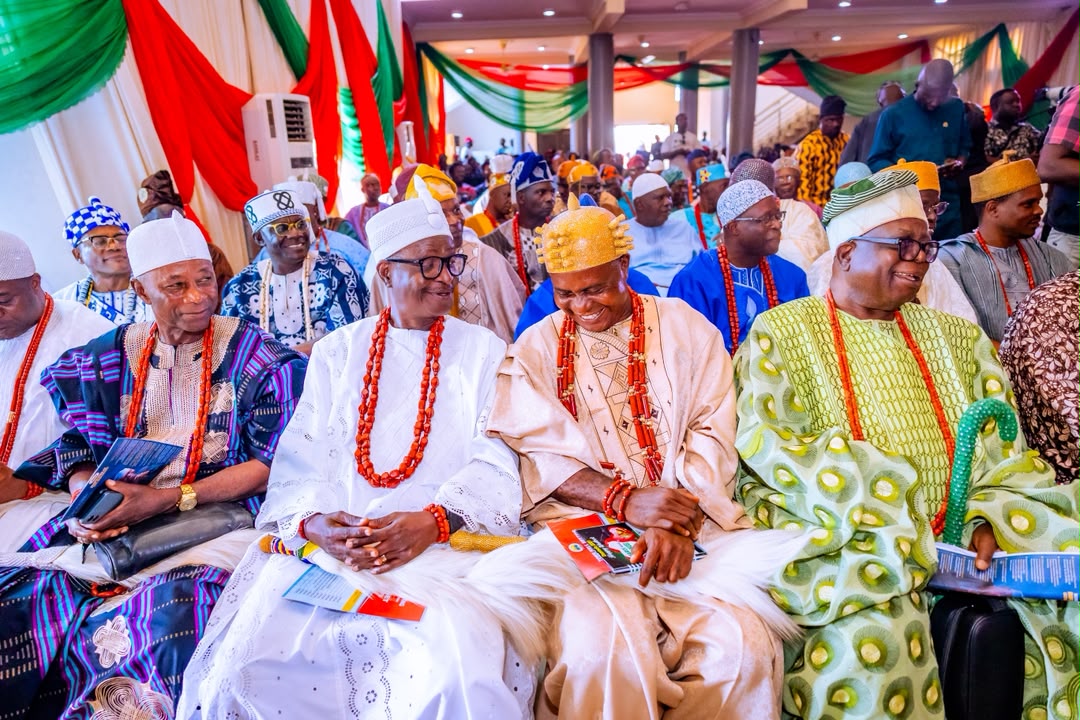


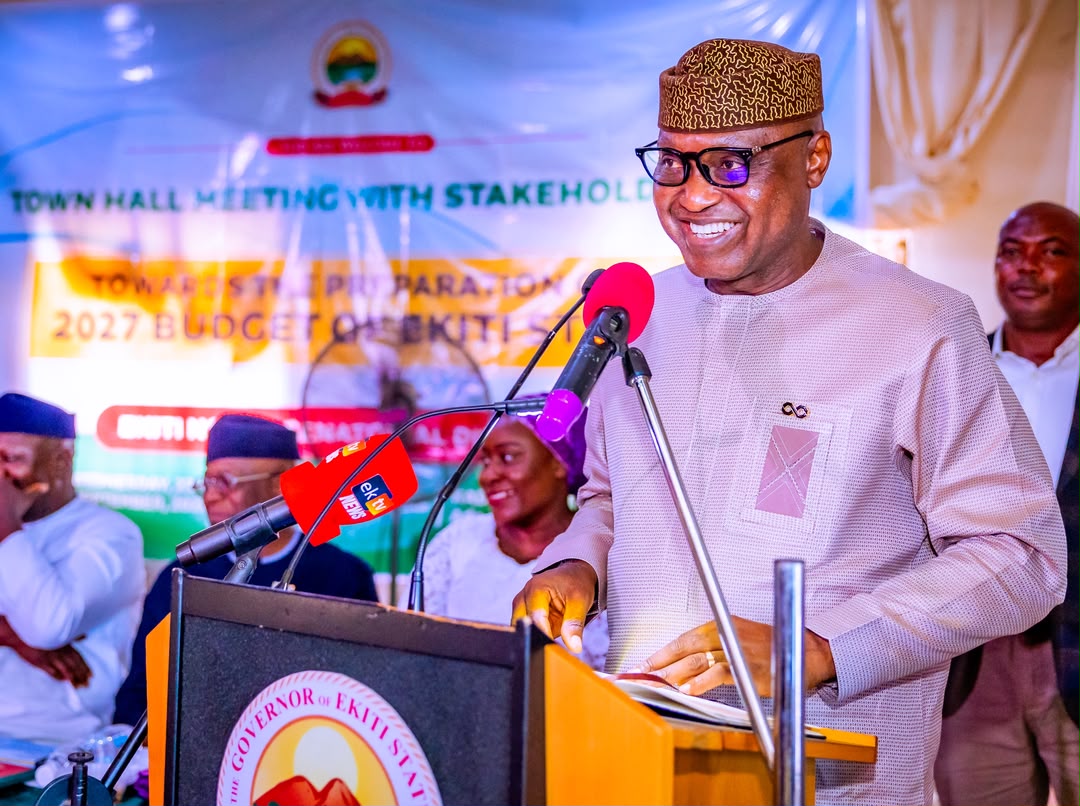
Ekiti State Governor, Mr Biodun Oyebanji, says projects to be executed during his second term will be strategically targeted at boosting commerce, enhancing productivity and stimulating sustainable business growth across the state.


The Governor also says Ekiti State will take the re-election bid of President Bola Ahmed Tinubu in the 2027 presidential election seriously, promising increased mobilisation to improve the President’s votes in the state.


Oyebanji spoke on Wednesday at a Town Hall Meeting with stakeholders from Ekiti North Senatorial District as part of consultations ahead of the 2027 Budget, held in Ifaki-Ekiti.


At the meeting, traditional rulers, community leaders, youths and other stakeholders pledged stronger support for the Governor’s second-term administration, which begins on October 16, 2026, to enable him to deliver on his shared prosperity agenda.


Oyebanji said his administration would sustain its consultative approach to governance in the second term, with greater emphasis on public participation and inclusive development.


He said government investments would be channelled strategically into critical sectors, including healthcare, electricity, roads and water supply, to improve living standards and enhance economic productivity.


The Governor said: “In our second term, whatever we are going to do must add value, because resources are limited. There must be value addition. We must catalyse productivity and ensure our people are productive.


“It is only when there is value that artisans like welders and auto mechanics can thrive and become prosperous.”


On electricity, Oyebanji said his administration had expanded access to power in some communities, but noted that existing legal provisions limiting states largely to electricity generation had affected efforts to fully address distribution challenges.


He reaffirmed his commitment to participatory governance, saying inputs from communities would continue to guide government’s decisions on project prioritisation.


“Governance is about the people. We are what we are today because of you. You gave us your mandate, and we must continue to seek your counsel in delivering good governance,” he said.


The Governor also commended traditional rulers for their support, particularly in intelligence gathering, which he said had contributed to improved security across the state.


He, however, urged residents to remain vigilant and continue to support security agencies with useful information.


On the 2027 presidential election, Oyebanji called on Ekiti voters to reciprocate what he described as President Tinubu’s support for the state by increasing the votes delivered to the President.


He cited federal appointments and infrastructure projects benefiting the state as evidence of the Federal Government’s attention to Ekiti.


“We must show appreciation. It will not be enough to repeat previous figures. We must do more in the next election,” he said.


On infrastructure, the Governor disclosed that collaboration with the Federal Government had facilitated the award of major road projects, including the Ado-Ijan-Ilumoba-Ikole and Ado-Aramoko-Ita-Ore roads.


He added that other critical roads across the state would be addressed subsequently.


Providing sectoral updates, the Commissioner for Health, Dr Oyebanji Filani, said more than 300 nurses and 1,500 health assistants had been recruited over the past four years.


He said the government had also upgraded several primary and secondary healthcare facilities, while three new general hospitals had been approved for Ipao, Ikogosi and Awo-Ekiti.


Also speaking, the Commissioner for Infrastructure and Public Utilities, Professor Bolaji Aluko, disclosed that more than 500 boreholes had been constructed across the state, while an additional 110 had been proposed to ensure equitable distribution of water.


In their remarks, traditional rulers and community representatives from Ekiti North Senatorial District commended the Governor for his development efforts and highlighted priority areas for consideration in the 2027 Budget.


Their requests included improved roads, electricity, water supply, healthcare and security.


Speaking on behalf of Ikole Local Government, the Alaaye of Oke Ayedun, Oba Femi Aribisala, appealed to the government to urgently intervene in the areas of roads, water and electricity.


He said poor road access and inadequate electricity supply were hindering economic activities and development in the area.


Representatives of Moba Local Government and the Obaleo of Erinmope, Oba Sunday Aniyi; Ido/Osi Local Government and the Olojudo of Ido-Ekiti, Oba Ayorinde Ilori-Faboro; as well as Oye Local Government and the Onisan of Isan-Ekiti, Oba Gabriel Adejuwon, also called for increased attention to roads, electricity, security and water supply in the 2027 Budget.


Dignitaries at the event included the Deputy Governor, Chief (Mrs) Monisade Afuye; Secretary to the State Government, Professor Habibat Adubiaro; Chief of Staff, Mr Oyeniyi Adebayo; Head of Service, Dr Folakemi Olomojobi; members of the State Executive Council; local government chairmen; traditional rulers; political leaders; and representatives of various community groups.

Continue Reading
Click to comment

Leave a Reply

Your email address will not be published. Required fields are marked *

News

FG Suspends 20 NSCDC Officers Over Deaths Of 37 Suspected Illegal Miners

Published

on

NSCDC Personnel
NSCDC Personnel
Share


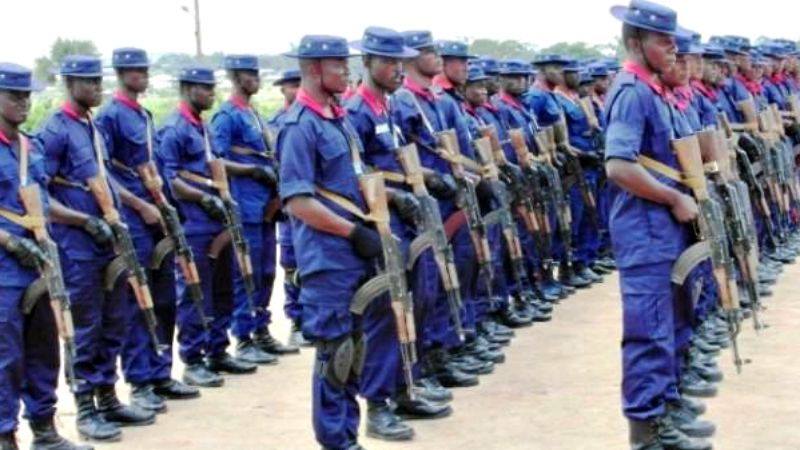
The Federal Government has suspended 20 officers of the Nigeria Security and Civil Defence Corps (NSCDC) over the reported deaths of 37 suspected illegal miners who were in the Corps’ custody in Niger State.

The Minister of Interior, Olubunmi Tunji-Ojo, announced the suspension on Saturday, following President Bola Tinubu’s directive for a transparent and comprehensive investigation into the incident, which occurred on Thursday.

Tunji-Ojo said the suspension would remain in place pending the outcome of the investigation. The affected officers include personnel involved in the arrest, investigation, security and detention of the suspected miners.

The Minister also constituted a 10-member independent committee to investigate the deaths and establish the identities of the deceased, the circumstances surrounding their arrest and detention, and the actual cause of death.

The committee is also expected to determine whether there was any responsibility, negligence or misconduct and recommend appropriate action, including compensation where necessary.

The committee is chaired by retired DSS Deputy Director-General, Jonathan Kure, mni, while Prof. Isa Hayatu Chiroma, SAN, a former Director-General of the Nigerian Law School, will serve as Secretary.

Other members include retired AIG Hosea Hassan Karma, Prof. Olayinka Buhari, representatives of the Minna Emirate Council and Niger State Government, the National Secretary of the Miners Association of Nigeria, Alhaji Liman Sulaiman, lawyer and human rights activist Deji Adeyanju, Blueprint Newspaper’s Zainab Suleiman Okino, and public affairs analyst Dr. George Agbakahi.

The committee has two weeks to complete its investigation and submit its report to the Minister.

Tunji-Ojo directed the NSCDC leadership and all relevant officers to fully cooperate with the investigation and ensure that all records and evidence relating to the incident are preserved.

He warned that anyone who attempts to destroy or conceal evidence, intimidate witnesses or obstruct the investigation would face serious consequences.

The Minister described the deaths as deeply disturbing, condoled with the families of the deceased and appealed for calm while the investigation continues.

Continue Reading

News

43 Feared Dead as Illegal Fuel Siphoning Turns Fatal in Rivers Community

Published

on

Rivers State Map
Share

OKRIKA, Rivers — What began as an overnight attempt by hundreds of youths to siphon petroleum products from an illegal pipeline connection has ended in tragedy, with at least 43 people feared dead in Okrika Local Government Area of Rivers State.

The incident occurred around midnight on Thursday at Okari Jetty in Okrika Mainland, leaving families searching for loved ones and the community grappling with the scale of the disaster.

Community sources said more than 200 youths from neighbouring communities arrived at the jetty in wooden boats and attempted to collect petroleum products from an illegally connected tapping point on a pipeline linked to the facility.

The operation reportedly turned deadly after the youths were exposed to concentrated fumes while loading the product into waiting boats.

Several people reportedly lost consciousness. Some fell into the river and drowned, while others managed to escape and are receiving treatment for respiratory complications.

Of the 43 people reportedly dead, 37 have been identified as indigenes of Okrika, while six others remain unidentified. Several people are also still unaccounted for.

The incident has left relatives and community members facing the painful task of searching for missing family members and identifying those who died.

Blessing Agabe, spokesperson for the Rivers State Police Command, confirmed the incident and said investigations were underway to determine the circumstances surrounding the deaths and establish the actual number of casualties.

Fyneface Fyneface, Executive Director of the Youths and Environmental Advocacy Centre (YEAC-Nigeria), said the victims were allegedly involved in an illegal operation at a tapping point on a pipeline transporting petroleum products from the Indorama Eleme Petrochemicals area through the Port Harcourt refinery corridor to export vessels.

According to him, the victims were loading the product into waiting boats while a vessel was receiving supplies from the pipeline.

Fyneface described the incident as a major warning about the dangers associated with tampering with oil and gas infrastructure and illegal bunkering activities in the Niger Delta.

YEAC-Nigeria has called on the National Oil Spill Detection and Response Agency (NOSDRA) to conduct a joint investigation into the incident and determine what led to the deaths.

The organisation also urged operators of oil and gas facilities to strengthen security around critical infrastructure to prevent vandalism and unauthorised access.

Beyond the immediate investigation, Fyneface called for stronger measures to reduce the economic pressures that drive young people into dangerous activities, including the creation of alternative livelihood opportunities, industrial development programmes and other sustainable economic initiatives across the Niger Delta.

For families in Okrika, however, the immediate concern is more personal: finding missing relatives, identifying the dead and coming to terms with a tragedy that has claimed dozens of lives in a single night.


Continue Reading

News

Uber Exits Nigeria After 12 Years, Cites Changing Business Priorities

Published

on

Share

Global ride-hailing giant Uber has ended its ride-hailing operations in Nigeria, bringing its 12-year presence in the country to a close.

Uber announced the decision on Wednesday, September 2, 2026, saying it would wind down its operations in Nigeria following a review of its business priorities and investment focus across Africa.

The company, which launched its service in Lagos in 2014, said the decision takes effect immediately.

“After a thorough review, we have taken the difficult decision to wind down operations in Nigeria and Uganda, effective September 2, 2026,” Uber said in a statement.

Uber stressed that the decision is limited to Nigeria and Uganda and does not represent a withdrawal from the wider African market.

The company said it remains committed to Sub-Saharan Africa, which it described as a region with strong growth prospects and long-term opportunities.

Why Uber is leaving Nigeria

Uber attributed its Nigerian exit to its “evolving business priorities and investment focus across the continent.”

The company said it was concentrating investments on markets where it could create the greatest value for drivers by providing earning opportunities at scale while allowing passengers to move around seamlessly.

Uber did not cite regulatory difficulties in Nigeria as the reason for its withdrawal.

The company also specifically denied that its decision was linked to a recent directive by the Federal Airports Authority of Nigeria (FAAN) concerning e-hailing operations at Nigerian airports.

“No,” Uber said when asked whether the FAAN directive was responsible for its decision.

FAAN had recently clarified that it had not imposed a blanket ban on e-hailing services at Nigerian airports, explaining that discussions with operators were focused on establishing an appropriate framework for their operations within airport premises.

Drivers, riders affected

Uber said its immediate priority is supporting drivers, riders and employees affected by the shutdown.

The company said it is communicating directly with affected stakeholders about the implications of the decision and arrangements for the transition.

Uber has operated in Nigeria for more than a decade, expanding beyond Lagos to several cities, including Abuja, Port Harcourt, Ibadan, Enugu, Kano and other major urban centres.

Its departure is expected to reshape Nigeria’s increasingly competitive ride-hailing market, where operators compete for passengers and drivers amid rising operating costs and evolving regulatory requirements.

End of an era

Uber’s exit marks the end of a significant chapter in Nigeria’s digital transport industry.

The company helped popularise app-based ride-hailing in the country after launching in Lagos in 2014, offering passengers an alternative to conventional taxi services and creating new earning opportunities for thousands of drivers.

Its withdrawal also comes at a time when ride-hailing companies across Africa are reassessing their operations and investment strategies.

Uber previously withdrew from Côte d’Ivoire in 2025 and ended operations in Tanzania in January 2026, reflecting the challenges global mobility platforms can face in adapting their business models to individual African markets.

For Nigerian passengers and drivers, however, the immediate question is what Uber’s departure will mean for competition, fares, driver earnings and service availability.

While Uber is leaving Nigeria, the company maintains that its broader commitment to Sub-Saharan Africa remains intact.

The exit therefore represents a strategic withdrawal from the Nigerian market rather than a retreat from Africa, according to the company.

Continue Reading