Connect with us

Defence and Security

Insecurity: DHQ Strategies operation, holds joint simulation exercise

Published

on

Defence HQ Logo
Defence HQ Logo
Share


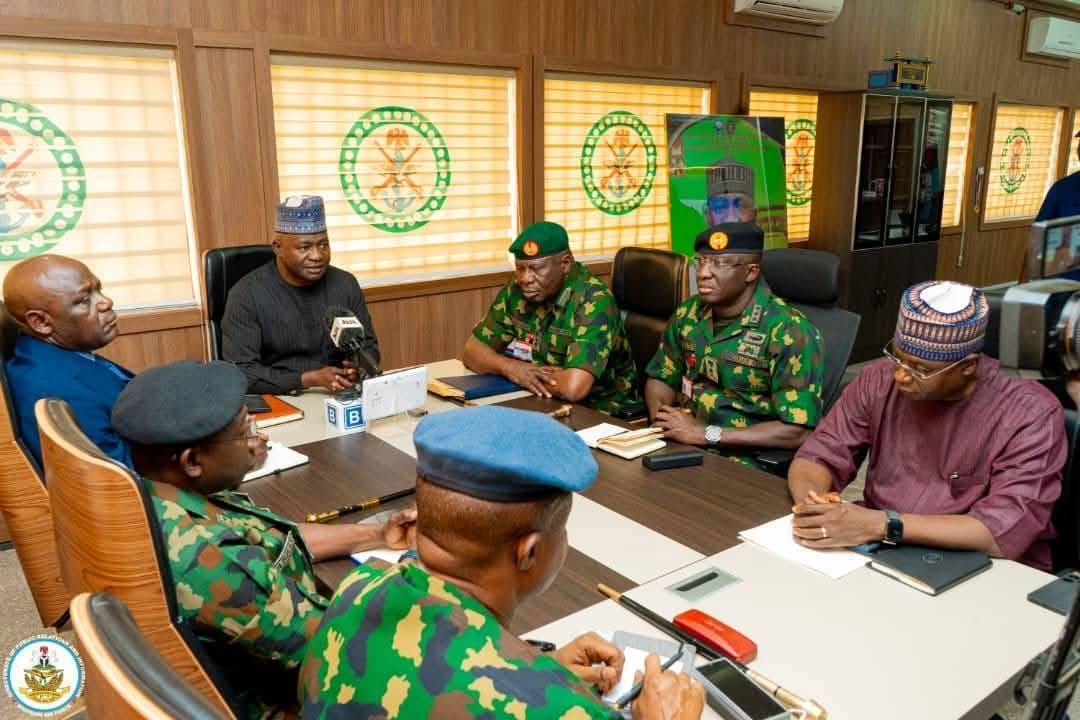
The Chief of Defence Staff (CDS), Gen. Lucky Irabor on Wednesday, unveiled the Defence Headquarter (DHQ) joint simulation exercise and the review of ongoing Operation Whirl Punch.

The News Agency of Nigeria (NAN) reports that Operation Whirl Punch is a DHQ led operation that deals with the menace of banditry and terrorism in Kaduna and Niger States.

Irabor said professionalism remained the thrust of the Armed Forces in addressing the prevailing security challenges in the country.

He said the simulation exercise was designed to reshape and review the operation in a bid to enhance operational effectiveness of the military,

The CDS added that joint training was needed to contend with the current issues and reposition personnel to effectively address future threats to the nation.

According to him, professionalism is a process and every organization will have to continue to review its structure and setting in a bid to get better.

“For us in the armed forces, a lot of mileage has been covered, but I will also indicate that we still have so much more to cover.

“Since we operate within a geographic environment which is within our geographical space, the contending issues are far beyond those within our space.

“They also involve those that are global in nature, some are made, others, of course, are natural.

“But as members of the armed forces, it is necessary for us to sieve these issues and have them properly contextualized and get ready to plan contingencies to be able to redress them.

“At any point in time when the armed forces are called upon, there would not be any reason for any excuse for failures.

“Currently, the armed forces, as you know, is engaged in various theatres across the country.

“Dealing with issues that are more internal in nature, which at some points have had to involve the resources and the capacities of the armed forces”, he said.

Irabor disclosed that the armed forces looked forward to assisting other agencies to increase their capacity to respond to internal security challenges.

This, according to him, is to enable the military to focus more on issues that were traditionally its responsibilities.

He said it was a long-term goal that the armed forces would continue to escalate in the interim, to sufficiently bring respite to the security environment.

The Chief of Defence Training and Operations, Maj.-Gen. Adeyemi Yekini, said the exercise was a follow up to one of the key decisions reached during the defence retreat at Asaba.

Yekini said the main objective was to find ways to further enhance jointness in military operations, working with other security agencies to overcome the contemporary security challenges facing the country.

This, according to him, is in line with the CDS’ leadership focus, which is to foster a professional armed force.

Yekini therefore said there was no better way of fostering professionalism other than through joint training involving personnel of the three services.

“This exercise is designed to upgrade one of our key operations, Operation Whirl Punch, which is involved in counter terrorism and counter insurgency operation in Kaduna and Niger states.

“It is instructive to mention that the operation was recently reviewed to bring together under a unified command, the different civil service and police operations in the area.

“This review was followed by the launching of Operation Forest Sanity, which has substantially degraded enemy forces in the two states, thereby improving security along the general axes,” he said.

Yekini said the participants were expected to articulate lessons and observations derived during the exercise.

He urged them to be committed to the exercise and bridge the lapses already experienced by troops in the joint operations.


(NAN)

 

Defence and Security

TINUBU SWEARS IN GEN. CHRISTOPHER MUSA AS DEFENCE MINISTER

Published

on

President Bola Ahmed Tinubu, New Minister of Defence, General Christopher Musa and others dignitaries at the Oath taking ceremony in Abuja
Share

President Asiwaju Bola Ahmed Tinubu on Thursday swore in retired General Christopher Gwabin Musa as Nigeria’s Minister of Defence at the Presidential Villa, Abuja.

Musa’s appointment follows the resignation of former Defence Minister Mohammed Badaru Abubakar on December 1. His nomination was sent to the Senate on Tuesday and swiftly confirmed.

Born in Sokoto in 1967, Musa was commissioned into the Nigerian Army in 1991. He served as Chief of Defence Staff from 2023 until his retirement in October 2025, during which he promoted stronger cooperation among the armed forces.

With his swearing-in, Musa is expected to immediately take charge as the Tinubu administration intensifies security reforms and seeks to consolidate recent gains toward lasting peace nationwide.

Dignitaries at the ceremony included Senate President Godswill Akpabio, Senate Leader Opeyemi Bamidele, Information Minister Mohammed Idris, National Security Adviser Nuhu Ribadu, and senior military chiefs. Also present were Musa’s wife, Lilian Oghogho Musa; Bishop Matthew Hassan Kukah; and retired Justice Kumai Bayang Akaahs.

Continue Reading

Defence and Security

Senate Confirms Former Defence Chief Christopher Musa as Minister

Published

on

General Christopher Musa Rtd
Share

The Senate has confirmed General Christopher Musa (rtd), the immediate past Chief of Defence Staff, as Nigeria’s new Minister of Defence.

Musa’s nomination was approved on Wednesday after a screening session in which senators examined his military credentials and asked questions on national security challenges.

Addressing the lawmakers, Musa pledged commitment to diligent service and emphasised collaboration in tackling insecurity.

“The challenges we are facing are Nigerian challenges, not just for the armed forces or security agencies,” he said. “We will win if we work together as a team.”

He highlighted gaps in security operations and called for a unified national database to support intelligence gathering. Musa also urged stronger roles for local governments and the judicial system.

Rejecting ransom payments to kidnappers and terrorists, he warned that negotiation only emboldens criminals. “They use the money to buy more arms,” he noted.

Responding to claims of religious targeting in violence across the country, Musa said terrorism affects all citizens. “We must stop the killings. Nigerians should not be killed. We must unite,” he stated.

Senate President Godswill Akpabio praised Musa’s performance during the screening, describing him as the most thorough nominee since 1999. He encouraged the new minister to immediately visit defence industry facilities.

Musa’s nomination was subsequently approved through a unanimous voice vote.

Continue Reading

Defence and Security

Senate Backs Death Penalty for Kidnapping, Moves to Redefine Crime as Terrorism

Published

on

Senate in Session
Senate in Session
Share

In a decisive move to stem rising insecurity, the Senate has approved key amendments to the 2022 Terrorism (Prevention and Prohibition) Act, prescribing the death penalty for kidnappers and anyone who aids kidnapping operations.

During Wednesday’s plenary, senators across political lines overwhelmingly supported the bill sponsored by the Leader of the Senate, Senator Opeyemi Bamidele. The amendment seeks to classify kidnapping, hostage-taking, and related offences as acts of terrorism, granting law enforcement broader powers to dismantle criminal networks.

The bill has now been referred to the Committees on Judiciary, Human Rights and Legal Matters, National Security and Intelligence, and Interior for further scrutiny, with instructions to report back within two weeks.

Presenting the proposal, Bamidele said kidnapping had evolved from sporadic activity into organised violence affecting all regions of the country. He argued that the severity and scale of the crime now bear the hallmarks of terrorism, warranting the strongest punishment.

> “Kidnapping has instilled fear in communities, disrupted economic activities, ruined families, and claimed countless innocent lives,” he declared. “Our legal framework must reflect the magnitude of this threat.”

The amendment prescribes capital punishment not only for perpetrators but also for financiers, informants, logistics suppliers, harbourers, and anyone who knowingly supports kidnapping operations. Attempt, conspiracy, or incitement would attract the same penalty.

The Senate leader explained that reclassification under terrorism laws would enable intelligence-led operations, asset tracing, inter-agency cooperation, and disruption of funding channels.

Backing the proposal, Senator Adams Oshiomhole dismissed existing deradicalisation programmes as ineffective, arguing that some offenders return to crime after release.

> “Even Scriptures acknowledge that those who kill cannot be allowed to continue living,” Oshiomhole said. “If convicted for terrorism, the penalty should be death.”

Senator Orji Uzor Kalu lamented the suffering inflicted on Nigerians, citing cases of widows, traumatised families and victims of sexual assault.

> “Everyone involved in this criminal enterprise must face consequences,” he maintained.

Minority Leader Senator Abba Moro described kidnapping as a business venture for criminals and endorsed the bill as a necessary measure to deter offenders.

Also speaking, Senator Victor Umeh condemned the killing of victims after ransom payment and called for sanctions against facilitators, including complicit financial institutions.

The Senate President, Godswill Akpabio, welcomed the bipartisan support and mandated the lead committee to expedite consultations and present recommendations at a public hearing.

The proposed amendment marks one of the strongest legislative responses to Nigeria’s worsening kidnapping crisis, signalling a toughened stance on national security and criminal justice.

Continue Reading