Connect with us

Defence and Security

Insecurity: Army to review operations across the Country

Published

on

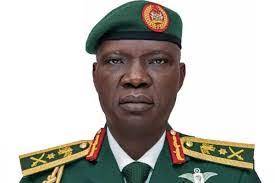
Chief of Army Staff, General Faruk Yahaya
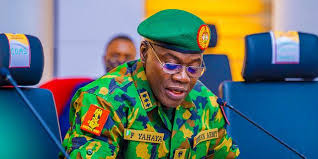
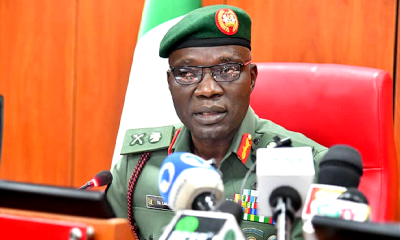
Chief of Army Staff (COAS), Lt.- Gen. Faruq Yahaya
Share


…as COAS conference holds in Sokoto Dec 4-10

The Nigerian Army is set to review its various operations across the country with a view to advancing its fight against criminal activities.

The Director, Army Public Relations, Brigadier General Onyema Nwachukwu stated this in Abuja during the news briefing on the fourth quarter Chief of Army Staff (COAS) Conference scheduled to take place in Sokoto State this week from 4 December till 10.

The conference is themed, “Building a Professional Nigerian Army for the 21st Century Security Environment.”

The Nigerian army said it is reviewing its operations to rout terrorists, bandits, kidnappers, separatist groups, and other criminal gangs terrorising the peace in the country.

It said the fluidity of the threats and security situation in the country, requires dynamism to continually review its operational strategies.

According to General Nwachukwu, the conference will offer a reappraisal of the administrative affairs of the Nigerian Army and evaluate and comprehensively review ongoing operational engagements of the Nigerian Army in all theatres of operations across the six geo-political zones within the year.

Nwachukwu said this would provide the Nigerian Army with an in-depth insight to take far-reaching decisions that will be result oriented towards achieving its set objective of addressing the multifaceted security challenges in the country.

The conference would also create an opportunity for the Chief Of Army Staff to have a face-to-face interaction with all the General Officers Commanding, field commanders, and other senior officers to provide possible guidance on enhancing the army activities and operations.

He said, “The conference would also create an opportunity for the COAS to have a face-to-face interaction with all the General officers Commanding, field commanders and other senior officers to provide possible guidance on enhancing NA activities and operations”.

“I must acknowledge that the fluidity of the threat situation requires dynamism to continually review our operational strategies. Hence, this conference offers a veritable platform to deliberate on ways and means through which the NA would continue to enhance national security. I, therefore, reiterate the commitment and resolve of NA troops to continue to discharge their duties professionally and proficiently within its constitutional mandate. We will also be resolute in upholding our values of courage, professionalism, sacrifice, respect, discipline and unflinching loyalty to duly constituted authority.

Nwachukwu, while noting that the Nigerian Army, has demonstrated its capacity and zeal in defending Nigeria’s territorial integrity and sovereignty against external aggression and giving aid to civil authority in mitigating internal security challenges in the country over the years, said “This is further demonstrated in the purposeful leadership drive of the Chief of Army Staff, Lieutenant General Faruk Yahaya (CFR) whose efforts have tremendously enhanced the capacity and dexterity of troops in the onslaughts against terrorists, bandits and other criminal elements in the country”.

He said “With his transformational and selfless leadership drive, troops have continued to decimate Boko Haram/ISWAP terrorists in the North East, leading to the obliteration of terrorists high profile commanders, foot soldiers and their hideouts. This has led to mass surrendering of terrorists and their family members in droves. Troops have also maintained this feat, through their operational engagements in other theatres of operations in other parts of the country, with significant successes recorded. These feats would not have been achieved without the support and collaboration of law-abiding Nigerians, sister services and other security agencies, the political leadership and the international community”.

He said the opening ceremony will feature a lecture titled “Proliferation of Regional/State Security Outfits in Nigeria: Challenges and Prospects” by Gen Martin Luther Agwai (retired), former Chief of Defence Staff.

“On 6 December 2022, there shall be commissioning of various Nigerian Army Civil Military Cooperation projects in various communities in Sokoto State. Furthermore, the conference will review decisions taken at the Chief of Army Staff third quarter conference, while series of briefs and other updates bothering on various activities of the NA will be presented and deliberated upon from 7 to 8 December.

“The NA will also seize the opportunity to recognise and appreciate eminent Nigerians who have in no small measure supported the NA.

Continue Reading
Click to comment

Leave a Reply

Your email address will not be published. Required fields are marked *

Defence and Security

FG Increased Soldiers’ Minimum Monthly Salary from ₦49,000 to ₦100,000, Says Defence Minister Christopher Musa

Published

on

Minister of Defence, Christopher Musa
Share


The Minister of Defence, Christopher Musa, has disclosed that the Federal Government has increased the minimum monthly salary of Nigerian soldiers from ₦49,000 to ₦100,000 as part of efforts to improve the welfare and morale of personnel of the Armed Forces.

Musa made the disclosure during an interview with News Central ahead of the broadcast of its NC Exclusive programme scheduled for Friday.

According to the minister, the salary adjustment reflects the commitment of President Bola Tinubu’s administration to strengthening the military, even though he acknowledged that the defence sector remains underfunded.

“When they started, a soldier was collecting ₦49,000 monthly. We tried so hard; now he’s collecting ₦100,000,” Musa said.

Despite the increase, he stressed that more resources are still required to adequately equip and sustain the Armed Forces in tackling Nigeria’s growing security challenges.

On the rising wave of kidnappings across the country, Musa advocated the death penalty for convicted kidnappers, arguing that stronger punishments are necessary to deter the crime.

“I think we should do that. There must be deterrence. The laws are soft, and that’s why people take advantage. If they know once you commit an offence, there must be punishment,” he said.

Speaking on the recent abduction of schoolchildren in Oyo State, the Defence Minister described the incident as unfortunate and alleged that the kidnappers were attempting to pressure the military into releasing some of their detained commanders.

He revealed that the abductors had threatened to kill the children if security forces attempted a rescue operation.

“They are looking for leverage because we have some of their commanders with us. They feel taking these kids and holding them to ransom will make us release their commander. They are now threatening that if we come any closer, they’re going to kill all the kids,” he stated.

Musa also dismissed allegations that Nigerian soldiers are poorly fed, insisting that reports circulating on social media do not reflect the reality within the military.

Reacting to a viral video involving an influencer identified as Justice Crack, the minister alleged that the soldier deliberately removed food items from his meal to create the false impression that troops were being poorly catered for.

According to him, the meal served contained meat and other food items, but these were intentionally taken out before the video was recorded to mislead the public.

The Defence Minister maintained that the Federal Government remains committed to improving the welfare of military personnel while intensifying efforts to combat terrorism, banditry, kidnapping and other security threats across the country.

Continue Reading

Defence and Security

State Police May Fail Without Financial Autonomy, Adequate Funding — Senate Leader Bamidele Warns

Published

on

Senate Leader, Senator Michael Opeyemi Bamidele
Share


ABUJA, Nigeria — Leader of the Senate, Opeyemi Bamidele, has warned that the proposed establishment of state police in Nigeria could fail if the new policing system is not backed by guaranteed funding and financial independence.

Speaking on Thursday at the ARISE NEWS Townhall on State Police, Bamidele said inadequate funding would expose state police to undue influence from politicians, wealthy individuals, corporate interests and criminal elements, thereby undermining its ability to effectively protect lives and property.

He stressed that financial autonomy would be a critical factor in determining the success of decentralised policing.

“If the state police is not well funded, it may as well be a highway to nowhere,” Bamidele said.

The Senate Leader explained that the constitutional amendment currently before the National Assembly is not intended to compel every state to immediately establish its own police force. Rather, it seeks to provide the constitutional framework that would enable states to create and operate their own police services if they choose.

According to him, the amendment proposes moving policing from the Exclusive Legislative List to the Concurrent Legislative List, thereby granting states the constitutional authority to establish state police.

“It’s not every state that will immediately, after we finish amending this constitution, go to town to say, ‘We’re launching our state police.’ All we are trying to achieve with this constitutional amendment is to move this duty from the exclusive legislative list to the concurrent legislative list,” he stated.

Addressing widespread concerns over the possible misuse of state police by political office holders, Bamidele acknowledged that such fears are legitimate and must be addressed through robust legal safeguards.

He said the National Assembly is committed to enacting laws that would ensure accountability, transparency and operational independence while preventing abuse of the proposed security structure.

“The various concerns that have been expressed from different quarters are well-founded concerns that we cannot sweep under the carpet or pretend that they are not real,” he said.

The Senate Leader noted that accountability would require not only legislative intervention but also active oversight by citizens and civil society organisations.

“When it comes to issues of accountability, it’s something that will have to be addressed, both at the level of legislative intervention through the law, as well as vigilance on the part of the Nigerian people,” he added.

Bamidele further cautioned that the danger of undue influence extends beyond politicians, warning that poorly funded state police could become susceptible to manipulation by private businesses, influential organisations and criminal networks.

“It’s not only state actors or politicians that can abuse this. Business class, some other organisations, even criminals can abuse it, because he who pays the piper dictates the tune,” he warned.

To safeguard the operational independence of state police, Bamidele proposed constitutional and statutory provisions that would guarantee a stable source of funding outside the discretion of state governors.

He suggested that legislation should provide for a fixed percentage of state budgets to be dedicated to policing, with clear mechanisms governing access to and management of such funds.

“We must have a situation where there will be some first-line provisions in our law. The police chief and the police service commission must have a guaranteed source of income in a way that it will not be subject to the whims and caprices of a sitting governor,” he said.

The Senate Leader also stressed that constitutional amendment alone would not be sufficient to establish an effective state policing system, noting that comprehensive amendments to the Police Act and other relevant legislation would be necessary to define the structure, powers, operations and inter-agency relationships of state police.

He said lawmakers would also need to determine the future roles of existing paramilitary organisations and how they would coordinate with state police.

“We must see beyond constitutional amendment, because once the constitution has been amended, what is next?” he asked.

Bamidele explained that the ultimate objective of state police is to strengthen community policing and improve security at the grassroots level. However, he maintained that the initiative would deliver limited results without genuine local government autonomy.

“The whole essence of trying to emphasise on the move for state policing is because we want community policing. If we do not address the issue of local government autonomy, we will not have achieved much, even with the creation of state police,” he said.

He disclosed that the National Assembly has examined international best practices in developing a framework that would establish minimum national standards for state police operations across Nigeria.

According to him, while Nigeria has reached a stage where decentralised policing has become necessary, the success of the initiative will depend on strong legal safeguards, sustainable funding, accountability mechanisms and clearly defined operational standards.

“We are at a stage now where we must bring this to reality,” Bamidele concluded.

The renewed push for state police comes amid growing insecurity across Nigeria and increasing calls for a decentralised policing structure capable of responding more effectively to local security challenges. The National Assembly is currently considering constitutional amendments that would transfer policing from the Exclusive Legislative List to the Concurrent Legislative List, enabling states to establish their own police services while operating within nationally prescribed standards.

Continue Reading

Defence and Security

Police Recover ₦8.25 Million Ransom, Arrest Six Suspected Kidnappers in FCT

Published

on

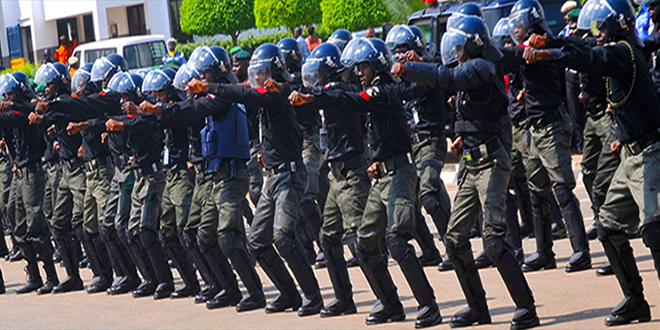
Policemen
Policemen
Share


The Federal Capital Territory (FCT) Police Command has recorded a major breakthrough in its fight against kidnapping with the arrest of six suspected kidnappers and the recovery of ₦8.25 million allegedly paid as ransom for the release of an abducted woman in Abuja.

The arrests were carried out by operatives of the Command’s Violent Crime Response Unit (VCRU) following a painstaking investigation into the abduction of the victim, who was kidnapped in the Maitama area of the Federal Capital Territory on June 29, 2026.

According to security sources, the kidnappers initially demanded a ransom of ₦20 million from the victim’s family. After negotiations, they reportedly accepted ₦8.25 million before releasing the victim on July 3.

Following the victim’s release, police detectives launched an intensive intelligence-driven investigation, deploying digital tracking and other investigative tools. Their efforts led investigators to Kwan-Kwashe Village in neighbouring Niger State, where the victim was allegedly held during her captivity.

The operation culminated in the arrest of six suspects on July 5 in Suleja, Niger State. The suspects were identified as Ifeoma Nnamchi, 35; Peter Rasheed Onwunumah, 40; Olanipekun Anuoluwa, 46; Jemimah Monday, 25; Gabriel Nnamchi, 14; and Stanley Nnamchi, 17.

During the operation, police recovered the full ₦8.25 million ransom allegedly paid to secure the victim’s freedom. Officers also recovered two vehicles—a Toyota Corolla and a Toyota Camry—believed to have been used by the syndicate.

Other items recovered include a cutlass, seven pairs of AirPods, assorted jewellery suspected to have been stolen from previous victims, five mobile phones and a laptop.

Preliminary investigations further revealed that two of the suspects had previously been arrested over alleged kidnapping-related offences. Ifeoma Nnamchi was reportedly arrested in 2022, while Olanipekun Anuoluwa had earlier been arrested in 2019 for similar offences.

Investigators believe the criminal syndicate has been operating in several parts of the FCT, particularly along the Kubwa Expressway, Maitama Federal Housing area and surrounding communities since 2024.

The FCT Police Command said investigations are ongoing to identify and apprehend other members of the kidnapping network, while efforts are also being intensified to establish possible links between the suspects and previous kidnapping incidents within the territory and neighbouring states.

The Command reaffirmed its commitment to sustaining intelligence-led operations aimed at dismantling criminal networks and improving security across the Federal Capital Territory.

Continue Reading