Connect with us

Defence and Security

Insecurity: Army to review operations across the Country

Published

on

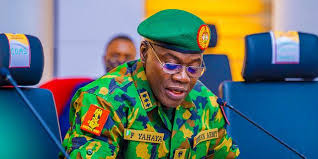
Chief of Army Staff, General Faruk Yahaya
Chief of Army Staff (COAS), Lt.- Gen. Faruq Yahaya
Share


…as COAS conference holds in Sokoto Dec 4-10

The Nigerian Army is set to review its various operations across the country with a view to advancing its fight against criminal activities.

The Director, Army Public Relations, Brigadier General Onyema Nwachukwu stated this in Abuja during the news briefing on the fourth quarter Chief of Army Staff (COAS) Conference scheduled to take place in Sokoto State this week from 4 December till 10.

The conference is themed, “Building a Professional Nigerian Army for the 21st Century Security Environment.”

The Nigerian army said it is reviewing its operations to rout terrorists, bandits, kidnappers, separatist groups, and other criminal gangs terrorising the peace in the country.

It said the fluidity of the threats and security situation in the country, requires dynamism to continually review its operational strategies.

According to General Nwachukwu, the conference will offer a reappraisal of the administrative affairs of the Nigerian Army and evaluate and comprehensively review ongoing operational engagements of the Nigerian Army in all theatres of operations across the six geo-political zones within the year.

Nwachukwu said this would provide the Nigerian Army with an in-depth insight to take far-reaching decisions that will be result oriented towards achieving its set objective of addressing the multifaceted security challenges in the country.

The conference would also create an opportunity for the Chief Of Army Staff to have a face-to-face interaction with all the General Officers Commanding, field commanders, and other senior officers to provide possible guidance on enhancing the army activities and operations.

He said, “The conference would also create an opportunity for the COAS to have a face-to-face interaction with all the General officers Commanding, field commanders and other senior officers to provide possible guidance on enhancing NA activities and operations”.

“I must acknowledge that the fluidity of the threat situation requires dynamism to continually review our operational strategies. Hence, this conference offers a veritable platform to deliberate on ways and means through which the NA would continue to enhance national security. I, therefore, reiterate the commitment and resolve of NA troops to continue to discharge their duties professionally and proficiently within its constitutional mandate. We will also be resolute in upholding our values of courage, professionalism, sacrifice, respect, discipline and unflinching loyalty to duly constituted authority.

Nwachukwu, while noting that the Nigerian Army, has demonstrated its capacity and zeal in defending Nigeria’s territorial integrity and sovereignty against external aggression and giving aid to civil authority in mitigating internal security challenges in the country over the years, said “This is further demonstrated in the purposeful leadership drive of the Chief of Army Staff, Lieutenant General Faruk Yahaya (CFR) whose efforts have tremendously enhanced the capacity and dexterity of troops in the onslaughts against terrorists, bandits and other criminal elements in the country”.

He said “With his transformational and selfless leadership drive, troops have continued to decimate Boko Haram/ISWAP terrorists in the North East, leading to the obliteration of terrorists high profile commanders, foot soldiers and their hideouts. This has led to mass surrendering of terrorists and their family members in droves. Troops have also maintained this feat, through their operational engagements in other theatres of operations in other parts of the country, with significant successes recorded. These feats would not have been achieved without the support and collaboration of law-abiding Nigerians, sister services and other security agencies, the political leadership and the international community”.

He said the opening ceremony will feature a lecture titled “Proliferation of Regional/State Security Outfits in Nigeria: Challenges and Prospects” by Gen Martin Luther Agwai (retired), former Chief of Defence Staff.

“On 6 December 2022, there shall be commissioning of various Nigerian Army Civil Military Cooperation projects in various communities in Sokoto State. Furthermore, the conference will review decisions taken at the Chief of Army Staff third quarter conference, while series of briefs and other updates bothering on various activities of the NA will be presented and deliberated upon from 7 to 8 December.

“The NA will also seize the opportunity to recognise and appreciate eminent Nigerians who have in no small measure supported the NA.

Continue Reading
Click to comment

Leave a Reply

Your email address will not be published. Required fields are marked *

Defence and Security

Nigeria Climbs to 4th in 2025 Global Terrorism Index as Attacks Surge by 43%

Published

on

Islamic State West Africa Province
Share

Nigeria has risen to fourth place in the 2025 Global Terrorism Index (GTI), following a sharp escalation in terrorist activities across the country, according to a new report by the Institute for Economics & Peace.

The report indicates that terrorist attacks in Nigeria increased by 43 percent in 2025, with 171 incidents recorded compared to 120 in 2024. This surge has pushed the country up two places from its previous sixth position.

Nigeria now ranks behind Pakistan, Burkina Faso, and Niger Republic, which occupy the top three positions on the index.

According to the findings, the majority of attacks were carried out by Islamic State West Africa Province and Boko Haram, with both groups accounting for 80 percent of terrorism-related deaths in the country.

The report further highlights a growing human toll, with fatalities rising by 46 percent to 750 deaths in 2025—the highest level recorded since 2020. In addition, 243 people were injured in the attacks, bringing the total number of terrorism-related deaths in Nigeria since 2007 to 12,581.

Geographically, violence remained heavily concentrated in Borno State, which accounted for 67 percent of all attacks and 72 percent of total deaths recorded during the year.

Civilians continued to bear the brunt of the violence, representing 67 percent of those killed, while military personnel accounted for 19 percent. The report notes a sustained shift toward increased targeting of civilians over the past five years.

The GTI attributes the worsening security situation to ongoing internal instability and intensified clashes between ISWAP and Boko Haram, underscoring persistent challenges in counterterrorism efforts across Nigeria.

Continue Reading

Defence and Security

Nigeria Must Move Beyond Kinetic Approach to Defeat Terrorism – Senate Leader, Bamidele

Published

on

Senate Leader, Senator Michael Opeyemi Bamidele
Share


The Senate Leader, Opeyemi Bamidele, has called for a strategic shift in Nigeria’s fight against insecurity, urging authorities to complement military operations with sustained investments in human capital development and social cohesion.

In his Eid al-Fitr message to Muslims across the country, Bamidele congratulated Nigerians on the successful completion of Ramadan, describing the holy month as a period marked by sacrifice, reflection, charity, and devotion to God.

He noted that the lessons of Ramadan—tolerance, compassion, and self-discipline—should guide both individual conduct and government policies, particularly at a time of global uncertainty and domestic security challenges.

The Senate Leader referenced recent security incidents, including bomb explosions in Maiduguri, which resulted in loss of lives and injuries, stressing that such tragedies underscore the urgent need for a more comprehensive approach to national security.

While commending Nigeria’s defence, intelligence, and security agencies for their resilience, Bamidele emphasised that reliance on military force alone—often described as a kinetic approach—cannot guarantee lasting peace.

“Time and experience have shown that kinetic operations alone cannot guarantee the peace and stability of our nation,” he stated.

He therefore advocated a broader, multi-dimensional strategy that addresses the root causes of violent extremism.

According to him, religious leaders must promote tolerance and desist from teachings that could incite radicalisation, while socio-cultural leaders should prioritise dialogue in resolving inter-ethnic conflicts rather than resorting to violence.

Bamidele also highlighted the role of subnational governments, noting that the fight against insecurity is not solely the responsibility of the federal government. He urged state governments to prioritise human capital development by investing in education, healthcare, nutrition, and social protection systems.

He added that creating opportunities for innovation and creativity among young people would help reduce vulnerability to extremist ideologies.

At the legislative level, the Senate Leader disclosed that the National Assembly is pursuing a multi-pronged approach to strengthen national security and development.

He revealed that the Senate has constituted an ad-hoc committee on a National Security Summit aimed at identifying the root causes of insecurity across the country. He also pointed to the ongoing review of the 1999 Constitution, which he said would include amendments to grant subnational governments greater authority in managing security within their jurisdictions.

Bamidele reaffirmed the commitment of the National Assembly to enacting laws that support the fight against terrorism and violent extremism.

He concluded by extending warm Eid al-Fitr wishes to Muslims nationwide, urging Nigerians to embody the values of peace, unity, and mutual respect beyond the Ramadan season.

Continue Reading

Defence and Security

Tinubu Pushes UK Alliance to Counter Sahel-Linked Terror Threats

Published

on

President Bola Tinubu with King Charles
Share


President Bola Ahmed Tinubu has called for deeper security cooperation with the United Kingdom to combat rising terrorism threats and strengthen regional stability across West Africa.

Speaking at a state banquet at Windsor Castle, Tinubu warned that the growing influence of extremist groups operating from the Sahel poses significant risks to Nigeria and neighbouring countries.

He stressed that Nigeria bears a “major responsibility” in maintaining stability in the region and requires sustained international partnerships to address evolving security challenges, including cross-border insurgency and terrorism financing.

The President noted that intelligence sharing, counterterrorism coordination, and capacity building would be key areas of collaboration in his upcoming talks with UK Prime Minister Keir Starmer.

Tinubu also highlighted the longstanding strategic ties between Nigeria and the UK, particularly in governance, institutional development, and defense cooperation. He said the partnership remains critical in addressing modern security threats that transcend national borders.

While acknowledging historical links through the Commonwealth of Nations, Tinubu emphasized that current realities demand a stronger, security-focused alliance to counter instability emanating from the Sahel region.

Despite ongoing threats, the President expressed confidence in Nigeria’s resilience, reaffirming the country’s commitment to working with global partners to ensure peace, security, and sustainable development in West Africa.

Continue Reading