Connect with us

Health

FCT: Centre offers free medical care to 700 indigent women, children

Published

on

FCTA
FCTA
Share

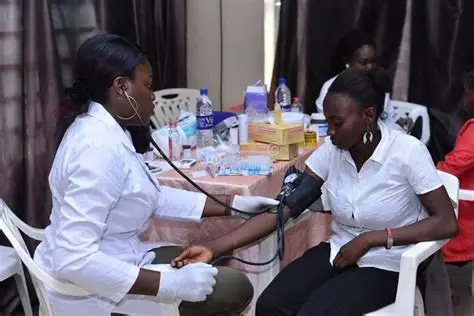
The International Centre for Islamic Culture and Education (ICICE) has offered free medical treatment to over 700 indigent women, children and the elderly in Karmo, Abuja.

Our Correspondent reports that the centre is the custodian of Al-Noor Mosque, Abuja.

Addressing newsman during the exercise, Dr Mohammed Ibrahim, Chairman of the Medical Outreach Committee, said most of the beneficiaries have illnesses that are easily treatable, but lack access to healthcare.

“We have been doing this free medical outreach regularly until the time when we had the outbreak of COVID-19 pandemic and we had to slow down.

“During this month of ramadan this is our second outing. This is a community which deserves medical care, a lot of them have illnesses that are easily treatable, but unfortunately they have no access to healthcare.

“We are here to help where we can and people have come out in large numbers and our volunteer doctors, nurses and others are ready to help.

“We are going to be here until we see everyone who has a complain,” he added.

Ibrahim, who is also a member of the Advisory Board of ICICE, said those with serious medical challenges would be referred to appropriate health facilities under the sponsorship of the centre.

“It is very important for communities and organisations like ours to go out to help people in need, to complement government efforts,” he added.

The centre’s Director-General, Dr Kabir Kabo-Usman, said the over 700 people who turned up included persons with disabilities.

He explained that Karmo was chosen based on need assessment earlier conducted by the centre, in line with its mandate of offering assistance in the areas of poverty reduction and healthcare.

“These people don’t have adequate drinking water, they don’t have good roads and they don’t have good schools.

“We are doing our best to give them all the necessary medical assessment, diagnosis, treatment and relevant medication and medicaments that they require.

“Not only that, we also make sure that they are referred to general hospitals, and those that are tremendously urgent, the centre takes care of that; that is part of our responsibility,” Kabo-Usman added.

Head of the Medical Team, Dr Amina Kumaliya, said most of those attended to were hypertensive and diabetic, while some have malaria, peptic ulcer, respiratory tract infection and diarrhea.

“We saw one patient that has hernia. So we intend to help the patient to do follow up and if there is any need of surgery.

“We also saw one that has breast tumor which we will also inform the management of the ICICE so that we can follow up the patient to a tertiary hospital to take care of it,” she said.

The Head of Hausa community in Karmo, Malam Bashir Musa, expressed gratitude to the ICICE for the gesture.

“The free medical assistance to the community is the first of its kind, we have never received this kind of medical assistance, that is why you see the large turn out of people,” Musa said.

Continue Reading
Click to comment

Leave a Reply

Your email address will not be published. Required fields are marked *

Health

Nigeria Commence Development of First National Rehabilitation and Assistive Technology Strategic

Published

on

Share

The Federal Government has commenced the development of Nigeria’s first National Rehabilitation and Assistive Technology Strategic Plan aimed at strengthening disability-inclusive healthcare and expanding access to rehabilitation services nationwide.

The initiative was unveiled on Tuesday in Abuja during a three-day stakeholders’ zero draft meeting on the proposed national rehabilitation and assistive technology strategic plan.

Speaking at the event, Dr Ahmed Ozi, Director of the Family Health Department, Federal Ministry of Health and Social Welfare, described the exercise as Nigeria’s first coordinated effort on rehabilitation services.

He said the initiative would establish a national framework for rehabilitation and assistive technology in the country.

Ozi said the strategic plan reflected the ministry’s commitment to achieving Universal Health Coverage by ensuring that persons with disabilities had equitable access to healthcare services.

He said that the initiative aligned with the World Health Organization (WHO) guidance on rehabilitation and disability-inclusive healthcare.

According to him, the strategic plan will serve as a roadmap for strengthening rehabilitation services and expanding access to assistive technology across the country.

“Disability can affect anyone at any stage of life. We must therefore promote empathy, protection and support for all citizens requiring rehabilitation services,” he said.

Ozi added that the strategy would guide rehabilitation programmes and strengthen disability-inclusive health policies nationwide.

He acknowledged that the document remained a zero draft and expressed confidence that stakeholders’ contributions would improve its quality and implementation potential.

The director urged participants to provide technical expertise and recommendations to ensure the development of a comprehensive and practical national strategy.

Also speaking, Head of the Georgia Society for Healthcare Engineers (GASHE), Dr Umeh Sunday, said work on the national rehabilitation strategic plan began following the establishment of a Rehabilitation Technical Working Group by the ministry.

Sunday explained that Nigeria previously lacked a federal rehabilitation policy, leaving states without a coordinated national framework for rehabilitation services.

He said the proposed strategy aligned with the WHO Rehabilitation 2030 initiative and the World Health Assembly Rehabilitation Strategy 2025–2035.

According to him, rehabilitation is an essential component of healthcare and should commence whenever patients require such services rather than after complications arise.

Sunday said that the Technical Working Group conducted nationwide situational assessments using WHO guidelines before drafting the strategy.

“Preliminary drafts have been prepared and are undergoing stakeholder review to reflect Nigeria’s rehabilitation priorities and healthcare realities,” he said.

He added that the workshop would further refine the document before endorsement, official inauguration and nationwide implementation.

Sunday urged stakeholders to make meaningful contributions that would strengthen rehabilitation services and improve outcomes for Nigerians requiring such care.

The Regional Rehabilitation Consultant for Africa, Dr Nassib Tawa, said the development of the strategic plan followed nearly two years of preparation and consultations.

Tawa said the strategy was informed by findings from a national situational assessment of rehabilitation services across Nigeria.

“The assessment identified major challenges, including the absence of a national rehabilitation policy and inadequate financing.

“It also revealed infrastructure deficits, limited clinical spaces and shortages of trained rehabilitation professionals nationwide,” he said.

According to Tawa, one in five Nigerians could benefit from rehabilitation services or assistive products.

He said the government would prioritise realistic and achievable interventions within the proposed five-year implementation period.

Tawa explained that the strategic plan would run from 2027 to 2031 and outline national priorities, objectives, vision, mission and implementation targets.

“Five technical task teams will review key workstreams before consolidating recommendations into the final draft.

“The strategy will promote a shared national understanding of quality rehabilitation benefiting every Nigerian requiring such services,” he said.

He added that the plan would strengthen partnerships, improve coordination and expand financing, infrastructure, workforce development and access to assistive technology across the country

Continue Reading

Health

NMA Inaugurates Newly Elected Executives in Zamfara

Published

on

Share

The Nigerian Medical Association NMA, Zamfara chapter, on Saturday inaugurated newly elected executives to steer the affairs of the association for the next two years in the state.

In his acceptance speech, Salahudden pledged to provide transparent and inclusive leadership aimed at advancing the interests of medical practitioners and strengthening healthcare delivery across Zamfara.

He said his administration would collaborate with relevant stakeholders to promote the medical profession and support initiatives that would improve the health sector in the state.

The new chairman also appealed to members of the association and other stakeholders to support his leadership to enable it achieve its goals and objectives.

Earlier, the outgoing chairman, Dr Ibrahim Hano, commended medical doctors in the state for the support and cooperation extended to his administration throughout its tenure.

Hano said his leadership recorded significant achievements, particularly in promoting members’ welfare, unity, mutual understanding and professional harmony among doctors across the state.

According to him, the association under his stewardship maintained cordial relationships with key stakeholders, especially the state government, resulting in improvements in healthcare service delivery.

Administering the oath of office, former NMA Chairman, Dr Abubakar Danladi, urged the newly elected executives to justify the confidence reposed in them by members.

Danladi advised the new leadership to carry all members along and promote teamwork, unity, peace and stability within the association for sustained progress and professional development.

The officials were elected during the association’s 2026 Annual General Meeting and Scientific Conference held in Gusau, the state capital.

The election was conducted under the supervision of the electoral committee chaired by Dr Ibrahim Halilu, who oversaw the voting process and declaration of results.

Dr Murtala Salahudden, Incident Manager of the Polio Emergency Operations Centre, Gusau, emerged chairman after polling 110 votes to defeat Dr Bashir Isa of Yariman Bakura Specialist Hospital, Gusau, who secured 55 votes.

Six other executive officers emerged unopposed and were subsequently inaugurated to serve alongside the chairman in administering the affairs of the association during the tenure.

Continue Reading

Health

U.S.-Based Nigerian Scholar, Nwajiaku, Team Build AI Robot for Jaw, Bone Surgery in U.S.

Published

on

U.S.-based Nigerian scholar and control engineer, Mr Kenechukwu Nwajiaku
Share
A U.S.-based Nigerian scholar and control engineer, Mr Kenechukwu Nwajiaku, alongside his research team, has developed an intelligent robotic control system that bends and twists skeletal fixation plates to fit patients’ jaws or bones precisely.

Nwajiaku disclosed this in a telephone interview with the News Agency of Nigeria (NAN) in Lagos on Saturday.

He said the innovation combined robotics, machine learning, and advanced control technology to shape patient-specific surgical plates accurately, potentially making reconstructive surgery easier and more precise.

The research team—comprising scholars from Case Western Reserve University and The Ohio State University—includes Nwajiaku, Ethan Regal, Tyler Babinec, Yi Jin, Brian Thurston, Glenn Daehn, Changyong Cao, David Dean, Kenneth Loparo, David Hoelzle, and Robert X. Gao.

“The system uses a Gaussian Process-Enhanced Model Predictive Control framework, known as GP-MPC, to predict how a fixation plate will respond while being bent and twisted.

“Reconstructive surgeons use fixation plates to restore damaged facial and jaw bones following trauma, cancer, congenital conditions or surgical treatment.

“These procedures can affect a patient’s appearance and essential functions, including speaking, chewing, breathing and swallowing, making accurate plate shaping important to surgical outcomes,” he said.

Nwajiaku explained that surgeons often shaped the plates manually to match each patient’s anatomy.

However, the process can be difficult and time-consuming because the metal may partially return toward its original form after force is removed, a behavior known as “springback”.

“Our system predicts the plate’s response, compensates for springback and determines the deformation required to produce the desired shape.

“Working in control and automation taught me that machines do not always behave in the real world exactly as mathematical models predict.

“This inspired me to combine advanced control systems with machine learning so that machines can learn from data, account for uncertainty and make more accurate decisions,” he added.

The Nigerian-born engineer noted that the framework combines physics-based modeling with machine learning to improve the robot’s accuracy and consistency.

“Physics helps us understand how the system should behave, while machine learning accounts for what the simplified model may be missing.

“Combining them creates a control system that is better equipped to handle the nonlinear and uncertain behaviour of the material.

“The peer-reviewed study conducted at Case Western Reserve University evaluated the technology through computer simulations and experiments on a physical robotic testbed.

“In combined bending-and-twisting tests, the GP-enhanced system improved deformation accuracy by approximately 22 per cent along the bending axis and 34 per cent along the twisting axis compared with conventional Model Predictive Control.

“The system also recorded low variability during stochastic simulations, suggesting reliable performance under uncertain conditions,” he said.

Nwajiaku pointed out that further development and clinical validation would be required before the technology could be introduced into routine surgical practice.

He, however, noted that the findings demonstrate the potential of artificial intelligence and robotics to support the precise and automated production of patient-specific surgical components.

“I am inspired by the possibility that the same principles used to make industrial machines more intelligent and precise can be applied to challenges that directly affect people’s lives,” he said.

Nwajiaku, whose research interests include artificial intelligence, machine learning, advanced control systems, robotics, digital-twin technologies, and intelligent automation, added that similar technologies could support other medical and industrial processes requiring precise material shaping and reliable decision-making.

“I want my work to contribute to intelligent systems that solve real problems and create benefits beyond a single laboratory or organisation,” Nwajiaku said.

The research points toward a future in which surgical expertise, robotics, physics-based prediction, and machine learning converge to enable safer, more precise, and patient-specific reconstructive procedures.

Continue Reading