Uncategorized
Comment maîtriser le paiement multi‑devise dans les casinos mobiles : guide technique et programme de fidélité
Published
5 months agoon
By
News EditorLe marché des jeux d’argent en ligne connaît une évolution fulgurante : les plateformes ne se contentent plus d’accepter l’euro ou le dollar, elles intègrent désormais plus d’une dizaine de monnaies fiat, des cryptomonnaies comme le Bitcoin et des portefeuilles électroniques tels que Skrill ou Neteller. Cette diversification répond à une clientèle véritablement globale, qui veut jouer depuis son smartphone, que ce soit dans un café de Paris, un bar de Tokyo ou un salon de streaming live à New York.
Dans ce contexte, la fluidité du paiement devient un critère de choix aussi décisif que le taux de redistribution (RTP) d’un jeu. Un joueur qui doit attendre plusieurs minutes pour convertir ses fonds ou qui voit son solde fluctuer à cause de frais cachés risque d’abandonner rapidement. Pour approfondir le sujet, Esportsinsider propose un panorama des nouveaux casinos qui adoptent ces solutions : https://esportsinsider.com/fr/jeux-dargent/nouveau-casino-en-ligne.
Les programmes de fidélité, quant à eux, offrent une passerelle entre la technique du paiement et l’expérience utilisateur. En transformant chaque dépôt, chaque conversion ou chaque mise en points de fidélité, ils encouragent la rétention et augmentent la valeur vie du joueur. Ce guide détaille les étapes essentielles pour mettre en place un système de paiement multi‑devise robuste sur mobile, tout en concevant un programme de fidélité qui s’adapte à toutes les monnaies.
1. Les bases du système de paiement multi‑devise
Un système de paiement multi‑devise permet à un joueur de déposer, jouer et retirer des fonds dans la monnaie de son choix, sans passer par une conversion manuelle à chaque transaction. Le principe repose sur une couche d’abstraction : le portefeuille du casino conserve les soldes dans plusieurs monnaies parallèles et applique les taux de change en temps réel lorsqu’une opération implique deux devises différentes.
Parmi les devises supportées, on retrouve les monnaies fiat classiques (EUR, USD, GBP), les cryptomonnaies (BTC, ETH, USDT) et les e‑wallets (PayPal, Apple Pay, Google Pay). Chaque catégorie apporte ses propres exigences : les fiat nécessitent des accords bancaires, les cryptos exigent des nœuds blockchain et les e‑wallets demandent des API de tiers.
Les avantages sont multiples. Les opérateurs élargissent leur marché, réduisent le taux d’abandon lié aux frais de conversion et améliorent la conformité locale grâce à des passerelles qui respectent les régulations de chaque pays. Les joueurs bénéficient d’une expérience sans friction, d’un meilleur contrôle de leur budget et d’opportunités de bonus spécifiques à la devise utilisée, comme un bonus de bienvenue de 100 % en Bitcoin ou 50 % en euros.
2. Intégrer les passerelles de paiement mobiles
Sélectionner la bonne passerelle
Choisir une passerelle adaptée requiert de comparer trois critères majeurs : la sécurité (certifications PCI‑DSS, chiffrement TLS 1.3), la latence (temps de réponse moyen inférieur à 300 ms pour les dépôts mobiles) et la couverture géographique (présence de banques locales dans les 20 % de marchés cibles). Par exemple, Worldpay offre une large portée en Europe et en Amérique du Nord, tandis que PayU se démarque en Asie du Sud‑Est.
Implémentation technique
Deux approches sont possibles : les API REST, qui permettent d’appeler les services de paiement via des requêtes HTTP standard, et les SDK natifs, qui offrent des bibliothèques pré‑intégrées pour iOS et Android. Les API REST sont idéales pour une architecture micro‑services, tandis que les SDK natifs réduisent la charge de développement UI et gèrent automatiquement les tokens d’authentification (OAuth 2.0, JWT).
Étapes d’implémentation typiques
1. Créer un compte marchand et récupérer les clés API.
2. Configurer les webhooks pour recevoir les notifications de statut.
3. Implémenter le flux de tokenisation du paiement.
4. Tester les scénarios de dépôt, retrait et remboursement.
Tests et conformité
Avant de passer en production, chaque passerelle doit être testée dans un environnement sandbox. Les tests portent sur les cas limites (montants supérieurs à 10 000 USD, devises exotiques) et sur la conformité PCI‑DSS 4.0. Il faut également vérifier les exigences locales : la législation française impose le respect de la directive PSD2, tandis que la Malaisie requiert une licence de jeu en ligne pour les transactions en Ringgit.
3. Gestion des taux de change en temps réel
Les taux de change doivent provenir de sources fiables pour éviter les déséquilibres financiers. Les API de marché comme Open Exchange Rates, CurrencyLayer ou les agrégateurs de données blockchain offrent des mises à jour toutes les 30 secondes.
Algorithmes de conversion
Un algorithme typique calcule le taux de base, y applique une marge fixe (souvent 0,5 % à 1 %) et ajoute une commission variable selon le volume du joueur. Par exemple, un joueur VIP qui convertit 5 000 EUR en Bitcoin verra une marge réduite à 0,2 % pour encourager la fidélité.
Impact sur le solde et les bonus
Les conversions influencent directement le solde affiché et les conditions de mise (wagering). Si un joueur reçoit un bonus de bienvenue de 20 EUR et le convertit immédiatement en USDT, le casino doit recalculer le wagering en fonction du taux appliqué au moment du dépôt. Une bonne pratique consiste à « geler » le taux au moment de l’octroi du bonus, afin d’éviter les réclamations liées à la volatilité des devises.
4. Sécurité des transactions transfrontalières
Chiffrement end‑to‑end
Toutes les communications entre le client mobile et les serveurs de paiement sont chiffrées avec TLS 1.3, garantissant une confidentialité maximale et une protection contre les attaques de type man‑in‑the‑middle. Les données sensibles (numéros de carte, adresses de portefeuille) sont stockées sous forme de jetons (tokens) et jamais en clair.
Authentification forte
Le 2FA devient la norme : un code à usage unique envoyé par SMS ou une notification push via une application d’authentification. Certains opérateurs intègrent la biométrie (empreinte digitale, reconnaissance faciale) pour valider les retraits supérieurs à un seuil prédéfini (par ex. 1 000 USD).
Détection de fraude multi‑devise
Les systèmes de prévention utilisent l’analyse comportementale (fréquence des dépôts, géolocalisation) et les listes noires de wallets associés à des activités illicites. Un moteur de rules peut bloquer automatiquement les transactions qui dépassent un ratio de conversion inhabituel (par ex. 10 EUR → 0,001 BTC en moins de 5 secondes).
5. Programme de fidélité adapté au multi‑devise
Structuration des points
Chaque euro, dollar ou Bitcoin dépensé génère un nombre de points proportionnel à la valeur réelle de la transaction. Par exemple, 1 € = 1 point, 1 USD = 0,9 point, 0,00002 BTC = 1 point. Le système normalise ainsi les contributions, quel que soit le moyen de paiement.
Bonus de conversion et promotions exclusives
Les joueurs qui effectuent une conversion entre deux devises bénéficient d’un bonus de conversion de 5 % supplémentaire sur leurs points de fidélité. Des promotions « cash‑back en crypto » peuvent être lancées lors d’événements de streaming live, offrant un pourcentage de remise en Bitcoin sur les pertes nettes.
Tableau de niveaux et de récompenses
| Niveau | Points requis | Avantages | Bonus de bienvenue |
|---|---|---|---|
| Bronze | 0‑2 000 | Support standard | 10 % en crédits |
| Argent | 2 001‑5 000 | Retraits accélérés | 20 % en crédits + 5 % de points bonus |
| Or | 5 001‑10 000 | Gestionnaire de compte dédié | 30 % en crédits + 10 % de points bonus |
| Platine | >10 000 | Cashback quotidien, invitations à des tournois VIP | 50 % en crédits + 15 % de points bonus |
Ce tableau montre comment la fidélité peut être décorrélée de la devise, tout en offrant des incitations ciblées.
6. Optimiser l’expérience mobile grâce aux wallets intégrés
Avantages d’un wallet natif
Un wallet intégré au sein de l’application mobile stocke plusieurs monnaies simultanément, éliminant le besoin de rediriger l’utilisateur vers une page externe. Cela réduit le temps de dépôt à moins de 2 secondes et permet un cash‑out en un clic grâce à des API de paiement pré‑autorisées.
UX/UI
L’interface doit afficher clairement chaque solde avec son symbole monétaire (€, $, BTC). Un onglet « Historique des conversions » montre les taux appliqués, les marges et les dates, offrant transparence et confiance. Les notifications push informent l’utilisateur lorsqu’un taux favorable apparaît, incitant à convertir au bon moment.
Cas d’usage
- Dépôt instantané : le joueur sélectionne « Bitcoin », le wallet crée un QR code, le scanner via une appli de portefeuille, le paiement est confirmé en 1,2 s.
- Cash‑out en un clic : le joueur appuie sur le bouton « Retirer tout », le système utilise le solde principal (ex. euros) et le convertit automatiquement en USDT, puis le transfère vers le wallet externe.
7. Analyse des données et personnalisation des offres
Collecte et agrégation
Les métriques clés comprennent le montant total dépensé, la devise utilisée, la fréquence des conversions et le taux de rétention mensuel. Ces données sont agrégées dans un data‑lake sécurisé, puis analysées via des tableaux de bord Power BI ou Tableau.
Segmentation
Les joueurs sont segmentés en fonction de leur profil :
– Convertisseurs fréquents : plus de 5 conversions par mois, sensibles aux bonus de conversion.
– Déposants fiat : préfèrent les euros ou dollars, réactifs aux tours gratuits en cash.
– Crypto‑enthousiastes : utilisent principalement BTC/ETH, attirés par les jackpots en crypto.
IA et offres ciblées
Des modèles de machine learning prédisent la probabilité de churn et recommandent des promotions personnalisées. Par exemple, un joueur qui n’a pas converti depuis deux semaines reçoit une offre « double points de fidélité sur la prochaine conversion ». Cette approche augmente la rétention de 12 % en moyenne selon les tests internes.
Conclusion
Maîtriser le paiement multi‑devise sur les casinos mobiles repose sur une infrastructure technique solide, une sécurité irréprochable et une gestion dynamique des taux de change. En couplant ces éléments avec un programme de fidélité pensé pour toutes les monnaies, les opérateurs créent une expérience fluide qui transforme chaque dépôt en opportunité de rétention. Les meilleures pratiques présentées – sélection rigoureuse des passerelles, intégration de wallets natifs, analyses IA et offres personnalisées – permettent aux casinos de rester compétitifs dans un paysage où le joueur attend rapidité, transparence et récompenses pertinentes.
Les acteurs du secteur sont invités à appliquer ces recommandations, à consulter des ressources comme Esportsinsider pour rester informés des évolutions du marché, et à tester continuellement leurs flux afin d’offrir le meilleur service possible aux joueurs du monde entier.
You may like
Uncategorized
FG unveils New Reforms to Tackle Almajiri, Out of School Children
Published
1 week agoon
August 24, 2026
The Federal Government has unveiled new reforms aimed at ensuring every Nigerian child returns to school and acquires relevant knowledge and skills.
Special Adviser to the Minister of Education on Almajiri, and Out of School Children, Dr Balarabe Kakale disclosed this in Kaduna on Monday while speaking at a National Education Sector Renewal Initiative (NESRI) advocacy and stakeholders engagement on Almajiri and out-of-school children.
He said the Federal Ministry of Education has introduced transformative policies to address challenges confronting Almajiri, out-of-school and other non-formal education systems.
According to him, the reforms are designed to strengthen coordination between federal and state agencies working in the education and out-of-school subsectors.
He said the policies were anchored on five pillars, including foundational literacy, numeracy, vocational and technical education, digital education and civic education.
Kakale said proper implementation of the policies by states would ensure that no Nigerian child was left without access to education.
He urged states to domesticate the National Commission for Almajiri and Out-of-School Children Education Act according to their peculiar educational challenges.
He also called for domestication of policies on Almajiri education, non-state schools, alternative pathways and Accelerated Basic Education Programme.
Kakale commended the Kaduna Government for implementing several reforms through the Reaching Out of School Children (ROSK) project.
He described Kaduna as a model that could provide lessons for national scale-up of interventions addressing out of school children.
The special adviser said the Federal Government was promoting data sovereignty through the Nigerian Education Data Infrastructure and other digital education management systems.
He said the initiative would ensure that every child, school, teacher and infrastructure gap was properly captured for effective policy interventions.
Kakale said Nigeria currently had no final figure for out-of-school children, stressing that reliable and verifiable data remained critical to solving the challenge.
He said the Federal Government would no longer depend on third-party estimates, but would track children from enrolment through retention and academic progress.
The special adviser urged North-West states to embrace federal education policies and digital data initiatives to accelerate efforts to return children to school.
He expressed optimism that coordinated implementation would help Nigeria achieve its goal of becoming a leading nation in Africa.
Representing the Executive Secretary of the National Commission for Almajiri and Out of School Children Education, Malam Halliru Musa Halliru said the commission was committed to transforming Almajiri education.
Halliru said the commission had developed a 10 year strategic plan for 2025–2035 to provide coordinated and sustainable interventions in Almajiri and out of school education.
He said the National Policy on Enhancement of Almajiri Education sought to strengthen traditional education through literacy, numeracy, vocational training and quality assurance.
According to him, the policy seeks to build bridges between traditional and modern education without discarding the religious and cultural values of the Almajiri system.
Halliru said about 200 Almajiri learners at the Tinubu Legacy Skills Training Institute in Kaduna had received Arabic, English, vocational and practical skills training.
He said the learners had also excelled in examinations conducted by the National Board for Arabic and Islamic Studies.
The commission’s representative said 119 learning centres had been established nationwide to support Almajiri learners and out of school children.
He added that the commission had mapped more than 700,000 out of school children to support targeted interventions and enrolment.
Halliru said the commission was also collecting comprehensive data on Tsangaya centres to improve planning, support, coordination and quality assurance.
He said the commission had established offices in all states and the Federal Capital Territory to strengthen collaboration and monitoring.
Prof. Abubakar Sambo, Kaduna State Commissioner for Education, said the challenge of Almajiri and out of school children required coordinated action by governments and stakeholders.
Sambo said poverty remained a major factor forcing children out of school, particularly in rural and peri urban communities.
He said some parents also sent very young children to Almajirai, describing the practice as a growing challenge in northern states.
The commissioner urged participants to carefully study the federal policies and develop strategies for implementing them across states and local governments.
He identified accurate data on out of school children as critical to successful planning and intervention.
Sambo said Kaduna State had fully embraced the Federal Government’s policies and remained committed to addressing the out-of-school children challenge.
Mr Ezra Angai, Coordinator of the Kaduna ROOSC project, said the state had adopted a holistic approach to returning children to learning.
Angai said the project was designed to return 100,000 out of school children to education through formal schools and alternative learning pathways.
He said Kaduna had mapped 187,912 out of school children across its 23 local government areas.
According to him, the project had established alternative learning systems, including Accelerated Basic Education Centres and interventions within Tsangaya schools.
Angai said the state had signed memoranda of understanding with 25 Tsangayas, reaching 6,326 learners, while plans were underway to engage 50 more.
He said the project would also provide interventions for Tsangayas, recognising them as important learning centres within communities.
The coordinator said 272 schools, comprising new and renovated facilities, were planned under the project, including 102 new schools.
He said six Tsangayas would benefit from the first phase of infrastructure intervention, while 27 others were proposed for the second phase.
Angai said more than 25,000 children had already been returned to learning through the ROOSC project.
He said over 40,000 teaching and learning materials had been distributed, alongside uniforms, textbooks and psychosocial support.
According to him, more than 2,000 children with disabilities had received assistive devices across nine local government areas.
Angai said the project had received support from development partners, including the Islamic Development Bank, Kuwait Fund, UNICEF and Save the Children International.
He said the project also collaborated with Education Above All and the Global Partnership for Education.
He urged stakeholders to sustain collaboration with the Federal Government to strengthen implementation of policies addressing education exclusion.
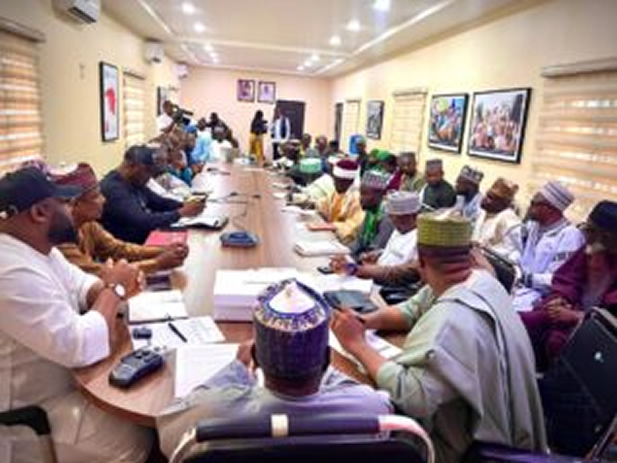
The engagement brought together government agencies, traditional rulers, Islamic scholars, Alarammas, Tsangaya proprietors, civil society organisations and development partners.
Participants also called for stronger collaboration, improved data collection and community mobilisation to ensure vulnerable children returned to learning.
The stakeholders pledged continued support for reforms aimed at integrating Almajiri education with broader educational opportunities and reducing the number of out of school children.
They also stressed the need to move beyond data collection and policies towards practical interventions capable of improving children’s access, retention and learning outcomes.
NAN

Politics
Tinubu, Obi, Adebayo, Sowore: Sign Peace Pact to Shun Violence Ahead Of 2027 Poll
Published
2 weeks agoon
August 19, 2026
Political parties and presidential and National Assembly candidates on Tuesday signed the first National Peace Accord ahead of the 2027 general elections, pledging to shun violence, hate speech, misinformation and personal attacks during campaigns.
The ceremony, organized by the National Peace Committee in partnership with The Kukah Centre, was held in Abuja barely 24 hours before the statutory commencement of public campaigns on Wednesday, August 19, 2026.
Those who signed included President Bola Tinubu, represented by Secretary to the Government of the Federation, Senator George Akume; Nigeria Democratic Congress candidate Peter Obi; Social Democratic Party candidate Adewole Adebayo; and African Action Congress candidate Omoyele Sowore.
Also present were APC National Chairman Prof Nentawe Yilwatda; PRP presidential candidate Donald Duke; Labour Party’s Chibuzor Okereke; Deputy Senate President Barau Jibrin; PRP National Chairman Hakeem Baba-Ahmed; INEC Chairman Prof Joash Amupitan; and IGP Olatunji Disu.

Notable absentees were ADC presidential candidate Atiku Abubakar and APM candidate, Oyo State Governor Seyi Makinde.
General Abdulsalami Abubakar, Chairman of the National Peace Committee, was represented by former Chief of Defence Staff, General Martin Agwai.
Speaking through Akume, President Tinubu urged parties to prioritize national interest and campaign on ideas, not ethnicity or religion.
“Signing this peace accord is a solemn pledge to the Nigerian people that we, as leaders, will put the nation’s interests above personal or partisan ambitions,” he said.
The President said the APC rejects “violence, hate speech, the spread of misinformation, including through artificial intelligence, and all forms of incitement, especially via social media,” and called for peaceful, transparent elections.
INEC Chairman Prof Amupitan described the accord as an effort to define “the ethical boundaries of their contest” before campaigns begin. He warned of an “alarming resurgence” of hate speech, toxic polarization and AI-driven misinformation.
“Electoral contests in a constitutional democracy are not total wars; they are competitive job interviews before the electorate. Nigerians do not want insults; they want solutions,” Amupitan said.
He challenged candidates to focus on the economy, security, infrastructure, healthcare, education and social inclusion. The INEC boss also disclosed that the commission will deploy about 1.4 million ad hoc personnel across more than 176,000 polling units for the 2027 polls.
“Leadership attained at the expense of public peace, institutional integrity, or human life is a hollow victory,” he warned.
According to INEC’s revised timetable, presidential and National Assembly elections will hold on January 16, 2027, while governorship and State House of Assembly elections are scheduled for February 6, 2027.
The National Peace Committee said it has facilitated 30 peace accords since 2015 and established faith-based peace structures in 23 states to support peaceful elections.

Uncategorized
Israel-US-Iran Conflict: NCPC Lifts Ban on Christian Pilgrimage to Israel
Published
1 month agoon
August 1, 2026
The Nigerian Christian Pilgrim Commission (NCPC) has lifted the ban on Christian pilgrimage to Israel following an assessment of the security situation in the Holy Land.
The Executive Secretary of the NCPC, Bishop Stephen Adegbite, announced the decision in a statement on Saturday in Abuja.
Adegbite who was at the Wailing Wall in Jerusalem, Israel, said his declaration followed an on-the-spot assessment of the security atmosphere during his three-day visit to Jerusalem.
”I promised everyone that I will be here to see what is happening in the Holy Land. I have been here in the last three days. The Holy Land is peaceful.
“Jerusalem is at peace and will continue to be at peace.
”Consequently, the ban on Christian Pilgrimage from Nigeria to Israel is hereby lifted from today,” he said.
He further revealled that under the new arrangement, Nigerian pilgrims would only be permitted to travel through the Ben Gurion International Airport in Tel Aviv.
He said that pilgrimage routes through Jordan remained suspended due to ongoing security concerns in that territory.
”Jordan is not safe at the moment, and the commission can not take that risk,” he added.
Adegbite expressed confidence in the safety of Nigerian pilgrims, assuring that every prayer offered in the Holy Land would be answered.
He reassured prospective pilgrims that the commission had maintained a record of safe returns from past exercises and that the 2026 exercise would be no exception.
The NCPC helmsman also offered prayers for national unity, praying for peace for President Bola Tinubu, the First Lady, and government officials across all six geopolitical zones of Nigeria.
The NCPC is the federal agency established to supervise and coordinate the movement of Nigerian Christian pilgrims to holy sites around the world, primarily in Israel, Jordan, and Rome.
The commission had in February, suspended pilgrimage activities to the region following the outbreak of the US-Israel-Iran conflict.
Escalations stemming from the US-Israel-Iran conflict led to heightened security risks across the Middle Eas
This forced international flight disruptions and prompted several governments, including Nigeria, to temporarily halt religious pilgrimages to the region to protect citizens.
The lifting of the ban marks the formal resumption of state-backed and private Christian pilgrimage operations from Nigeria to Tel Aviv for the remainder of the 2026 pilgrimage calendar
Latest News
NLC Requests More Crude For Refineries, Rejecst Petrol Price Hike
ShareThe latest increase in the price of Premium Motor Spirit, popularly known as petrol, has been rejected by the Nigeria...
2 Abuja Doctors, 2 Others Arrested Over Organ Harvesting in Abuja
ShareTwo medical doctors and two other suspects have been arrested in Abuja for organ harvesting by the Nigerian Police Force...
Shettima at 60: VP Rejects Birthday Gifts, Asks Nigerians to Give to the Needy
Share Vice President Kashim Shettima has rejected birthday gifts, elaborate celebrations and other material gestures as he...
Lionel Messi Retires From International Football at 39
ShareLionel Messi has announced his retirement from international football, bringing an extraordinary 20-year career with the Argentina national team to...
10 of 15 Abducted NYSC Members in Kogi Rescued
ShareTen of the 15 National Youth Service Corps (NYSC) members abducted by suspected bandits in Kogi State have been rescued,...