Connect with us

Business & Economy

Cashless Policy: CBN Gives Conditions For Bulk Withdrawal

Published

on

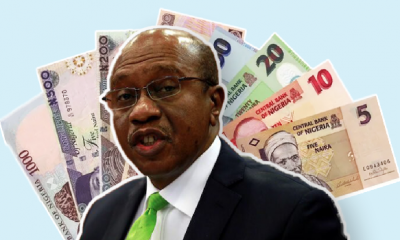
CBN Governor, Godwin Emefiele
CBN Governor Godwin Emefiele
Share

The Central Bank of Nigeria (CBN) has countered claims that its new policy limiting cash withdrawals is targeted at point-of-sales (PoS) agents in particular.

Though the apex bank, on December 6, set the weekly withdrawal limit at N100,000 and N500,000 for persons and organisations, respectively, it made allowances for compelling cases to withdraw up to N5 million or N10 million.

“Let me just correct an impression: not in any way are they (PoS agents) endangered,” the CBN’s Director of Banking Supervision, Mustafa Haruna, said during a live appearance on Channels Television’s Sunrise on Saturday.

“When you do the numbers, how much does a typical agent outlet need in a day? People need to just see this as a policy that is intended at contributing to economic growth and development, and when Nigerians know the enormous benefits inherent in this policy, I’m very sure it will shift mindsets.

“It is typical when you introduce something new, there is always that trepidation and apprehension. But that is why we are also combining it with extensive and sustained campaigns and sensitisation just to ensure that Nigerians understand what is at play, what is involved, and what is in it for them.”

Haruna cited the December 6 circular of the apex bank which stated that in “compelling circumstances,” should an individual or organisation need an amount above the set limit, there are conditions to fulfill.

The CBN had stated that in such instances, not exceeding once a month, withdrawals above the limit shall be subject to processing fees of five and 10 percent for individuals and corporate entities, respectively, in addition to “enhanced due diligence and further information requirements.”

Applicants are also required to upload the following on the CBN’s portal: Valid means of identification of the payee (National ID, International Passport, Driver’s License); Bank Verification Number (BVN) of the payee; and notarised customer declaration of the purpose for the cash withdrawal; senior management approval for the withdrawal by the Managing Director of the drawee, where applicable; and approval in writing by the MD/CEO of the bank authorising the withdrawal.

Haruna explained that the CBN had seen exponential growth in the agent networks around Nigeria, describing them as “quite ubiquitous.”

“There is hardly any nuke or cranny in Nigeria where you go that you won’t see one agent outlet or the other where they do cash-in, cash-out services. Such customers can take advantage of those services,” the CBN director said.

“But to the point about the quantum of naira such a customer would need, of course, this is an evolutionary process; we will get there. And if you have such a need for a high volume of cash, you can always go to your bank to say, ‘Look, this is my business,’ and they will be able to (attend to you).”

According to him, the CBN policy was about expanding the cashless policy first launched a decade ago as a pilot programme in major cities like Lagos and Abuja. He explained that scaling up the policy was necessary due to the high cost of currency management.

“We started since 2012 and we had some charges that you have to pay, although the revised limit and charges are different from what we had. This is not something new. We feel we should take things to a high level if we must make progress, in line with global trends,” he said.


Continue Reading
Click to comment

Leave a Reply

Your email address will not be published. Required fields are marked *

Business & Economy

Tinubu Welcomes Nigeria’s Removal from FATF Grey List, Pledges Continued Financial Reforms
Published

on

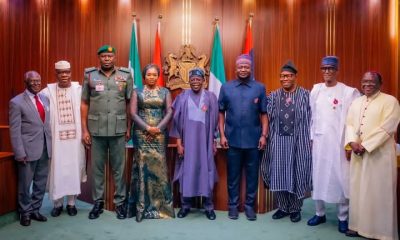
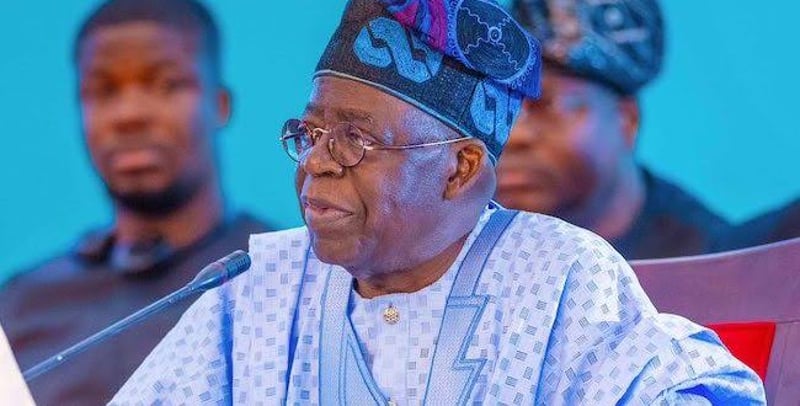
President Bola Tinubu
President Bola Ahmed Tinubu
Share

President Bola Ahmed Tinubu has welcomed the removal of Nigeria from the Financial Action Task Force (FATF) grey list, describing it as a major milestone in the nation’s economic reform and global credibility drive.

The FATF, the world’s foremost body for combating money laundering, terrorist financing, and proliferation financing, announced Nigeria’s delisting on Friday at its plenary session in Paris, France.

The decision formally removes Nigeria from the list of countries under increased monitoring, following the nation’s successful completion of its FATF Action Plan after over two years of sustained reforms and inter-agency coordination.

In a statement issued by his Special Adviser on Information and Strategy, Bayo Onanuga, President Tinubu said the development reflects Nigeria’s progress in strengthening its Anti-Money Laundering and Counter-Financing of Terrorism (AML/CFT) framework.

“Rather than treat our placement on the grey list in 2023 as a setback, we saw it as a call to action,” the President said. “This delisting is a strategic victory for our economy and a renewed vote of confidence in Nigeria’s financial governance.”

The President credited the achievement to far-reaching legal, institutional, and operational reforms implemented under his administration through the Nigerian Financial Intelligence Unit (NFIU), in collaboration with the Attorney-General of the Federation, the Minister of Finance and Coordinating Minister of the Economy, and other key ministries.

Tinubu commended the Director/CEO of the NFIU, Ms. Hafsat Abubakar Bakari, and her team for their diligence and professionalism, as well as the contributions of several ministries, agencies, and private sector representatives who participated in the National Task Force on AML/CFT.

He also acknowledged the support of international partners including France, Germany, the United Kingdom, the United States, the United Nations, and the European Commission, for their technical assistance throughout Nigeria’s reform process.

President Tinubu assured that his administration will sustain and deepen the reforms that led to the country’s delisting.

“This is not just a technical accomplishment,” he said. “It marks the beginning of a new chapter in our financial reform agenda as we continue building a system Nigerians and the world can trust.”

Continue Reading

Business & Economy

Lagos Tops 2024 State Revenue Ranking with ₦1.26 Trillion — NBS Report

Published

on

lagos state logo
Lagos State coat of Arms
Share

Lagos State has retained its position as Nigeria’s highest internally generated revenue (IGR) state in 2024, according to a new report released by the National Bureau of Statistics (NBS).

The report, published on Monday via the NBS X handle, revealed that the 36 states and the Federal Capital Territory (FCT) collectively generated ₦3.6 trillion in 2024, marking a 49.7 per cent increase from ₦2.43 trillion recorded in 2023.

Lagos led the chart with ₦1.26 trillion, followed by Rivers with ₦317.3 billion, and the FCT with ₦282.36 billion. Ogun and Enugu States completed the top five with ₦194.93 billion and ₦180.5 billion, respectively.

The bottom five states on the list were Adamawa (₦20.29 billion), Taraba (₦17.46 billion), Kebbi (₦16.97 billion), Ebonyi (₦13.18 billion), and Yobe (₦11.08 billion).

Other states that made the top 10 include Delta (₦157.79 billion), Edo (₦91.15 billion), Akwa Ibom (₦75.77 billion), Kano (₦74.77 billion), and Kaduna (₦71.57 billion).

The NBS noted that the sharp increase in overall IGR reflects growing fiscal efforts by states to boost their internal revenue base amid declining federal allocations.


Continue Reading

Business & Economy

FG Launches Free Financial Education Programme for 100,000 Youths 

Published

on

FG logo
Share

The Federal Ministry of Youth Development, in partnership with Investonaire Academy, has commenced registration for a nationwide financial education programme designed to train 100,000 Nigerian youths annually in financial literacy, entrepreneurship, global trade, and investment.

In a statement signed by Omolara Esan, Director of Information & Public Relations, the Ministry said the initiative reflects its commitment to equipping young Nigerians with the skills to navigate today’s complex financial landscape, enhance employability, and foster sustainable wealth creation.

The programme will provide participants with exposure to global asset classes, including commodities, gold, equities, and foreign exchange, as well as training in risk management, portfolio development, and wealth-building strategies.

Successful candidates will receive industry-recognised certificates to support career advancement and entrepreneurial opportunities. Training will be delivered via an interactive Learning Management System (LMS), incorporating gamified learning, simulations, quizzes, and real-life trading scenarios. Physical sessions will begin in Abuja before expanding nationwide.

The programme is open to students, NYSC members, entrepreneurs, job seekers, and young professionals across Nigeria’s 36 states and the FCT.

Registration is free and currently ongoing via www.investonaire.org.


Continue Reading