….Says parliament should be commended, not vilified
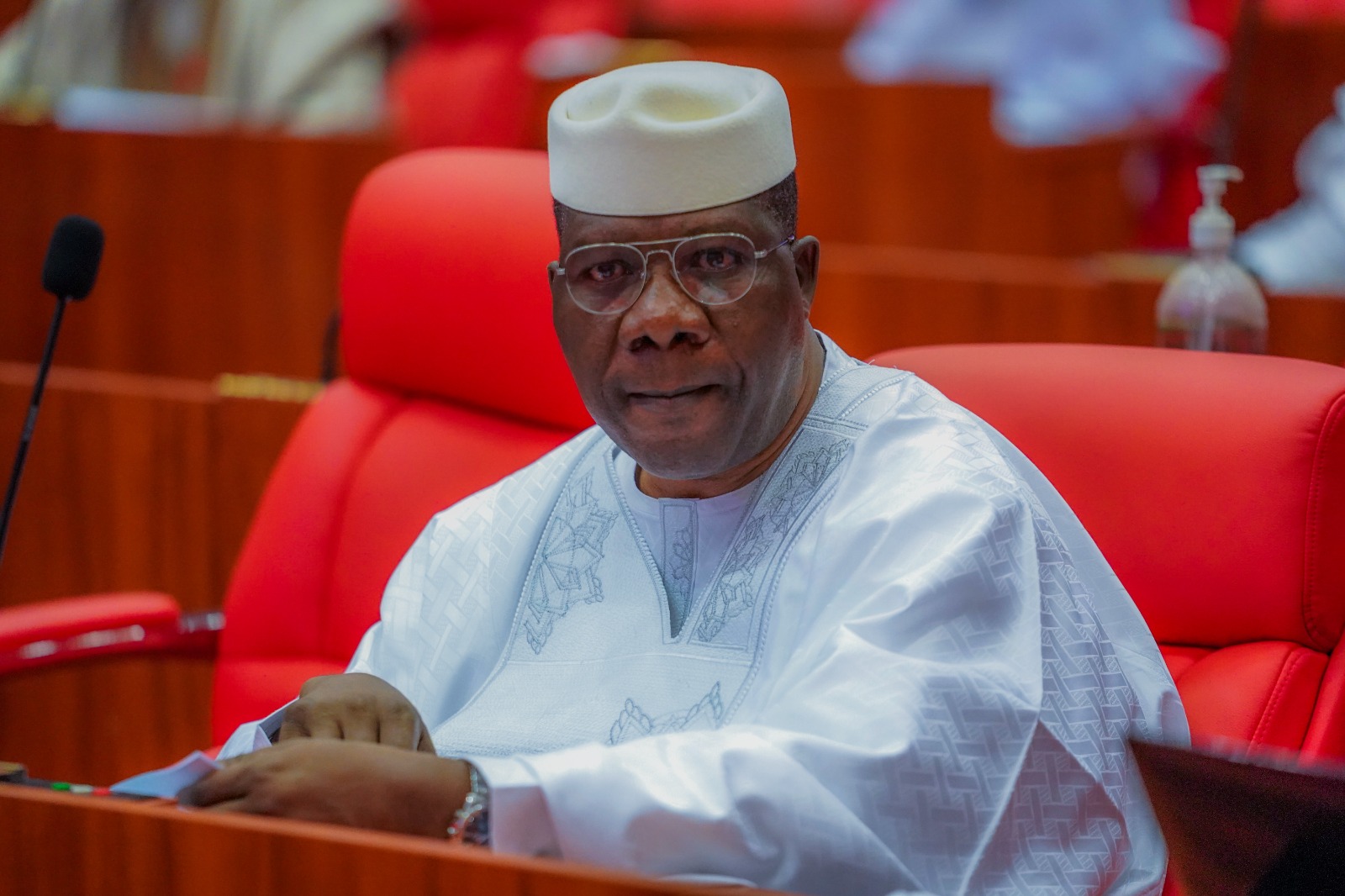
The Leader of the Senate, Senator Opeyemi Bamidele on Saturday defended the decision of the National Assembly to ratify the proclamation of state of emergency in Rivers State by President Bola Tinubu, noting that they should be commended and not vilified.
As a responsible and responsive parliament, Bamidele argued that an emergency “is an extraordinary measure, and it must be treated as such in the interest of peace and without subjecting to the scrutiny of some parochial interests.”
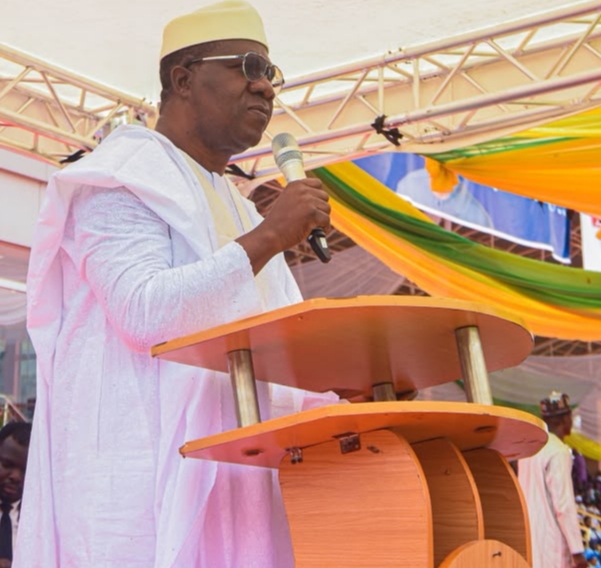
He made these clarifications yesterday at the 29th convocation of Ekiti State University (EKSU), Ado Ekiti, Ekiti State where he was decorated with a honorary degree, Doctor of Law (Honoris Causa.
Bamidele received the honour yesterday alongside Chairman, Federal Inland Revenue Service, Dr. Zacch Adedeji and Chairman, Governing Board, Bank of Industry, Dr. Mansur Muhtar, thus making it the third honorary doctorate he had received between January 2003 and March 2025.
The convocation was attended by President of the Senate, Senator Godswill Akpabio; Deputy President of the Senate, Senator Jubril Barau; Deputy Leader of the Senate, Senator Lola Ashiru; Deputy Whip of the Senate, Senator Onyekachi Nwaebonyi and Chairman, Senate Committee on Appropriation, Senator Olamilekan Adeola, among others.
Giving insight into the patriotic interventions of the National Assembly, Bamidele observed that the proclamation of emergency rule in Rivers State and its ratification by the National Assembly significantly eased political tension in the state.
But for this laudable decision that prevented further descent into anarchy in Rivers State, the senate leader said the National Assembly “has been subjected to all forms of toxic criticism that do not portray us well before the comity of nations.
“What exactly do we want as a people? A federation that functions for all? Or a federation that relapses into an intractable crisis? We must recognise that emergency rule is an extraordinary measure, and it must be treated as such in the interest of peace and security.
“As stipulated in Section 305 of the 1999 Constitution (as amended), the National Assembly is required to provide its details. The provisions of the 1999 Constitution cannot be interpreted casually without proper understanding of the Nigeria Interpretation Act. 2004.
“As a responsible and responsive parliament that sees peace and stability as a catalyst of growth and development, we were inaugurated into office to promote a nation that works for all and that guarantees the peaceful coexistence of all.
“This desire defines our resolve to ratify the proclamation of the state of emergency in Rivers State with far-reaching provisions. One of such provisions is the constitution of the National Peace Committee to midwife the peace process between the Executive and Legislature in the state.
“We should be commended for this laudable initiative and not be vilified by some political actors, who do not bother about what happens to our national security, but about their parochial interest. Regardless of their unpatriotic moves, we firmly stand for the peace and stability of Nigeria.
“We shall continue to leverage the Authority of the National Assembly to guarantee her peaceful co-existence. Our decision, as an institution, is taken purely in the national interest. If any interest is unsatisfied with it, they can as well seek redress in the law court,” Bamidele reflected.
He expressed grave concerns about a barrage of attacks that the opposition parties are viciously launching against the National Assembly, noting that the reasons for such attacks “are purely based on emotion and not reasons; sentiment and not substance.
“Regardless of baseless and needless attacks our critics are throwing at the National Assembly, we are undeterred because we are truly on a rescue mission. The essence of the mission aims at bringing our fatherland from the abyss of regression to the path of progression through the enactment of pro-people legislations and by cultivating strategic collaboration with other arms of government.
“Collaboration, in this sense, does not suggest the erosion of the independence of the National Assembly for any reason. Rather, in reality, it reinforces the spirit of interdependence that constitutional democracy entails in order to resolve hydra-headed issues that often clog the mechanism of accountable governance,” he clarified.
Bamidele, therefore, revealed that the National Assembly more than before “is now focused on building a federation that enjoys internal stability and that rests solidly on the rules of law through the instrumentality of legislation, oversight and representation.
“We are also committed to creating a system that will enable quality education; that will guarantee limitless placements for all our graduates; that will prioritise access to decent houses nationwide; that will significantly reverse our nation’s reports of untold misery and that will, most importantly, remove all barriers to gender inequality.
“How can our nation attain this lofty status without a strategic collaboration being forged among various arms of government? This is the exact question that our hardened critics have failed to ask themselves. Anyway, we have left them to their politically motivated attacks.
“This does not suggest we are afraid of criticisms as the foremost democratic institution. We are not and we will never be because we believe democracy naturally thrives on public criticism. But such criticisms must be constructive and well structured with the intention of providing alternative, credible and patriotic initiatives, “Bamidele observed.
Also, at the convocation, Pro- Chancellor of the Institution, Prof. Akin Oyebode acknowledged the contribution of alumni of the institution toward its development, saying the alumni plays significant roles in giving support to their alma mater in many institutions all over the world.
He specifically spoke about how the alumni association facilitated the donation of two medical hostels (male and female) through Senator Bamidele.
He added that the alumni through Senator Bamidele ensured construction of another two medical hostels, a mini stadium to the university and the construction of two kilometres road linking the alumni village with the college of medicine, as well as the 500 capacities CBE Centre and FM Radio Station.
In his own address, the Vice-chancellor of the university, Prof. Joseph Ayodele said he was elated about the recent ranking of the institution as Nigeria’s best state university by the Times Higher Education.
Ayodele, also, noted that the success of the institution could be linked to improvement in the monthly subvention of the university from N260 million to N410 million monthly.
He commended the contribution of alumni association to the rapid development of the institution through strategic collaboration with Leader of the Senate, Senator Opeyemi Bamidele