Nigeria and the Republic of Benin have agreed to strengthen their bilateral defence cooperation and deepen joint efforts to tackle cross-border security threats, terrorism, piracy and other forms of transnational crime across West Africa.
The agreement followed a three-day working visit to Cotonou by Nigeria’s Minister of Defence, General Christopher Musa (Rtd.), at the invitation of his Beninese counterpart, Gildas Agonkan.
During the high-level engagements, both countries discussed measures to harmonise regional security frameworks, enhance intelligence sharing and reinforce military collaboration to safeguard democratic governance, secure shared land borders and strengthen security in the Gulf of Guinea against piracy and maritime crime.
A major outcome of the discussions was the decision to establish seamless, real-time intelligence fusion mechanisms that will enable the armed forces of both countries to track, monitor and neutralise transnational criminal networks and insurgent groups before they carry out attacks.
General Musa reaffirmed Nigeria’s commitment to a zero-tolerance policy against terrorism, stressing the need for closer military cooperation to deny violent extremist groups safe havens within the shared border communities. Nigeria also offered Benin an expanded pursuit range for security personnel operating along the borders to help prevent insurgent infiltration, illegal trafficking and other cross-border crimes.
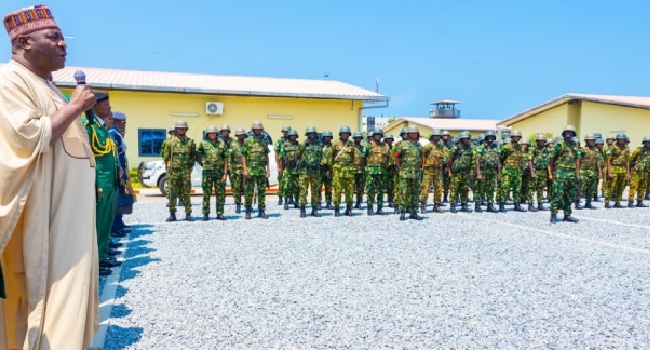
As part of the visit, the Defence Minister inspected Nigerian Army troops deployed in Togbin, Cotonou, under Operation ATILEYIN ALAFIA II, a Peace Support Mission in the Republic of Benin.
Addressing the troops, General Musa commended their dedication and assured them of the Federal Government’s continued support.
“We are going to partner with the troops of the Republic of Benin to ensure that we stop all those bandits and criminals that are killing people in our countries, so that we can deal with them,” he said.
He explained that one of the key objectives of his visit was to engage with Benin’s Defence Minister to develop coordinated operational strategies aimed at preventing criminal elements from exploiting the porous borders between both countries.
General Musa also conveyed President Bola Ahmed Tinubu’s commitment to improving the welfare of members of the Armed Forces. He assured the troops that the Federal Government was taking concrete steps to provide better welfare packages, equipment and other necessary support to enable them to effectively carry out their duties.
The Nigerian delegation also visited the Centre for Post-Conflict Demining and Explosive Ordnance Disposal Operations, as well as the Glo-Djigbe Industrial Zone. The visits were aimed at promoting local capacity building and supporting the Defence Ministry’s Intelligence-Driven and Technology-Enabled Defence strategy.
Both countries also exchanged ideas on strengthening industrial development, economic cooperation and regional integration in line with the Economic Community of West African States (ECOWAS) protocols and the African Continental Free Trade Area (AfCFTA).
General Musa further held diplomatic consultations with Nigeria’s Ambassador to the Republic of Benin, Mrs. Mopelola Ibrahim, where he reaffirmed President Tinubu’s commitment to military welfare, regional peace and enhanced security cooperation among neighbouring countries.
The Defence Minister has since concluded his official visit and returned to Abuja after reaffirming Nigeria’s commitment to closer defence collaboration with the Republic of Benin in addressing emerging security challenges across the West African sub-region.