Connect with us

Health

CSOs urge FG to seek sustainable funding for primary healthcare centres

Published

on

Primary Health care
Share


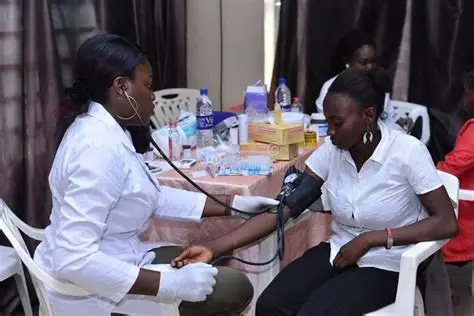
Connected Development (CODE) and BudgIT, Civil Society Organisations (CSOs) have called on the Federal Government to seek sustainable funding for primary healthcare systems in Nigeria.

The CSOs made the call at a meeting to build momentum for health care accountability orgainsied by CODE and BudgIT with a support from Conrad Hilton Foundation and Skoll Foundation in Abuja.

The meeting which was part of the activities on implementing the second phase of the COVID-19 Transparency and Accountability Project(CTAP) was aimed at tracking all funds and donations made in support of the Federal Government COVID-19 intervention.

Assistant Manager, BudgIT, Iyanuoluwa Bolarinwa, who spoke on `Strengthening  Formidable Partnerships for Accountability ‘’the group in the course of their  work observed  that most primary healthcare centres need a face lift .

“These centres are the first point of call to an average Nigerian where they go first to access care before they  can be referred to general hospitals.

“So, when you are  going to your first call and it is not well equipped, it does not  put you in an advantageous position, it sets you back further.

“So we are recommending that the centres should be revamped and we also hope that  the federal government can  put more funds into research and development.

“At the end of the day, we need to also understand that without proper research, we are going to just be imbibing whatever has been concluded in the other climes.

“We need to be able to put our foot down as the giant of Africa that we are.’’

Bolarinwa also called for more investment in the health sector and  the need to implement the Abuja declaration by  committing  15 per cent of the budget to healthcare .

He urged the government to tackle the issue of brain drain  by empowering medical personnel to remain in the country to service citizens.

Also speaking, Mr Hamza Lawal  Founder of Follow the  Money and the Chief  Executive Officer of CODE, said that the COVID-19 pandemic showed that  Nigeria’s  fiscal accountability mechanism was not so strong.

Lawal said that the group began monitoring the N38 billion raised in the  Coalition Against COVID-19(CACOVID) a  private sector-led organisation established to assist the government in combating the Coronavirus disease .

“Today, we are having an important conversation with civil society partners and  the media to galvanise action around COVID-19.

“However, this time around, we are  more focused around how  Nigeria  and Africa can  prepare for the next pandemic because COVID-19 literally brought us to  our knees.

“We want to ensure that one, we are  able to put in place a framework of fiscal accountability, two ,we are able to also invest in primary health care because we know  the centres play a critical role when we experience a pandemic. ‘’

Lawal added that the aim of the group’s work was to also educate citizens on COVID-19 while  encouraging them to take the vaccines .

This, he said was because a lot of citizens were not taking the jabs  due to the distrust ,misinformation and disinformation .

“I believe that this conversation with the media and  civil society partners would help set a pace on how we can engage, how we can get the needed funding and investment for primary health care centres.

“It will set a pace on  how Nigeria  can lead other African countries to prepare for another pandemic because another pandemic is just around the corner,’’ he said.

Contributing, Mr Busayo Morakinyo, Community Engagement Director of CODE assessed the Federal  Government ‘s intervention performance on Primary Health  centres(PHC).

“Findings by the Follow the Money initiative in communities indicated that most of  the centres fell below the minimum Primary Health Care standard.

“Findings also revealed that they lacked electricity, 30 per cent of the PHC have no access to clean water.

“ Interviews with some of the community indigenes shows that they rely on rain water and well water stored in the tanks.

“Fifty six out of 90 PHCs assessed, have the recommended pharmaceutical fridge to host vaccines  while some of the PHCs received less than 10 vials of Covid-19 vaccine.”

Morakinyo  said that  NPHCDA recently outlined plans for the  transformation of PHCs  to provide services aligned with the basic needs of the community, link individuals to PHC services, keep and transmit records.

He  however said that  most of things on ground were observed in the course of the report  were not seen to reflect the plan.

The News Agency of Nigerian (NAN)reports that  Dr Faisal Shuaib, the Executive Director of the National Primary Health Care Development Agency (NPHCDA), had at a different event attested to the fact that  poor infrastructure and poor staff was  hampering operations of PHC.
Shuaib had therefore said that the Agency had plans to transform the centres.


(NAN)

Continue Reading
Click to comment

Leave a Reply

Your email address will not be published. Required fields are marked *

Health

Akwa Ibom Declares Two Doctors Wanted for Abandoning Duty

Published

on

Akwa Ibom State Governor, Umo Eno
Share

The Akwa Ibom State Government has declared two medical doctors wanted for allegedly abandoning their duty posts after being trained for eight years at the state’s expense.

The Commissioner for Health, Dr. Ekem John, announced this on Tuesday, September 16, 2025, during a press briefing in Uyo.

He identified the doctors as Consultant Radiologist, Dr. Uduakabasi Ita, and Consultant Hematologist, Dr. Mfonobong Bassey, both staff of the state’s Ministry of Health.

According to him, the doctors left their duty posts for greener pastures without fulfilling their service bond with the government.

“The state government has repeatedly said that any medical personnel it trains is bond to first serve the state to cover the cost of the training before they will be allowed to leave for greener pastures,” John said.H

He added that the ministry had declared the doctors wanted, ordered the stoppage of their salaries, and would pursue disciplinary action through local and international medical councils if necessary.

John urged the doctors to immediately return to their duty posts or refund all resources spent on their training, warning that their families should advise them to comply before sanctions are enforced.

The commissioner stressed that going forward, all medical officers trained by the state must serve out their agreed years before being allowed to resign.

He also commended Governor Umo Eno for declaring a state of emergency in the health sector, noting that Akwa Ibom was positioned to achieve improved healthcare under the ARISE Agenda of the present administration.

Continue Reading

Health

Tinubu Congratulates NAFDAC On Retaining WHO Maturity Level 3 Status

Published

on

NAFDAC DG, Prof. Mojisola Adeyeye
NAFDAC DG, Professor Mojisola Adeyeye
Share

President Bola Tinubu has congratulated the National Agency for Food and Drug Administration and Control (NAFDAC) for retaining the World Health Organisation’s (WHO) Maturity Level 3 (ML3) status for the regulation of medicines and vaccines.

The WHO conducted a re-benchmarking exercise from May 28 to May 30, 2025, assessing NAFDAC’s regulatory performance against globally recognised standards. NAFDAC attained the ML3 status in 2022, becoming Africa’s first National Regulatory Authority to achieve the milestone in regulating medicines and vaccines (non-producing).

According to the WHO’s assessment, NAFDAC has maintained a stable, well-functioning, and integrated framework for regulating medicines and vaccines, a feat attributed to sustained government investment in strengthening the regulatory system.

President Tinubu commended the agency’s management and staff for their professionalism and dedication to safeguarding public health, describing the achievement as a boost to Nigeria’s standing in global health security and pandemic preparedness.

The President reiterated his administration’s commitment to ensuring the safety, quality, and efficacy of medicines and vaccines in line with international best practices. He noted that the milestone aligns with the Renewed Hope Agenda to transform Nigeria’s healthcare system, upgrading over 17,000 primary health centres, improving maternal care and diagnostics in underserved areas, training 120,000 frontline health workers, and doubling national health insurance coverage within three years.

Tinubu also pledged continued support for NAFDAC’s bid to achieve WHO’s Maturity Level 4, the highest global standard of regulatory excellence, and reaffirmed plans to promote local production of healthcare products, attract investment in the pharmaceutical sector, and expand manufacturing capacity.


Continue Reading

Health

FCTA To Launch Mandatory Hepatitis Screening For Food Handlers

Published

on

FCTA
FCTA
Share

The Federal Capital Territory Administration (FCTA) has announced plans to begin mandatory hepatitis screening for food handlers across Abuja. This initiative aims to strengthen public health and enhance food safety in the capital.

Targeting food vendors in restaurants, markets, bakeries, and canteens, the screening is designed to reduce the spread of foodborne diseases, including Hepatitis A and E, which are primarily transmitted through contaminated food and water, as well as Hepatitis B and C, which are spread through blood and bodily fluids.

The announcement was made in a statement issued Tuesday by the FCT Minister, Nyesom Wike, as part of a goodwill message for World Hepatitis Day 2025. The message was delivered on his behalf by Dr. Adedolapo Fasawe, the Mandate Secretary of the Health Services and Environment Secretariat.

According to the Minister, the screening will be conducted through a Public-Private Partnership (PPP) arrangement, combining the efficiency, technical expertise, and resources of the private sector with the regulatory oversight of the government.

“This strategic initiative aligns with the National Policy on Food Safety and Quality and will include regular mandatory screening for Hepatitis B and C among all food handlers within the FCT,” Wike stated.

He emphasised that food handlers are “an often overlooked group” whose roles are critical in ensuring the safety of what people consume daily. He urged the public to view them as essential public health stewards.

The FCTA also called on all stakeholders—government agencies, healthcare providers, food business operators, and the public—to support the initiative. This includes promoting hepatitis awareness, encouraging vaccinations, and enforcing hygiene and safety standards.

“We must act urgently. Hygiene cannot wait. Screening cannot wait. Action cannot wait. Together, let’s ensure the FCT leads by example, turning our food industry into a model of health, safety, and excellence,” the statement concluded.

Further details regarding the screening timeline and rollout will be communicated in due course by the administration.

Continue Reading