Defence and Security
Senate to FG: Declare known leaders of terrorists wanted
Published
4 years agoon
By
News Editor
…demands massive deployment of military to areas under attack
The Senate has called on the President Muhammadu Buhari-led Federal Government to declare all know leaders of terrorist wanted.
The call was made on Wednesday in a six-point resolution reached by the chamber, following a motion considered on the urgent need to stem the increasing spate of kidnappings and insecurity across parts of the country.
The motion entitled, “urgent need to surmount all kinds of kidnappings, banditry and related security challenges in Wasagu-Danko, Sakaba and Yauri Local Government Areas of Kebbi State”, was sponsored by Senator Bala Ibn Na’allah (Kebbi South).
The motion was co-sponsored by twelve other Senators.
Na’allah, in his presentation, noted with concern the current rise in security challenges in Danko/Wasagu and Sakaba Local Government Areas (LGAS) of Kebbi State and indeed across the federation.
According to him, “the bandits are moving in hundreds from village to village, house to house in search of cattle to rustle and people to abduct.”
He lamented that, “in some cases, the houses and foodstuffs of the residents are entirely burnt down, rendering them homeless and without food to survive.
“Besides, many of their victims have been maimed while women, both old and young, are raped and dehumanized.”
The lawmaker, stated that the bandits now conduct their criminal operations in broad daylight, fully armed on motorcycles, and shooting and killing whoever was unfortunate to come their way.
He raised the alarm that the Bandits have reportedly been laying siege around Yar-Kuka, Morai, Dankade, to Wadako and, recently in Bena, where 20 people were abducted.
He added that they have also found refuge in Ayu, where most of the residents were forced to flee, under Wasagu Chiefdom of Wasaga/Danko LGAS of Kebbi State.
“The same challenges are going on at Sakaba town under Sakaba LGAS of the State unabated”, he said.
Na’allah said that on the 19th February 2022, the bandits in large numbers passed through Waje, Sabon-layi, Zuttu and Kangon Wasagu, where they killed many people and herds of cattle rustled.
He noted with concern that the incident had increased the number of Internally Displaced Persons in Waje, Ribah, Kanya and Wasagu in Wasagu/Danko LGA, thereby creating a major humanitarian crisis in the zone.
He further recalled that the Bandits killed some traditional leaders and security agents in Dankade and Yar-Kuka.
According to the lawmaker, Bena to Bangi federal road linking Kebbi and Niger State was shut down by the bandits even though manned by Security Agencies.
He observed that twelve villages in Wasagu Chiefdom Danko/Wasagu LGA are under incessant attacks of Bandits.
He gave the names of the villages to include: Doka; Ganyale; Morai; Ktare; Banku; Mutare; Bawada; Tungar-Dangula; Tungar Galla; Gimi; Zagami; Kahalmo; and Chud-kubu.
He revealed that under Sakaba LGA, the bandits have invaded and ransacked Dankolo, Makuku, Sakaba Janbirni, and Kurmin-hodo villages, and also displaced the residents at Unguwar Wade, Agali, and Mazarko.
He bemoaned the kidnap of School Children of Federal Government College Yauri, noting that more than ten are still in captivity.
“The Females among them were said to have been married to the Bandits and reportedly three are said have been released to their parents after having been allegedly impregnated by their captors.
“Last week, the Bandits attacked Tungar Zarumai, under Yauri Emirate Council, killed and kidnapped so many people and set the entire village ablaze where foodstuff and other valuables were completely burnt down”, Na’allah said.
He warned that unless urgent steps are taken to tackle the security challenges, communities may be forced to resort to self-defence by acquiring arms and ammunitions.
Adamu Aliero (Kebbi Central), in his contribution, said the incidents of kidnappings and killings In Kebbi South are replications of what happened in Zamfara and Sokoto States.
“The military made it impossible for bandits to operate in Zamfara causing them to seek refuge in Kebbi State”, Aliero said.
He, therefore, underscored the need for coordinated military operations in Kebbi, Zamfara and Sokoto and Niger States.
Senator Sani Musa (Niger East), described the present security situation in the North-West part of the country as “alarming”.
He lamented the lack of military response to the recent killing of four officers of the Nigeria Security and Civil Defence Corps in Shiroro LGA.
Senator Musa expressed worry that Niger State has become a haven for terrorists going about with explosive devices.
“Are we not human beings, is there no government? Foreigners are coming into this country. Immigration should wake up, there are a lot of foreigners in Niger State. Niger State has become a haven for Bomo Haram.
“There is no action taken, no security forces, nobody is doing anything about it.
“These people have started using Improvised Explosive Devices (IEDs).
“If we can’t do it, why not call foreign countries to come and help us”, he queried.
Senator Nora Daduut (APC, Plateau South), on her part, called on federal government to urgently carry out investigations as to how bandits get a supply of arms and ammunition.
She lamented the waste of human lives by terrorists, adding that effort must be made by government to secure the lives of internally displaced persons who are potential targets of terror attacks.
Senator Nicholas Tofowomo (PDP, Ondo South), said the persistent insecurity across the country was a clear indication that the country’s internal security has failed.
Also contributing, Senator Uche Lilian Ekwunife (PDP, Anambra Central), advanced arguments for State Policing as means to addressing the nation’s security challenges.
“Are the Governors really the Chief Security Officers of their respective states? If the answer is yes, why can’t we support the creation of state policing?
“The security is getting off-hand in this country. This is time to forget our personal interests and support the creation of state policing”, the lawmaker said.
Senator Ifeanyi Ubah (YPP, Anambra South), said the issue insecurity was beginning to take a new dimension that may result in the eventual migration of persons from rural to urban areas in search of safety.
The Senate President, Ahmad Lawan, in his concluding remarks said, “let’s never be discouraged, because sometimes we feel why are we doing this, nothing is happening.
“There’s a limit to what we can do, but we must do what we are supposed to do well.
“When we debate things here, that is our primary responsibility.
“We can only do oversight to put pressure, but we cannot execute, because you can’t command anyone to go anywhere.
“What we do here to me is very significant. We should continue to debate it, talk about it, and follow up with some action.”
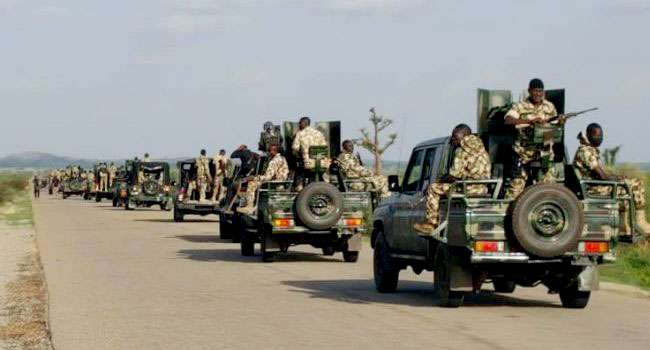
Accordingly, the Senate, in its resolution, urged President Muhammadu Buhari to deploy, massively, the law enforcement agencies to conduct a rigorous operation that would bring to an end banditry and cattle rustling in the affected LGAs.
It also urged the Chief of Defence Staff and Inspector General of Police to, as a matter of urgency, establish Commands in the affected areas.
The chamber urged the National Emergency Management Agency (NEMA) and all donor organisations to provide relief materials such as clothes, blankets, portable water, food and shelter to victims in the affected areas.
It urged Governments at all levels to provide grants to the victims as being done in other parts of the country to enable them recover from these unfortunate incident.
The chamber called on the Federal Government to invoke the provisions of Sections 17(3)(g) of the 1999 Constitution of the Federal Republic of Nigeria (as amended) to render the necessary assistance to the affected areas.

You may like
Defence and Security
Police Rescue Adegoke and Her Twin Sons in Ibadan; Two Suspected Kidnappers Killed
Published
5 hours agoon
June 6, 2026By
News Editor
ABUJA, June 6, 2026 — The Nigeria Police Force (NPF) has confirmed the successful rescue of a woman, Mrs. Olaide Busayo Adegoke John-Paul, and her 12-year-old twin sons, Peter and Paul, who were abducted in Ibadan, Oyo State, earlier this week.
The victims regained their freedom on Saturday evening following a coordinated intelligence-led operation carried out by operatives of the Force Intelligence Department Intelligence Response Team (FID-IRT).
According to a statement issued by the Force Public Relations Officer, Deputy Commissioner of Police (DCP) Anthony Okon Placid, the rescue operation was conducted at about 7:30 p.m. on June 6, 2026, after days of intensive surveillance, intelligence gathering, and tactical tracking of the kidnappers’ movements.
Mrs. Adegoke and her twin sons were reportedly kidnapped at approximately 7:30 a.m. on June 3, 2026, while she was driving the children to school in Ibadan. The incident triggered an immediate response from security agencies, with the FID-IRT launching a comprehensive operation aimed at locating the victims and apprehending their captors.
The police disclosed that sustained intelligence efforts enabled operatives to identify and monitor the movements of the kidnapping gang, leading to a confrontation between the suspects and security personnel during the rescue mission.
During the exchange, two suspected kidnappers were fatally wounded, while security operatives recovered two rifles believed to have been used by the criminal syndicate. The remaining members of the gang reportedly fled the scene.
The rescued victims were found unharmed and have since been placed under protective custody, where they are receiving medical attention and psychological support.
The Inspector-General of Police commended the courage, professionalism, and dedication demonstrated by the FID-IRT operatives and other officers involved in the operation. He noted that their commitment and resilience were instrumental in ensuring the safe recovery of the hostages without harm.
Meanwhile, the police have intensified efforts to track down and arrest other members of the kidnapping syndicate who escaped during the operation. Preliminary intelligence suggests that some of the fleeing suspects sustained gunshot injuries during the confrontation.
Security agencies have launched a manhunt across the area and adjoining locations to ensure all those connected to the abduction are apprehended and prosecuted.
The Nigeria Police Force also expressed appreciation to members of the public for their support, cooperation, and patience throughout the operation, reiterating its commitment to combating violent crimes, safeguarding lives and property, and maintaining public safety across the country.
DCP Anthony Okon Placid assured Nigerians that ongoing operations would continue until every member of the criminal network responsible for the abduction is brought to justice.
Defence and Security
Oyo School Kidnap: Police Arrest Six Informants, Couriers as Forest-Based Bandits Remain at Large
Published
16 hours agoon
June 6, 2026By
News Editor
The Oyo State Police Command has recorded a significant breakthrough in its investigation into the abduction of schoolchildren and teachers in Ahoro-Esiele, Oriire Local Government Area of the state, with the arrest of six suspected informants, couriers and collaborators linked to the kidnapping syndicate.
However, security authorities have confirmed that the principal bandits responsible for carrying out the attack remain at large, continuing to evade security forces operating within the forests surrounding the Old Oyo National Park.
According to official security reports, the suspects were identified and apprehended following extensive telephone surveillance and intelligence gathering that traced communications between the kidnappers and their local collaborators.
Suspects Served as Informants and Logistics Providers
Investigators disclosed that the arrested individuals were not members of the core kidnapping gang but played critical support roles by facilitating communication, movement of funds and logistical operations for the bandits.
Among those arrested are Babangida Buhari Awalu and Kabiru Aliyu, both commercial motorcycle operators popularly known as Okada riders. Security agencies said the duo functioned as couriers for the syndicate and were apprehended in the Ojoo area of Ibadan while allegedly attempting to retrieve ransom proceeds on behalf of the kidnappers.
Further investigations led to the arrest of Adewuyi Sunday, Ayanwola Gbenga, and Rafiu Abdulmajeed, who are believed to have assisted the criminal network by providing logistical support and facilitating financial transactions. The suspects reportedly hail from communities in Gbugbu, Kwara State, and Ago-Are in Oyo State.
Another suspect, Adeleye Ayomide, a university student, was tracked and arrested by military personnel after security operatives allegedly discovered a mobile phone belonging to one of the abducted victims in his possession. Investigators also traced electronic ransom demands sent to parents and guardians of the victims to a device linked to him.
Security agencies have declined to disclose the precise residential addresses of the suspects, citing ongoing investigations, prosecution procedures and security concerns.
Phone Intercepts Expose Local Collaboration
The arrests followed the interception of several telephone conversations made during and after the abduction.
According to the Oyo State Police Command, the intercepted communications revealed how local informants allegedly guided the kidnappers through difficult forest routes and provided real-time intelligence to help them evade military and police operations within the expansive Old Oyo National Park.
Security sources disclosed that some of the conversations contained detailed directions on movement routes, security checkpoints and escape paths, highlighting the level of collaboration between the forest-based bandits and their local accomplices.
Bandits Exploit Technology to Avoid Detection
Despite the breakthroughs, authorities acknowledged that tracking the core members of the kidnapping gang has proven difficult.
Officials from the Ministry of Communications, Innovation and Digital Economy explained that the criminals have adopted sophisticated communication methods designed to defeat conventional tracking systems.
Although Nigeria’s National Identification Number (NIN)-SIM linkage policy was introduced to improve traceability and curb criminal activities, investigators said the kidnappers deploy advanced call-routing techniques and portable network-masking devices that reroute communications through multiple remote telecommunications towers.
The technology effectively conceals their actual locations and makes it difficult for security agencies to pinpoint their exact coordinates during operations.
Security experts say the growing use of such tools by criminal networks presents a new challenge for law enforcement agencies battling kidnapping, terrorism and organized crime across the country.
Ransom Funds Traced Through Banking Channels
Investigators also uncovered a financial network allegedly used by the kidnappers to receive, distribute and conceal ransom payments.
Security reports indicate that ransom proceeds and electronic extortion payments linked to communications traced to Adeleye Ayomide were routed through an account with Wema Bank.
Authorities further discovered that funds were transferred through accounts belonging to Adewuyi Sunday, Ayanwola Gbenga and Rafiu Abdulmajeed. These accounts allegedly served as temporary collection and distribution channels before cash was delivered to bandits operating within the forest.
The financial trail is now being examined by investigators seeking to identify additional members of the criminal network and establish the full scope of the syndicate’s operations.
CBN, Anti-Graft Agencies Freeze Accounts
As part of ongoing efforts to dismantle the network, the affected accounts have reportedly been flagged and frozen by financial regulators and anti-corruption agencies.
Investigators are analysing transaction records to determine the movement of ransom funds, identify additional beneficiaries and uncover any wider criminal connections.
Security officials expressed optimism that the financial intelligence obtained from the frozen accounts could lead to further arrests and eventually expose the leadership structure of the kidnapping syndicate.
Search for Main Kidnappers Continues
While authorities describe the arrests as a major breakthrough, they stress that the operation remains ongoing.
Security forces continue to conduct coordinated ground and intelligence-led operations in forest corridors around Old Oyo National Park in an effort to locate and apprehend the principal kidnappers.
Officials maintain that the dismantling of the syndicate’s support network is expected to weaken the group’s operational capacity and improve the chances of capturing the armed bandits who orchestrated the school abduction.
The Ahoro-Esiele school kidnapping sparked widespread concern across Oyo State and renewed calls for stronger security measures to protect schools and rural communities from increasingly sophisticated criminal networks.
Defence and Security
Weapons Looted During Libya Conflict Ended Up in Hands of Terrorists in Nigeria — UN
Published
2 days agoon
June 5, 2026By
News Editor
The United Nations has revealed that weapons looted during the 2011 Libyan conflict eventually found their way into the hands of terrorist and extremist groups operating in Nigeria and other countries across the Sahel region, highlighting the long-term security consequences of uncontrolled arms proliferation following armed conflicts.
The disclosure was made by the United Nations Under-Secretary-General and High Representative for Disarmament Affairs, Izumi Nakamitsu, during a high-level discussion at the UN Headquarters in New York on the global spread of illicit firearms and their impact on international peace and security.
Nakamitsu warned that the diversion, theft and illegal circulation of weapons from conflict zones continue to fuel violence, terrorism and organised crime long after wars have ended, posing significant challenges to governments and international peacebuilding efforts.
According to her, the 2011 uprising in Libya, which culminated in the overthrow and death of former Libyan leader Muammar Gaddafi, triggered the widespread looting of military stockpiles. Many of those weapons subsequently spread across the Sahel region, reaching countries such as Niger, Burkina Faso and Nigeria.
“Libya, where weapons looted or diverted during and after the 2011 conflict, which ended the rule of Muammar Gaddafi, later surfaced across the wider Sahel region, including in Niger, Burkina Faso, and Nigeria,” Nakamitsu stated.
She explained that investigations and recovery efforts over the years showed that some of the weapons were eventually traced to extremist groups operating in the region, demonstrating how arms originating from one conflict can destabilise neighbouring countries for years.
“Some were subsequently found in the hands of extremist groups, illustrating how arms from one conflict can destabilise neighbouring countries years later,” she said.
“The end of the conflict does not mean the end of the circulation of those weapons; it stays, and it continues to harm people.”
Growing Threat to Regional Security
The UN disarmament chief stressed that the continued movement of illicit firearms remains one of the most serious threats to peace and stability in fragile states and conflict-affected regions.
She noted that weapons retained by armed groups, militias and local communities after conflicts often become instruments for renewed violence, criminal activity and insurgency.
According to Nakamitsu, the availability of illegal weapons has contributed significantly to the activities of terrorist organisations, bandit groups and transnational criminal networks operating across the Sahel and West Africa.
The region has witnessed increasing insecurity over the past decade, with extremist groups exploiting porous borders and weak governance structures to move weapons, fighters and resources across countries.
Beyond Security Concerns
Nakamitsu emphasised that the proliferation of small arms and light weapons is not merely a military or security issue but one with far-reaching humanitarian and developmental consequences.
She said the widespread availability of illicit firearms is closely linked to terrorism, human rights abuses, organised crime, forced displacement, gender-based violence and the erosion of state authority.
“It is not just a security issue. It is also about peacebuilding. It is about human rights. It is also about development,” she said.
The UN official argued that efforts to tackle illicit arms trafficking must therefore form part of broader strategies aimed at promoting peace, protecting human rights and fostering sustainable development.
Weapons Continue to Circulate After Wars
Highlighting a major challenge facing governments and international organisations, Nakamitsu noted that weapons used during conflicts frequently remain outside official control after hostilities end.
She explained that many firearms are hidden, sold on black markets or smuggled across borders, making them available for use in new conflicts and criminal enterprises.
“Wars end, but unfortunately, the weapons that are used in that particular conflict would not be under full control,” she said.
“They continue to circulate. They are sometimes hidden. They are brought across borders.”
Security analysts have long linked the influx of weapons from post-Gaddafi Libya to the rise in armed insurgencies, terrorism and banditry across the Sahel. The collapse of state institutions in Libya created vast ungoverned spaces that became major transit routes for arms trafficking networks.
Emerging Challenges in Arms Trafficking
Nakamitsu also warned that technological advancements are creating new challenges for law enforcement agencies seeking to combat illicit arms trafficking.
She pointed to the growing emergence of so-called “ghost guns,” 3D-printed firearms and sophisticated smuggling methods that make tracing illegal weapons increasingly difficult.
According to her, traffickers are now able to disassemble firearms into separate components, transport them across borders and reassemble them later, complicating efforts to identify their origins and track their movement.
“Those weapons or weapon parts, if they are disassembled and then trafficked, are more difficult to trace,” she said.
UN Calls for Stronger International Action
The United Nations has repeatedly raised concerns over the unchecked proliferation of small arms and light weapons in the Sahel region, warning that the trend continues to fuel terrorism, armed conflict, organised crime and political instability.
The organisation has consistently urged governments to strengthen border controls, improve weapons stockpile management, enhance intelligence-sharing and deepen regional cooperation to curb illicit arms flows.
Nakamitsu reiterated the need for coordinated international action to prevent weapons from conflict zones from entering illegal markets and falling into the hands of non-state actors.
Her remarks underscore growing global concerns that unresolved conflicts and weak post-war disarmament measures can have lasting consequences, allowing weapons to circulate for years and threaten peace and security far beyond the original battlefield.
Latest News
Police Rescue Adegoke and Her Twin Sons in Ibadan; Two Suspected Kidnappers Killed
Share ABUJA, June 6, 2026 — The Nigeria Police Force (NPF) has confirmed the successful rescue of a woman, Mrs....
Tinubu Celebrates Pastor Kumuyi at 85, Hails His Global Impact and Spiritual Leadership
Share President Bola Ahmed Tinubu has congratulated the General Superintendent and founder of the Deeper Christian Life Ministry, William Folorunso...
Oyo School Kidnap: Police Arrest Six Informants, Couriers as Forest-Based Bandits Remain at Large
Share The Oyo State Police Command has recorded a significant breakthrough in its investigation into the abduction of schoolchildren and...
Weapons Looted During Libya Conflict Ended Up in Hands of Terrorists in Nigeria — UN
Share The United Nations has revealed that weapons looted during the 2011 Libyan conflict eventually found their way into the...
State Police Constitutional Framework Near Completion as Tinubu Administration Advances Reform Agenda
ShareABUJA, Nigeria — The Federal Government says significant progress has been made toward the establishment of state police across Nigeria,...