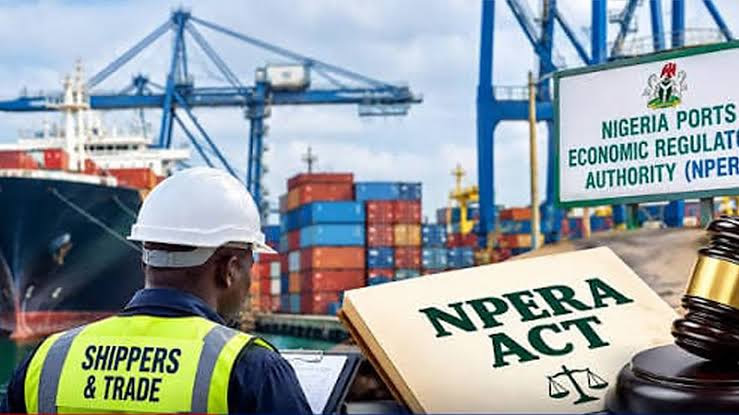
A major change in the running of commercial activities at the nation’s seaports is set to begin with the Nigeria Ports Economic Regulatory Agency (NPERA) officially commencing operations.
Those to head the running of the agency have also been appointed. Chairman of NPERA Governing Board has Dr. Ibrahim Shema, while Dr Pius Akutah, is the Executive Secretary and Chief Executive Officer.
Established under the Nigeria Ports Economic Regulatory Agency Act, 2026, the new agency is to foster order, transparency and predictability to the port business while enhancing Nigeria’s competitiveness as a regional trade hub.
At a press briefing in Lagos, Chairman of the NPERA Governing Board, Dr. Ibrahim Shema, said the development is a major milestone in the evolution of Nigeria’s port system.
Shema highlighted that the new law gives permanent legal backing to economic regulation of the ports, replacing the interim arrangement under which the Nigerian Shippers’ Council operated its role since 2014.
The board chair said the history of port economic regulation dates back to the establishment of the Nigerian Shippers’ Council in 1978 and the concessioning of port terminals in 2006.
But NPERA, under the new framework, he said, will regulate port tariffs and charges, licensing, service standards, competition, commercial disputes and trade facilitation, while also protecting the interests of port users.
The chairman stressed that the agency’s emergence would not create a power struggle with the Nigerian Ports Authority (NPA), which will continue to handle port infrastructure and its landlord responsibilities. In his words:
“This is not about creating competing authorities. It is about establishing a coherent system in which institutions work together, each within its statutory responsibilities.”
He said NPERA would focus on eliminating unnecessary regulatory hurdles, reducing uncertainty for businesses and improving the speed of cargo movement through Nigerian ports.
He identified transparency, fairness, predictability, efficiency and accountability as the principles that would guide the agency’s operations.
On port charges, Shema said the new system would provide clearer information on how regulated tariffs are determined, while giving terminal operators and other service providers a better understanding of their regulatory obligations.
He also promised easier access to dispute-resolution mechanisms and greater use of digital platforms for licensing, tariff management, monitoring, compliance and engagement with stakeholders.
He assured stakeholders that the transition from the Nigerian Shippers’ Council to NPERA would be handled without unnecessary disruption, with attention to staff, assets, liabilities, existing contracts, pending disputes, regulatory records and licences.
He called for cooperation among the NPA, Nigerian Maritime Administration and Safety Agency (NIMASA), Nigeria Customs Service, terminal operators, shipping companies, freight forwarders, importers, exporters and other stakeholders.
“The establishment of NPERA is a historic achievement, but the harder work begins now,” he said, stressing that the real test would be the agency’s ability to convert the new law into better services, improved efficiency and stronger competitiveness.
The Executive Secretary and Chief Executive Officer of NPERA, Dr. Pius Akutah, equally expressed confidence that the new regulatory regime would significantly improve the business environment at the ports within the next one to two years.
Akutah said the agency would pursue fair pricing, stronger competition and improved trade facilitation.