Connect with us

Business & Economy

Cashless Policy: CBN convinces Senate Panel on N100, 000 Cash Withdrawal Limit

Published

on

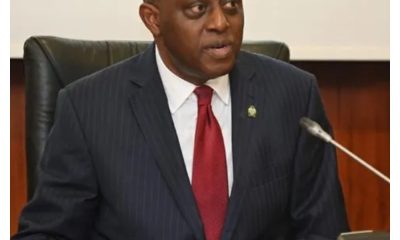
CBN Governor, Godwin Emefiele
Share

…. Says policy introduced since 2012

As controversies continue to trail the planned policy of the Central Bank of Nigeria (CBN) to limited cash withdrawal for individuals at N100,000 and Corporate Bodies N500, 000 per week, the bank has  succeeded in convincing the Senate Committee on Banking , Insurance and other Financial Institutions of the need for it.

The policy as disclosed by the Deputy Governor of CBN on Financial System Stability, Mrs Aishat Ahmad was introduced in 2012 during former President Good luck Jonathan ‘s administration and extended to Abuja and six other states in 2013.

The CBN Deputy Governor made the disclosure during screening exercise carried out on her and her counterparts on Corporate Services , Edward Lametek Adamu , for re  – appointments by the Senate Committee on Banking , Insurance and other Financial Institutions .

She said cashless policy being fully implemented by CBN now is not new, as required steps in that direction, was taken in 2012 with Lagos State as pilot scheme and Abuja and Six other states in 2013.

She explained that though full implementation of the policy has not been carried out by CBN since then, but its introduction then, has brought a lot of transformation in the banking and payment system.

” Distinguished Chairman of this committee and members, I ‘m happy for the opportunity given to make presentations on planned N100,000 withdraw limit for individuals and N500, 000 for Corporate Bodies per week , beginning from 9th January , 2023 , in line with cashless  policy introduced in 2012 .

” Based on information available to CBN, the time for full implementation of the policy with proposed limit on cash withdrawals per week is now.

” Required infrastructure for its implementation in terms of financial access point system, mobile money, e – naira etc., are available across the 774 local government councils in the country.

” All fears and worries being expressed by Nigerians on the planned limited cash withdrawal policy are seriously being taken care of as nobody or section of Nigerians, will be left out.

” In the past , banking transactions in Nigeria was limited to Bank Branches alone as the only means , which has now expanded into multiple electronic platforms  as well as geometrical increase in the number of agents from 88,000 to 1.4million “, she said.

She however said that the Apex bank is flexible and will be ready to accommodate opinions that won’t make the policy strainous to any category of Nigerians during implementation.

After her presentation, the Committee chaired by Senator Uba Sani (APC Kaduna Central) , gave the two nominees ‘  take a bow and go treatment ‘ as moved by the Whip of the Senate , Senator Orji Uzor Kalu and seconded by Senator Danjuma Goje .

Chairman of the Committee in his remarks said : ” With presentation made by the Deputy Governor of CBN on Financial System Stability , Aisha Ndanusa Ahmad on the planned limited cash withdrawal , required information on the merits of the policy has been given and will be communicated to the Senate in plenary through our report .

” The two Deputy Governors, having earlier been screened before serving their first tenures, need not to again as unanimously agreed by members of the Committee.

” They should therefore take a bow and go “.

Continue Reading
Click to comment

Leave a Reply

Your email address will not be published. Required fields are marked *

Business & Economy

NERC Dissolves Kaduna Electricity Distribution Company Board Over ₦456.5bn Insolvency

Published

on

NERC Logo
Share


The Nigerian Electricity Regulatory Commission (NERC) has dissolved the Board of Kaduna Electricity Distribution Company (Kaduna Electric) with immediate effect over severe financial insolvency amounting to ₦456.5 billion.

NERC, in a statement, said the decision followed the company’s poor financial and operational performance.

According to the commission, Kaduna Electric remitted only 41.93 percent of its adjusted market invoices in 2025 and recorded aggregate losses of 71.88 percent.

The company also invested ₦2.48 billion against a required capital investment of ₦24.51 billion, while customer metering coverage remained below 36 percent.

To ensure continued electricity supply and operational stability, NERC has constituted an interim board of Special Directors chaired by Dr. Abdullahi Garba.

The commission also appointed Dr. Abubakar Umar Hashidu as Administrator of the company for an initial six-month term.

NERC further said Afrexim would coordinate a transparent 12-month competitive process to secure a competent replacement core investor for Kaduna Electric.

The commission assured electricity consumers across Kaduna Electric’s franchise area that distribution services would remain safe and uninterrupted during the transition.

Continue Reading

Business & Economy

Subsidy Removal Best Thing That Happened to Nigeria — NRS Chairman

Published

on

President Bola Ahmed Tinubu
Share


The Chairman of the Nigeria Revenue Service (NRS), Zacch Adedeji, has described the removal of petrol subsidy as one of the best economic decisions taken in Nigeria, saying President Bola Tinubu deserves commendation for the policy.

Adedeji made the remarks while appearing on Channels Television’s Sunday Politics on Sunday, August 9, 2026.

He said many of the positive economic developments being recorded by the government were linked to the decision to remove the subsidy, which he described as unsustainable and harmful to the country’s economy.

According to him, the subsidy regime had existed for decades and placed a heavy burden on government finances.

“All the good results that I will reel out soon come as a result of that courageous decision. So, it is not a mistake; it is the best thing that has happened to this country,” Adedeji said.

The NRS chairman said Tinubu inherited an economy facing several structural challenges, including an unsustainable petrol subsidy regime, an underperforming oil sector and a narrow tax base.

He said the administration had introduced major reforms to address these challenges and urged Nigerians to assess the policies based on their long-term economic impact rather than emotions.

Adedeji also challenged those seeking to contest the 2027 presidential election to explain how they would handle the country’s economic challenges differently.

He specifically questioned whether they would reverse the removal of fuel subsidy or the unification of the foreign exchange market.

The NRS chairman further argued that retaining the subsidy would have placed an even greater strain on Nigeria’s finances, particularly amid global energy market pressures.

He estimated that the subsidy bill could have risen to about ₦53 trillion, while the exchange rate might have reached ₦3,500 to the dollar.

President Tinubu announced the removal of petrol subsidy during his inauguration speech on May 29, 2023. The decision led to a sharp increase in petrol prices and contributed to higher transportation, food and production costs.

While the reform has increased government revenues and boosted allocations to the federal, state and local governments, its effect on the cost of living remains a major concern for many Nigerians.


Continue Reading

Business & Economy

Dangote Refinery Overtakes US Again as Europe’s Biggest Jet Fuel Supplier

Published

on

Dangote Refinery
Share


Dangote Petroleum Refinery has retained its position as Europe’s largest supplier of jet fuel for the second consecutive month, overtaking the United States and further strengthening Nigeria’s presence in the global energy market.

In a statement issued on Thursday, the refinery said the achievement highlights its growing influence in international refined petroleum trade and its ability to consistently meet the stringent quality standards required by one of the world’s most demanding aviation fuel markets.

According to the refinery, the latest European import data compiled by global commodities intelligence firm Kpler showed that more than 400,000 tonnes of jet fuel produced at the Dangote Refinery were delivered to Europe in July. This accounted for approximately 20 per cent of the continent’s total jet fuel imports during the month.

The July performance follows an even stronger showing in June, when the refinery exported a record 466,000 tonnes of jet fuel to Europe, marking the first time Nigeria displaced the United States as Europe’s leading supplier of imported aviation fuel.

Dangote Refinery noted that Europe imported about 2.06 million tonnes of jet fuel in July, with the Nigerian refinery accounting for the single largest share of those imports, ahead of traditional suppliers from the United States, the Middle East and Asia.

The company attributed its growing success to its strategic location on Nigeria’s Atlantic coast, large refining capacity, modern technology and efficient export infrastructure, which have enabled it to become a reliable supplier to international markets.

The refinery also disclosed that its export momentum has been supported by increased production.

According to the statement, jet fuel loadings at the Dangote export terminal in Lekki reached a record 550,000 tonnes in June, while crude oil deliveries to the refinery climbed to an all-time high of 660,000 barrels per day, providing the capacity needed to sustain rising exports of refined petroleum products.

Dangote Refinery further explained that changing global energy supply patterns have also contributed to its growing market share.

Although Europe continued to receive some jet fuel supplies from Kuwait, the United Arab Emirates and Oman in July, disruptions around the Strait of Hormuz and evolving geopolitical developments encouraged many buyers to diversify their sources of supply.

The refinery said these developments created an opportunity for Nigeria to strengthen its position as a dependable supplier of premium aviation fuel to Europe.

Commenting on the milestone, the Chief Executive Officer of Dangote Petroleum Refinery, David Bird, said the company has continued to expand exports beyond aviation fuel to include diesel, petrol and other refined petroleum products across Europe, Africa and other international markets.

He said the refinery’s growing export footprint is reinforcing Nigeria’s emergence as a net exporter of high-value refined petroleum products while boosting the country’s role in global energy trade.

Continue Reading