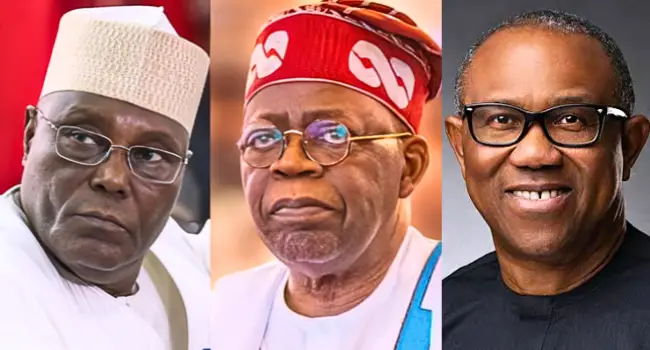
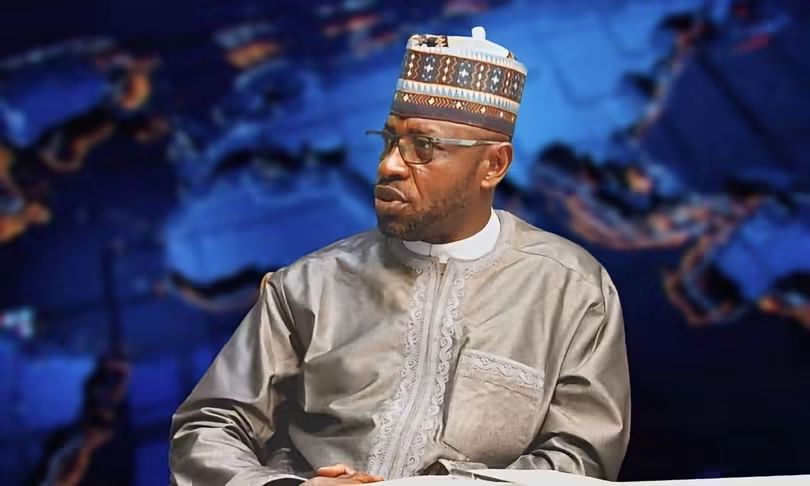
Former Jigawa State Governor and Peoples Democratic Party (PDP) chieftain, Sule Lamido, has raised the alarm over the deepening divisions within Nigeria’s opposition political parties, warning that the failure of former Vice President Atiku Abubakar and former Anambra State Governor Peter Obi to forge a common front could pave the way for President Bola Ahmed Tinubu’s re-election in 2027.
Lamido declared that the personal ambitions, political rivalries and growing hostility among leading presidential contenders had overshadowed the national interest, warning that Nigeria could emerge as the biggest casualty of the forthcoming presidential election, irrespective of who eventually wins.
Speaking on Channels Television’s Politics Today on Friday, the former governor argued that the inability of Atiku and Obi to consolidate their political strengths had significantly weakened the opposition and handed the ruling All Progressives Congress (APC) a strategic advantage ahead of the January 16, 2027, presidential election.
According to him, the political atmosphere has become increasingly dominated by propaganda, personality clashes and divisive campaigns, leaving Nigerians struggling to identify meaningful policy alternatives among the major contenders.
“I think the way things are, the propaganda and support warfare is too much. It’s too intense for even Nigeria to be able to really understand what’s happening,” Lamido said.
Atiku, Obi Divisions Strengthening Tinubu — Lamido
The former Jigawa governor maintained that President Tinubu’s political advantage was being reinforced by the APC’s growing network of serving and former governors, alongside the fragmentation of opposition forces.
He argued that the political influence and electoral structures available to Atiku and Obi could have presented a formidable challenge to the incumbent president if both leaders had agreed to work together.
“Because of the number of governors, both serving and former governors of the APC, and because Atiku and Obi divided their own force, it gives Tinubu the advantage,” he stated.
Lamido suggested that a joint presidential ticket featuring Atiku as the presidential candidate and Obi as his running mate would have significantly strengthened the opposition’s electoral prospects.
He further proposed a political arrangement under which Atiku could serve an initial four-year term before handing over to Obi, describing such an understanding as a potentially effective strategy for confronting the ruling party.
“So both Peter Obi and Atiku are simply handing Tinubu, very easily. But if they come together, it would have been a high-level canvas, you know, Atiku for president and Obi running mate, and then after four years, one takes over,” he said.
His remarks underscore the continuing debate over opposition unity and whether the fragmentation that characterised the 2023 presidential election could once again shape the outcome of the 2027 contest.
Opposition Coalition Collapses Amid Presidential Ambitions
The political disagreements between Atiku and Obi have remained a major concern among opposition stakeholders seeking to unseat President Tinubu.
Following the 2023 presidential election, opposition leaders initiated discussions aimed at building a broad political coalition capable of challenging the APC’s dominance.
The initiative gained momentum in July 2025 when prominent opposition figures adopted the African Democratic Congress (ADC) as a common political platform ahead of the 2027 general elections.
However, disagreements over party leadership, organisational structure, presidential ambitions and the sharing of political influence reportedly undermined the coalition’s unity.
The internal crisis eventually resulted in Obi leaving the ADC alongside former Kano State Governor Rabiu Musa Kwankwaso for the Nigeria Democratic Congress (NDC) in May 2026.
Obi subsequently emerged as the NDC presidential candidate, while Atiku remained in the ADC and secured the party’s presidential ticket.
The development effectively placed the two prominent opposition figures on separate political platforms, raising questions about the possibility of a united challenge against Tinubu.
Although both politicians have continued to pursue their presidential ambitions, Obi has maintained that any political alliance with Atiku must be founded on a formal agreement between their respective political parties rather than a personal understanding.
Lamido, however, believes the continued division could ultimately benefit the incumbent president, particularly in a closely contested election where opposition votes are distributed among several candidates.
Whoever Wins, Nigeria Will Lose — Lamido
Beyond the electoral calculations, Lamido expressed deeper concerns about what he described as the deterioration of national unity, political tolerance and mutual respect among Nigerians.
The PDP chieftain warned that the increasingly bitter political atmosphere could leave lasting divisions across the country, regardless of which candidate emerges victorious.
“I’ve been saying, look, whoever wins, Nigeria will lose. That’s my problem,” he declared.
“Whoever, whether Peter Obi, Atiku, whoever wins, in terms of our unity, our economy, our love as a country of brothers and sisters, it’s all gone down. It’s more about their personalities. They are abusing each other. Those things become very, very personal.”
Lamido argued that the forthcoming election should ordinarily provide an opportunity for Nigerians to assess competing visions for national development, economic recovery, security and democratic governance.
Instead, he lamented that political discourse had increasingly shifted towards personal attacks, ethnic suspicion and hostile exchanges among supporters of rival candidates.
The former governor insisted that his primary concern was not the eventual winner of the presidential contest but the long-term implications of the prevailing political hostility for Nigeria’s unity and stability.
Lamido Raises Concern Over Political Tension in North
Lamido also expressed concern over rising political tensions in northern Nigeria, warning that propaganda, hate campaigns and inflammatory political messaging could further undermine national cohesion.
He criticised the growing tendency among political actors and their supporters to promote personal rivalries at the expense of constructive engagement on pressing national challenges.
According to him, political campaigns should be centred on the welfare of citizens, the promotion of peaceful coexistence and the presentation of credible solutions to Nigeria’s socioeconomic difficulties.
“We’ve abandoned the traditional campaign on issues, about love, about empathy, about unity, about Nigeria, and then what can you offer? What can you offer? So it’s not there anymore,” he said.
His warning comes amid growing public debate over the tone of political campaigns as parties intensify preparations for the 2027 general elections.
2027: Tinubu, Atiku, Obi, Sowore Set for Presidential Contest
The January 16, 2027, presidential election is expected to feature several prominent political figures seeking to determine Nigeria’s leadership for another four-year term.
President Bola Ahmed Tinubu is seeking re-election on the platform of the ruling APC, while Atiku Abubakar is contesting under the ADC.
Peter Obi is flying the flag of the NDC, while former presidential candidate and activist Omoyele Sowore is representing the African Action Congress (AAC).
The contest is expected to test the electoral strength of the ruling party against opposition candidates campaigning on alternative approaches to governance, economic management and national development.
Political analysts have continued to examine the potential impact of opposition fragmentation on the outcome, particularly given the voting patterns recorded during the 2023 presidential election.
In that election, Tinubu emerged victorious with 8,794,726 votes, defeating Atiku, who polled 6,984,520 votes, while Obi secured 6,101,533 votes to finish third.
The results have continued to fuel discussions about whether a coordinated opposition could have produced a different electoral outcome.
However, the political dynamics ahead of 2027 remain subject to changing alliances, voter preferences, party structures and the effectiveness of nationwide campaign mobilisation.
INEC Registers Over 103 Million Voters Ahead of 2027 Polls
Meanwhile, the Independent National Electoral Commission (INEC) has scheduled the presidential and National Assembly elections for January 16, 2027, while governorship and State Houses of Assembly elections are slated for February 6, 2027.
According to figures announced by the commission, Nigeria’s National Register of Voters has risen to 103,428,715 following the three-phase Continuous Voter Registration exercise, which recorded 10,772,421 new registrations.
INEC disclosed on Tuesday, November 10, that more than 1.6 million invalid and duplicate registration records had been removed following a technical audit of the voter database.
The electoral body also reported that approximately 14 million Permanent Voter Cards (PVCs) remained uncollected nationwide as of November 2026.
It explained that the remaining Phase Three PVCs were being delivered for distribution, with collection scheduled to resume at Registration Area, or ward, levels nationwide from December 1, 2026.
For comparison, INEC recorded 93,469,008 registered voters ahead of the 2023 general elections, with 87,209,007 collecting their PVCs, representing approximately 93.3 per cent.
The growing voter register and continuing PVC collection exercise are expected to play important roles in determining the level of public participation in the forthcoming polls.
Opposition Unity Remains Major Test Ahead of 2027
As political parties intensify preparations for the presidential election, Lamido’s intervention has brought renewed attention to the question of opposition unity and the consequences of personal political ambitions.
His assessment suggests that while President Tinubu may benefit electorally from divisions among his challengers, the broader danger lies in the growing hostility that could outlast the election itself.
For Lamido, the stakes extend beyond who occupies the Presidential Villa in 2027.
The greater challenge, he argued, is whether Nigeria’s political leaders can restore issue-based campaigns, mutual respect and a shared commitment to national unity before the country goes to the polls.