Connect with us

News

Senate passes re-amended Proceeds of Crime Bill

Published

on

FEDERAL UNIVERSITY OF MEDICAL AND ENVIRONMENTAL SCIENCES, IYIN-EKITI: A LANDMARK ACHIEVEMENT OF SEN. MICHAEL. OPEYEMI BAMIDELE
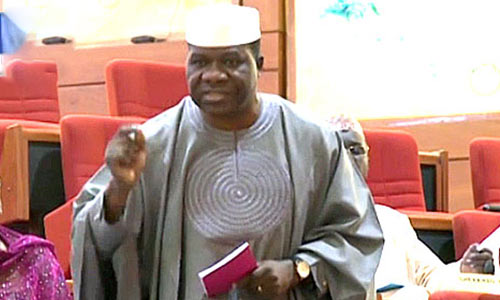
Senator Michael Opeyemi Bamidele
Share


The Senate, on Wednesday, passed a re-worked version of the Proceeds of Crime (Recovery and Management) Bill, 2022, after amending the provision of clause 74.

The passage of the bill followed the consideration of a report by the Joint Committee on Judiciary, Human Rights and Legal Matters; and Anti-Corruption and Financial Crimes.

The chamber, on 15th March, 2022, while relying on Orders 1(b) and 52(6) rescinded its decision on clause 74 of the bill as passed and re-committed same to the Committees on Judiciary, Human Rights and Legal Matters and Anti-Corruption and Financial Crimes.

Chairman of the Judiciary Committee, Senator Michael Opeyemi Bamidele, in his presentation, said after the passage of the Bill, series of reactions trailed its passage with respect to clause 74, which was amended in the course of deliberations.

In the original bill, clause 74 provides that, “Subject to the provisions of this Act, the defendant in any proceedings under this Act bears the burden of proving that he is is legitimate owner of the assets suspected to be proceeds of crime or derived from unlawful activity or that the assets is of legitimate origin and is not proceeds of unlawful activity.”
 
The Senate, however, amended the clause during consideration to provide that, “The burden of proof shall be on the investigating agencies and there shall be conviction before the property can be finally seized or forfeited to the Federal Government of Nigeria”.

The Senate, about two weeks ago, recommitted the Bill to the Joint Committee to engage the relevant Agencies with a view to safeguarding against the alleged abuse, and to report back with its recommendation.

Opeyemi stated that the Joint Committee while engaging with the investigating agencies, was told by the latter that maintaining the original provision of clause 74, as recommended by the former, was in the best interest of the country.

He said the agencies assured the Joint Committee that they would not abuse the powers conferred on them by the provision, as they (agencies) are subject to Standard Operating Procedures (SOPs) as well as the guiding principles of Chapter IV on Human Rights in the 1999 Constitution as amended.

According to the lawmaker, “the provision of the original Bill, which provides that the burden of proof lies on the defendant rather than on the Investigating Agencies, as provided in the amendment clause, is appropriate in line with global best practices and convention.”

He explained that making it mandatory for a criminal conviction to be established before forfeiture and seizure of proceeds of crime or assets derived from unlawful activities is against the general interest of the intendment of the Bill and not in conformity with similar legislations in other jurisdictions.

“Besides, the standard of proof in civil matters is on the balance of probabilities”, he said.

Opeyemi added that maintaining the provision of clause 74 of the Bill, as passed by the Senate would undoubtedly undermine Nigeria’s commitment and obligation to the United Nations Convention Against Transnational Organised Crime (UNTOC), which Nigeria is signatory to and has ratified.

He further observed that the amended clause is inconsistent with the principles of Article 12 of the United Nations Convention Against Transnational Organised Crime (UNTOC), which stipulates that States Parties may consider the possibility of requiring that “an offender demonstrate the lawful origin of alleged proceeds of crime or other property liable to confiscation.”
 
He said that one of the recommendations of the Financial Action Task Force on Non-Conviction Based Asset Forfeiture, provides that “Confiscation and provisional measures should adopt measures similar to those set forth in the Vienna Convention, the Palermo Convention, and the Terrorist Financing Convention, including legislative measures to enable competent authorities to freeze or seize and confiscate assets without prejudicing the rights of bona fide third parties.” 

The lawmaker emphasised that one of the salient intendments of clause 74 was that it ensures the recovery of proceeds of crime with or without conviction.

The report on the Proceeds of Crime Bill 2022, after consideration by the Committee of the Whole, was passed by the upper chamber in plenary.

 

Continue Reading
Click to comment

Leave a Reply

Your email address will not be published. Required fields are marked *

News

Senate Considers Review of 2025 Budget to ₦43.56 Trillion

Published

on

Senate Logo
Share

***Edun, Bagudu, others to appear before Senate Committee on Appropriations 

The Senate on Wednesday passed for second reading a Bill seeking to repeal and re-enact the 2024/2025 Appropriations Act, a move that would revise the 2025 budget size to ₦43.56 trillion.

Under the proposed expenditure framework, statutory transfers are pegged at ₦1.74 trillion, debt service at ₦8.27 trillion, recurrent (non-debt) expenditure at ₦11.27 trillion, and capital expenditure and development fund contribution at ₦22.28 trillion.

Following the development, the Senate directed the Minister of Finance, Mr. Olawale Edun; the Minister of Budget and National Planning, Senator Atiku Bagudu; and the Chairman of the Federal Inland Revenue Service, Dr. Zacch Adedeji, among others, to appear before the Senate Committee on Appropriations to provide further clarification on the proposed spending plan.

Leading the debate, the Leader of the Senate, Senator Opeyemi Bamidele, said the bill was a structural and reform-driven intervention aimed at repealing and re-enacting the existing appropriation framework to end the practice of running multiple budget cycles concurrently.

According to him, the practice had historically undermined budget clarity, weakened fiscal discipline and blurred accountability across ministries, departments and agencies. He explained that the amendment would provide a clear and orderly appropriation mechanism to lawfully consolidate and regularise expenditures considered critical, time-sensitive and unavoidable, particularly those incurred in response to emergency situations.

Bamidele noted that the proposal balanced responsiveness with fiscal responsibility, ensuring that urgent public spending does not erode legislative oversight or fiscal prudence. He added that the bill would strengthen safeguards requiring that appropriated funds be released and applied strictly for purposes approved by the National Assembly, while virement would only be permitted with prior legislative approval.

He said the provisions reaffirm the legislature’s power over public finance and ensure transparency, accountability and prudent financial management.

After the debate, the Senate, presided over by the Deputy President of the Senate, Senator Barau I. Jibrin, passed the bill to second reading and referred it to the Senate Committee on Appropriations, chaired by Senator Solomon Adeola, with a mandate to report back to plenary within two days.

Continue Reading

News

Supreme Court Affirms President’s Power to Declare Emergency Rule, Dismisses PDP Governors’ Suit

Published

on

President Bola Ahmed Tinubu
Share

The Supreme Court has upheld the president’s constitutional powers to declare a state of emergency in any part of the country to prevent a breakdown of law and order.

In a split decision of six to one, the apex court also affirmed the president’s authority to suspend elected officials for a limited period during a state of emergency.

The ruling followed a suit filed by Adamawa State alongside 10 other Peoples Democratic Party (PDP)-led states, challenging the emergency rule declared by President Bola Tinubu in Rivers State in March.

President Tinubu had suspended Governor Siminalayi Fubara, his deputy, and members of the Rivers State House of Assembly for an initial period of six months.

Delivering the majority judgment, Mohammed Idris held that Section 305 of the 1999 Constitution (as amended) grants the president the discretion to determine the measures required during a state of emergency.

The court consequently struck out and dismissed the suit for lack of jurisdiction.

The state of emergency in Rivers State was lifted in September.

Continue Reading

News

Senate Moves to Reshape Legal Profession, Proposes Two-Year Mandatory Pupillage for New Lawyers

Published

on

Senate Logo
Share

The Nigerian Senate on Wednesday considered sweeping reforms to the legal profession, passing into second reading a bill seeking to amend the Legal Practitioners Act 2004. Central to the proposal is a mandatory two-year pupillage programme for newly called lawyers, designed to align training and regulation with global best practices.

Debating the bill at plenary, lawmakers agreed that the legal system must evolve in response to technological advancement, complex commercial transactions, and growing demands for professional accountability. The bill was sponsored and led by the Leader of the Senate, Senator Opeyemi Bamidele.

According to Bamidele, the current law — nearly six decades old in design — no longer reflects contemporary realities of legal practice. He explained that the reform seeks to modernise oversight structures, strengthen discipline mechanisms, and enhance the quality of service within the profession.

A major highlight of the bill is the restructuring of the Body of Benchers, which, for the first time, will be established as a corporate legal entity with financial autonomy, strengthened secretariat, and defined rule-making authority. The reforms also introduce a clearer institutional framework for committees, oversight, and policy enforcement.

The Senate Leader stressed that the initiative would deliver “a coordinated and well-modernised regulatory framework that addresses admission to the bar, discipline, and professional standards.”

The bill also seeks to fast-track disciplinary processes by reorganising the Legal Practitioners Disciplinary Committee (LPDC). Under the proposed structure, multiple panels would sit across the country while wielding broader sanctioning powers, including suspension, disbarment, restitution, compensation, cost awards, and formal apologies. For transparency, disciplinary outcomes will be published, while affected practitioners will retain the right of appeal to the Supreme Court.

Additionally, the proposal creates a new Ethics, Adherence and Enforcement Committee empowered to inspect law offices, demand records, investigate public complaints, and prosecute cases before the LPDC.

To further boost competence, two years of compulsory pupillage and ongoing professional development will now be requirements for lawyers before full practice certification and licence renewal.

The bill also criminalises unauthorised legal practice, clearly defining the practice of law to protect the public from impersonators and unqualified service providers. Other provisions address the regulation of foreign lawyers, reform of the Senior Advocate of Nigeria rank, and improved safeguards for clients and public trust.

Speaking in support, Chief Whip of the Senate, Senator Tahir Monguno, recalled his experience entering practice over 35 years ago, noting that the realities of the digital age justify reform.

“This bill is very apt and germane,” Monguno said. “We are in the digital age, and our legal profession must reflect these realities.”

The Senate subsequently referred the bill to its Committee on Judiciary, Human Rights and Legal Matters for public hearing and a report within two weeks.


Continue Reading