Connect with us

News

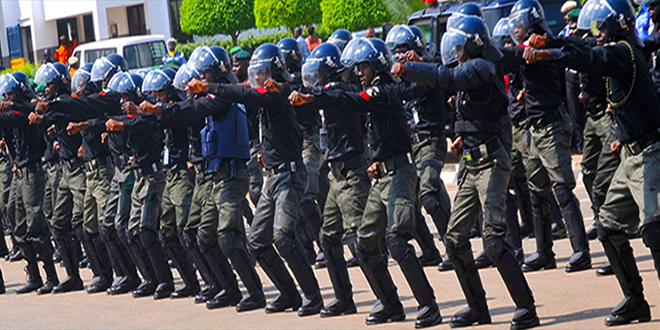
Senate moves to establish Police Pension Board

Published

on

Policemen
Nigeria Police
Share

…seeks equity in pension payments between police, military 

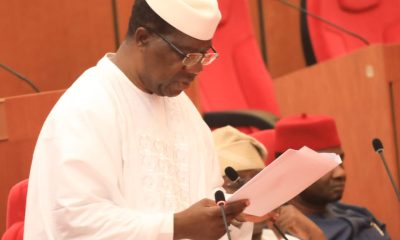
The Senate on Tuesday considered a bill seeking to establish the Police Pension Board.

The bill which scaled second reading on the floor was sponsored by Senator Elisha Ishaku (Adamawa North).

The bill was read for the first time on June 14th, 2022.

Leading the debate on the bill, Senator Ishaku noted that the current pension arrangement of the Nigeria Police is under the Pension Commission by virtue of Section 5(1) of the Pension Reform Act 2014.

According to him, the Nigeria Police, though a premier law enforcement and security agency, was left under the Contributory Pension Scheme unlike the Army, Navy, Airforce, Department of State Security Services (DSS), Defence Intelligence Agency (DIA), and the National Intelligence Agency (NIA), that have their Pension Boards, respectively.

“The resultant inclusion and continuous stay of the NPF in PENCOM has placed them on the wrong end of the post service emolument life, even though the Nigeria Police is saddled with the responsibility of not only protecting the lives and property of the citizenry, but also detecting crimes, preventing crimes, investigating crimes and prosecuting offences”, he said.

The lawmaker, expressed dismay at the disparities between the pension and gratuity benefits of the Nigeria Police and those of her counterpart in the military.

“A cursory look at the difference between the pension and gratuity benefits of the Nigeria Police and her counterpart in the Military shows, for example, the benefit of a Deputy Superintendent of Police (DSP) under the current Pension Scheme is N2.5 million and that of an Assistant Superintendent of Police (ASP) is N1.5 million, while their equivalents of DSP in the Army (Captain), Navy (Lieutenant), Air Force (Flight Lieutenant) and the DSS (Captain) are paid N12.8 million and N10.3 million, respectively”, Senator Ishaku said.

He added that ensuring equity and justice in the payment of pensions would boost the morale of serving personnel, as well as enhance the standard of living of the retired personnel of the Nigerian Police Force.

The Police Pension Board (Establishment) Bill 2022, after scaling second reading, was referred by the Senate President, Ahmad Lawan, to the Committee on Police Affairs for further work.

The Committee was given four weeks to report back to the chamber in plenary.

Also, a bill for an Act to Repeal the Administration of Criminal Justice Act 2015 and enact the Administration of Criminal Justice Bill, 2022, scaled second reading during plenary.

The bill sponsored by Senator Emmanuel Orker-Jev (Benue North West), seeks to provide for the establishment of administration of criminal justice monitoring council for effective and efficient administration of justice in Nigeria.

The bill after consideration was referred by the Senate President to the Committee on Judiciary, Human Rights and Legal Matters for further inputs.

The Senator Opeyemi Bamidele-led Committee was also given four weeks to turn in its report.

Continue Reading
Click to comment

Leave a Reply

Your email address will not be published. Required fields are marked *

News

Tinubu Renames Federal University of Medical Sciences, Azare, After Late Islamic Scholar Sheikh Dahiru Usman Bauchi

Published

on

Share

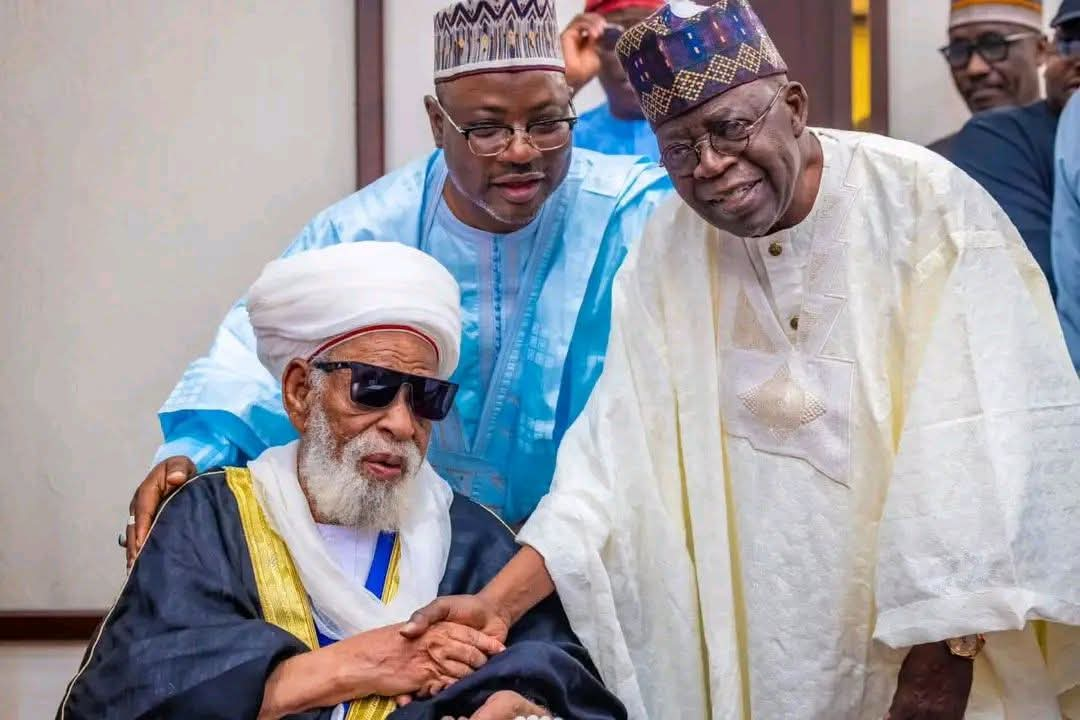
President Bola Ahmed Tinubu has approved the renaming of the Federal University of Medical Sciences, Azare, Bauchi State, in honour of the late renowned Islamic scholar, Sheikh Dahiru Usman Bauchi.

The President announced the decision on Saturday during a condolence visit to the family of the revered cleric at his country home in Bauchi State. According to Tinubu, the renaming is aimed at immortalising the scholar’s enduring legacy and his immense contributions to humanity, religious scholarship, and peaceful coexistence.

“From today onward, I announce this change of name to immortalise him. The Federal University of Medical Sciences, Azare, Bauchi State, will from today be known as Sheikh Dahiru Usman Bauchi University. May God bless his memory,” the President declared.

Describing the passing of the cleric as a “great national loss,” Tinubu said Sheikh Dahiru Bauchi lived a life defined by humility, selfless service, and unwavering dedication to the propagation of Islam, peace, and moral values across communities.

He prayed for Allah’s mercy upon the soul of the late scholar and asked that he be granted Aljannatul Firdaus. The President also prayed for strength and comfort for the family, the government, and the people of Bauchi State, urging Nigerians to continue to pray for peace, unity, and national harmony.

Speaking on behalf of the family, the eldest son of the late cleric, Sheikh Ibrahim Usman Bauchi, expressed profound gratitude to the President for the condolence visit, prayers, and the honour bestowed on their father. He also thanked Bala Mohammed, Governor of Bauchi State, for his consistent support to the family.

In his remarks, Governor Mohammed commended the President for honouring the family and Bauchi State, describing the gesture as a fitting recognition of Sheikh Dahiru Bauchi’s lifelong commitment to faith, education, and national unity. He noted that the late scholar’s influence transcended Bauchi and Nigeria, touching lives across generations.

The President was accompanied on the visit by the Speaker of the House of Representatives, Tajudeen Abbas; the Governor of Yobe State, Mai Mala Buni; and Seyi Tinubu, among other top government officials.

Tinubu arrived at the Sir Abubakar Tafawa Balewa International Airport, Bauchi, at about 4:09 p.m., where he was received with a guard of honour by the Nigerian Air Force. He was welcomed by Governor Bala Mohammed; the Governor of Plateau State, Caleb Mutfwang; the Coordinating Minister of Health and Social Welfare, Ali Pate; the Minister of Foreign Affairs, Yusuf Tuggar; and the Senator representing Bauchi South Senatorial District, Shehu Buba.

The condolence visit formed part of the President’s broader engagements to commiserate with the family and followers of the late Islamic scholar, whose influence and contributions to Islamic learning and spiritual leadership spanned decades across Nigeria and beyond.

Continue Reading

News

Tinubu Begins Multi-State Tour, Heads to Borno, Bauchi and Lagos

Published

on

President Bola Ahmed Tinubu
Share

President Bola Ahmed Tinubu is scheduled to depart Abuja on Saturday on a multi-state visit that will take him to Borno State, Bauchi State and Lagos State, as part of official and personal engagements.

The President’s first stop will be Borno State, where he is expected to commission a number of projects executed by the state government under Governor Babagana Zulum, in collaboration with the Federal Government. The projects are part of ongoing efforts to strengthen infrastructure, governance and post-conflict recovery in the North-East.

While in Maiduguri, President Tinubu will also attend the wedding ceremony of Sadeeq Sheriff, son of former Borno State Governor and Senator, Ali Modu Sheriff, and his bride, Hadiza Kam Salem.

From Borno, the President will proceed to Bauchi State for a condolence visit to the state government and the family of Sheikh Dahiru Bauchi, the late Islamic scholar and spiritual leader of the Tijjaniyya Muslim Brotherhood. The revered cleric passed away on November 27, drawing tributes from across Nigeria and beyond for his decades of religious scholarship and leadership.

Following the condolence visit, President Tinubu will travel to Lagos State, where he will spend the end-of-year holidays. During his stay, the President is expected to participate in several engagements, including serving as Guest of Honour at the annual Eyo Festival scheduled for December 27.

The festival, to be held at Tafawa Balewa Square, will honour notable personalities, including President Tinubu’s mother, Alhaja Abibatu Mogaji, as well as former Lagos State governors Lateef Jakande and Michael Otedola.

The trip underscores the President’s blend of official duties, cultural engagements and personal commitments as the year draws to a close.

Continue Reading

News

Senate Considers Review of 2025 Budget to ₦43.56 Trillion

Published

on

Senate Logo
Share

***Edun, Bagudu, others to appear before Senate Committee on Appropriations 

The Senate on Wednesday passed for second reading a Bill seeking to repeal and re-enact the 2024/2025 Appropriations Act, a move that would revise the 2025 budget size to ₦43.56 trillion.

Under the proposed expenditure framework, statutory transfers are pegged at ₦1.74 trillion, debt service at ₦8.27 trillion, recurrent (non-debt) expenditure at ₦11.27 trillion, and capital expenditure and development fund contribution at ₦22.28 trillion.

Following the development, the Senate directed the Minister of Finance, Mr. Olawale Edun; the Minister of Budget and National Planning, Senator Atiku Bagudu; and the Chairman of the Federal Inland Revenue Service, Dr. Zacch Adedeji, among others, to appear before the Senate Committee on Appropriations to provide further clarification on the proposed spending plan.

Leading the debate, the Leader of the Senate, Senator Opeyemi Bamidele, said the bill was a structural and reform-driven intervention aimed at repealing and re-enacting the existing appropriation framework to end the practice of running multiple budget cycles concurrently.

According to him, the practice had historically undermined budget clarity, weakened fiscal discipline and blurred accountability across ministries, departments and agencies. He explained that the amendment would provide a clear and orderly appropriation mechanism to lawfully consolidate and regularise expenditures considered critical, time-sensitive and unavoidable, particularly those incurred in response to emergency situations.

Bamidele noted that the proposal balanced responsiveness with fiscal responsibility, ensuring that urgent public spending does not erode legislative oversight or fiscal prudence. He added that the bill would strengthen safeguards requiring that appropriated funds be released and applied strictly for purposes approved by the National Assembly, while virement would only be permitted with prior legislative approval.

He said the provisions reaffirm the legislature’s power over public finance and ensure transparency, accountability and prudent financial management.

After the debate, the Senate, presided over by the Deputy President of the Senate, Senator Barau I. Jibrin, passed the bill to second reading and referred it to the Senate Committee on Appropriations, chaired by Senator Solomon Adeola, with a mandate to report back to plenary within two days.

Continue Reading