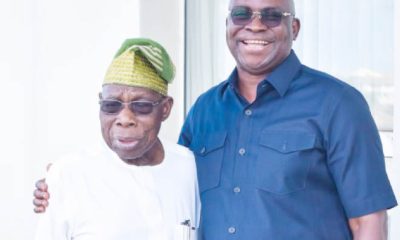
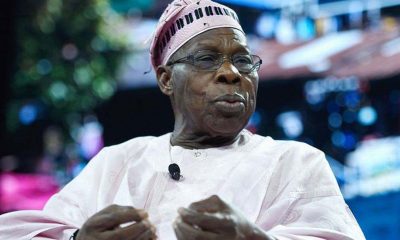
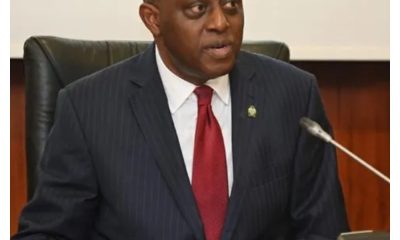
At 88, former President Olusegun Obasanjo is not mincing words about the urgency he feels for Nigeria’s progress. Reflecting on his journey through soldiering, statesmanship, imprisonment, and authorship, Obasanjo says he is “in a hurry” to see Nigeria rise before he takes his final bow from life’s stage.
“I am getting close to my departure lounge,” he admitted with rare candour, “but I remain deeply concerned about Nigeria’s future.”
Obasanjo, who led Nigeria first as military Head of State (1976–1979) and later as a civilian President (1999–2007), has never shied away from controversy. His just-released book, Nigeria: Past and Future, is another blunt assessment of the country’s leadership failures, one that spares neither the dead nor the living.
He describes the administration of the late Muhammadu Buhari (2015–2023) as “the worst civil administration regime so far in Nigeria’s history”, accusing it of waste, inefficiency, and unfulfilled promises. “Words are cheap,” he wrote, recalling how Buhari once justified a coup by condemning corruption and mismanagement, only to fall into the same traps decades later as an elected leader.
The late president’s spokesman, Garba Shehu, has fired back, accusing Obasanjo of harbouring personal grudges, especially over the contentious Mambilla Power Project. But Obasanjo shrugs off such insinuations. “Some accuse me of being guilty of what I write about others. I rely on my conscience and my records,” he said firmly.
Even the current government of President Bola Tinubu does not escape his scathing critique. “Only Tinubu’s administration seems to be competing with Buhari’s (in inefficiency) for now,” he declared.
Yet behind the fiery criticism lies an old soldier who insists his actions are driven by love, not malice. “All my writings have been aimed at making Nigeria better,” he explained. From his early memoir My Command to his monumental three-volume autobiography My Watch, Obasanjo has chronicled his triumphs, mistakes, and lessons for future generations.
His life has been a blend of privilege and pain: commanding troops during the civil war, helping Nigeria return to civilian rule, suffering imprisonment under Sani Abacha, and later presiding over one of Nigeria’s most ambitious reform agendas.
Now, as age and experience weigh on him, Obasanjo says his legacy will speak louder than detractors. “Yes, I am both angry and sad because I have seen the best and the worst of our country. With hindsight, we know we made some mistakes, but again we did some great things in our country, for our country and for Africa.”
For him, the urgency remains personal. “We were young, maybe naïve at times, but we were patriotic and committed. We sought to feed our people, provide infrastructure, prioritise education, and bring Nigeria to modernity. That dream remains unfinished.”
In his twilight years, Obasanjo’s voice still carries the force of a soldier’s command and the lament of a patriot. He may be close to the “departure lounge,” but he is not ready to board until he sees at least a glimpse of the Nigeria he has always fought for.