Politics
2023 Elections: Why Govt Cannot Fund Political Parties – Gbajabiamila
Published
4 years agoon
By
News Editor
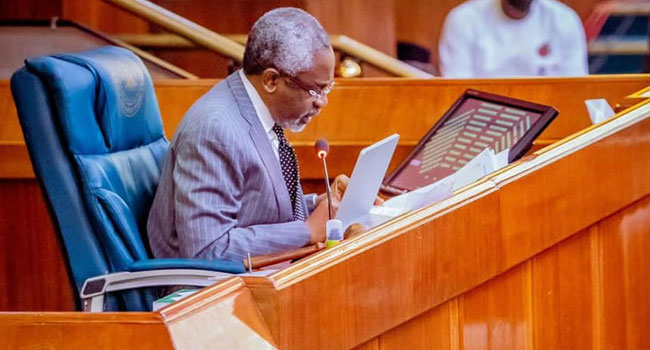
The Speaker of the House of Representatives, Femi Gbajabiamila, says it is not fashionable to expect the Federal Government to fund political parties at this critical period of Nigeria’s democratic advancement.
For him, using the government’s money to run the parties is an indirect invitation for it to assume control of the political parties by dictating choices and policies that might be in conflict with the tenets of democracy.
Gbajabiamila, who argued that the international best practice was for parties to be self-funded, added that using the government’s money would also lead to the proliferation of political parties.
He made the remarks on Wednesday while receiving a delegation of the Inter-Party Advisory Council (IPAC) at the National Assembly in Abuja.
The speaker stated that people would simply abuse the process by registering hundreds of political parties in the hope of cashing out on free government money.
“I am not sure how many countries fund their political parties; we will have to do research and to be sure that it’s international best practice …Government is an interested party if it will be providing the funds,” he was quoted as saying in a statement by his media aide, Lanre Lasisi.
“That will also mean they can compromise the system. There is also proliferation (of parties) that will become a problem if the government begins to fund the parties since there will be free money.”
Gbajabiamila, who also reacted to requests for fresh amendments to the Electoral Act 2022, said it was not advisable to do so a few months before the 2023 general elections.
He explained that making new amendments to the law during this period could disorganise election planning, create unnecessary tension in the polity, and raise credibility questions.
The Speaker said the safest route would be to further amend the Act after the elections if a need arose, or in the alternative, aggrieved persons could approach the judiciary to seek an interpretation of any contentious provisions.
He called for patience, urging parties to seize the opportunity of the upcoming polls to fully test the Act and determine the success of innovations, such as the electronic transmission of results, and the deployment of the BIVAS, among others.
Gbajabiamila added that upon a successful poll, other innovations such as electronic collation of results and diaspora voting could also be considered.
The IPAC delegation was led by the body’s national chairman, Yabagi Sani, who told the speaker the purpose of the visit was to seek synergy and a good working relationship between IPAC and the National Assembly.
Among the issues, he tabled before Gbajabiamila were the alleged flouting of Section 31 of the Electoral Act by the Independent National Electoral Commission (INEC), the funding of political parties, the urgency to establish the electoral offences commission, electronic collation of election results in addition to the electronic transmission of results, and the call for a change in the process of appointing the chairman of INEC.
For instance, he complained that while the law allowed political parties to replace candidates 90 days before the election, INEC opted to shut its portal when the days had yet to elapse, preferring to use its rules and regulations in determining the fate of the political parties and their candidates.
“A lot of people are being disenfranchised because INEC says we can’t substitute anybody even though the 90 days haven’t elapsed,” Sani said. “Do the INEC rules and regulations supersede the Electoral Act?”
The IPAC chairman said since it was the legislature that made the Act, the body was reporting INEC to the House so that lawmakers could caution the commission or invite the leadership of the electoral umpire for questioning.
He expressed concern that the issue had led to much litigation against INEC already, saying that if not resolved quickly, some of the cases could cause a setback to the electoral system in the future.
On electronic collation of results, Sani said while it was commendable that the results would be transmitted electronically, the collation would still be done manually, which he feared might be compromised.
Politics
Tinubu, Obi, Adebayo, Sowore: Sign Peace Pact to Shun Violence Ahead Of 2027 Poll
Published
5 days agoon
August 19, 2026
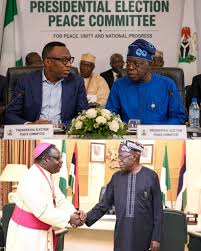
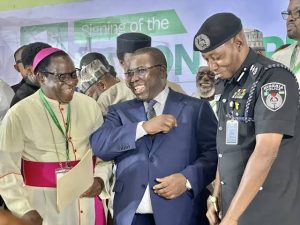
Political parties and presidential and National Assembly candidates on Tuesday signed the first National Peace Accord ahead of the 2027 general elections, pledging to shun violence, hate speech, misinformation and personal attacks during campaigns.
The ceremony, organized by the National Peace Committee in partnership with The Kukah Centre, was held in Abuja barely 24 hours before the statutory commencement of public campaigns on Wednesday, August 19, 2026.
Those who signed included President Bola Tinubu, represented by Secretary to the Government of the Federation, Senator George Akume; Nigeria Democratic Congress candidate Peter Obi; Social Democratic Party candidate Adewole Adebayo; and African Action Congress candidate Omoyele Sowore.
Also present were APC National Chairman Prof Nentawe Yilwatda; PRP presidential candidate Donald Duke; Labour Party’s Chibuzor Okereke; Deputy Senate President Barau Jibrin; PRP National Chairman Hakeem Baba-Ahmed; INEC Chairman Prof Joash Amupitan; and IGP Olatunji Disu.
Notable absentees were ADC presidential candidate Atiku Abubakar and APM candidate, Oyo State Governor Seyi Makinde.
General Abdulsalami Abubakar, Chairman of the National Peace Committee, was represented by former Chief of Defence Staff, General Martin Agwai.
Speaking through Akume, President Tinubu urged parties to prioritize national interest and campaign on ideas, not ethnicity or religion.
“Signing this peace accord is a solemn pledge to the Nigerian people that we, as leaders, will put the nation’s interests above personal or partisan ambitions,” he said.
The President said the APC rejects “violence, hate speech, the spread of misinformation, including through artificial intelligence, and all forms of incitement, especially via social media,” and called for peaceful, transparent elections.
INEC Chairman Prof Amupitan described the accord as an effort to define “the ethical boundaries of their contest” before campaigns begin. He warned of an “alarming resurgence” of hate speech, toxic polarization and AI-driven misinformation.
“Electoral contests in a constitutional democracy are not total wars; they are competitive job interviews before the electorate. Nigerians do not want insults; they want solutions,” Amupitan said.
He challenged candidates to focus on the economy, security, infrastructure, healthcare, education and social inclusion. The INEC boss also disclosed that the commission will deploy about 1.4 million ad hoc personnel across more than 176,000 polling units for the 2027 polls.
“Leadership attained at the expense of public peace, institutional integrity, or human life is a hollow victory,” he warned.
According to INEC’s revised timetable, presidential and National Assembly elections will hold on January 16, 2027, while governorship and State House of Assembly elections are scheduled for February 6, 2027.
The National Peace Committee said it has facilitated 30 peace accords since 2015 and established faith-based peace structures in 23 states to support peaceful elections.
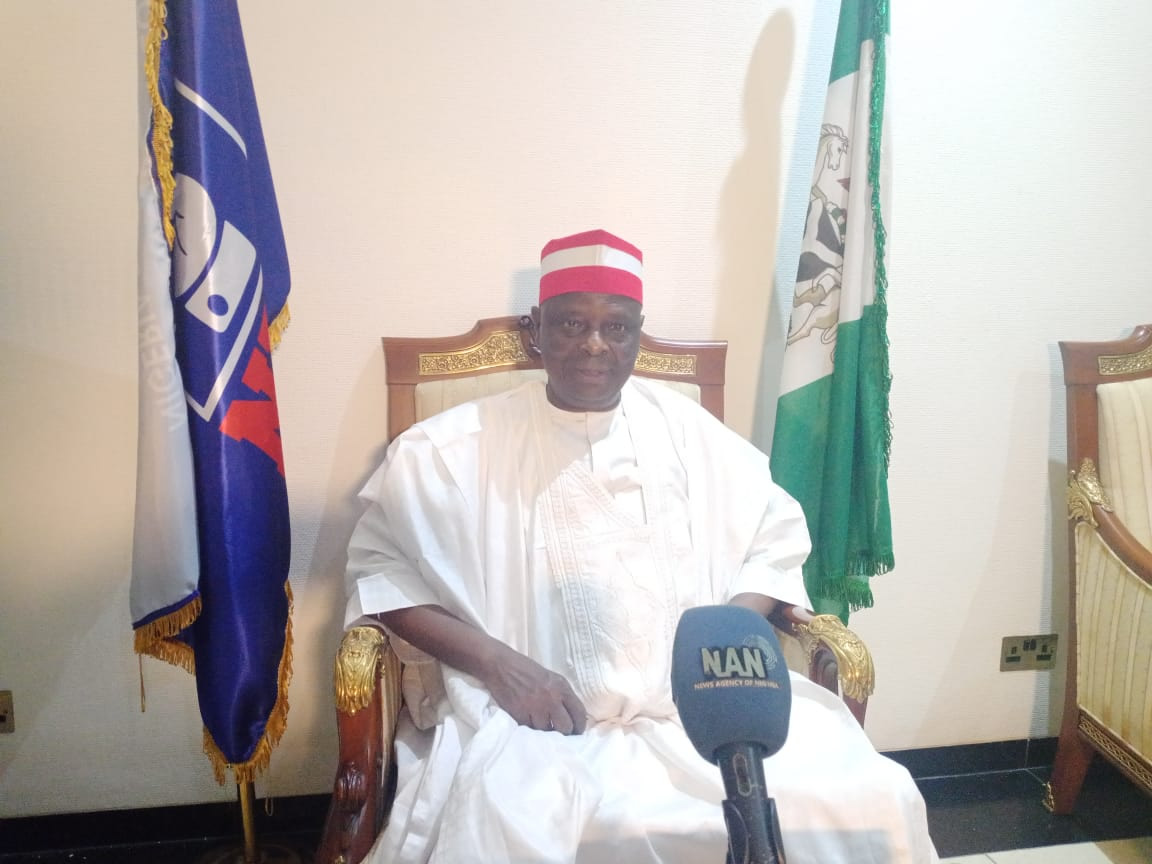
Vice-Presidential Candidate of National Democratic Congress (NDC), Sen. Rabiu Kwankwaso, says his decision to be running mate to Mr Peter Obi in the 2027 election is for national balance, equity and democratic change.
Kwankwaso said this when he featured on the News Agency of Nigeria (NAN) Personality Interview Series in Abuja on Sunday.
He explained that his experience from the 2023 election had helped him understand Obi better and that he was convinced that both of them could work together in the interest of the country.
Kwankwaso, a former Kano State governor, said the decision was also influenced by the need to allow the South to retain the presidency for another term after the completion of an eight-year tenure by former President Muhammadu Buhari.
“People learn every day and that is why experience is very important. In 2023, we attempted to work together and at that particular point, I knew little about Peter Obi.
“But over these last four years, I was able to learn a lot and realised that Peter is somebody that I could work together with,” he said.
He said that the decision was reached after consultations with members of the Kwankwasiyya Movement, supporters of the New Nigeria Peoples Party (NNPP) and the Obidient Movement.
He said that the groups believed that the country needed a balanced ticket capable of attracting support from both the North and the South.
Kwankwaso said the security challenges confronting the country, alongside declining agricultural productivity and deteriorating infrastructure further strengthened his resolve to support a political arrangement capable of bringing democratic change.
He said the economic hardship had particularly affected farmers, especially in Northern Nigeria, where agricultural production had become increasingly difficult and unprofitable.
The former Defence Minister said the dilapidation of infrastructure across the country, except in some areas such as Lagos, was another reason for accepting to pair with Obi.
He said the current situation required the kind of democratic change that Nigerians sought in 2015, adding that the need for such change was now greater.
Kwankwaso said the Obi-Kwankwaso ticket would provide a combination of regional balance, competence and credibility.
“Nobody, no ticket can beat our own in terms of credibility, in terms of capacity and of course, in terms of love for the country; even in terms of empathy for the poor that are suffering across the country today,” he said.
He explained that agreeing to serve as vice-president was not a setback for him, despite his extensive political experience, including serving as deputy speaker of the House of Representatives, governor, minister and senator.
“I have never been the vice-president. I think it is a step forward despite all the things you counted,” he said.
Kwankwaso said his decision was based on a broader national interest rather than personal ambition, stressing that public office should primarily be viewed as an opportunity to serve.
“To me, being in government is to serve. I don’t have to be president. I don’t have to even be vice-president. These are things that are in the hands of Almighty Allah.
“But the fact remains that the situation, as it is today, one has to look at it beyond your humble self,” he said.
He said the agreement with Obi was for the South to produce the president for one term, after which the political arrangement would return to the North.
Kwankwaso cited historical examples of political leaders who had accepted positions below what they could have attained, including Sir Ahmadu Bello, who chose to remain Premier of Northern Nigeria rather than becoming Prime Minister.
He also said Nigerians should understand that service could be rendered at different levels, including as councillor, local government chairman, legislator, governor, minister, vice-president or president.
According to him, political leaders should be prepared to serve wherever they are needed, rather than considering certain offices beneath them.
He dismissed claims by political opponents that his political engagements with the All Progressives Congress (APC) or other parties were contingent on securing either the presidential or vice-presidential ticket.
Kwankwaso said discussions he held with President Bola Tinubu after the 2023 election were about working together and not about abandoning NNPP or securing a particular position.
He said he had previously played a major role in the APC’s electoral victory, particularly through the votes recorded in Kano in 2015, but became disappointed with the party’s leadership after the election.
The former governor said his confidence in the Obi-Kwankwaso alliance was strengthened by what he described as Obi’s commitment to fairness, justice and national unity.
He said the arrangement would also ensure that the North would not be disadvantaged, stressing that the one-term understanding was important in securing the confidence of his supporters.
Kwankwaso said he was confident that Obi would respect the agreement and work with him as a partner rather than treat the vice-president as a “spare tyre.”
He said his experience as deputy speaker, minister and governor had taught him the importance of allowing deputies to function effectively.
According to him, a president or governor who gives his deputy meaningful responsibilities ultimately strengthens the government because the success of the deputy also benefits the principal.
He said he was therefore comfortable with the proposed arrangement and had confidence that Obi would allow him to contribute meaningfully to governance.
Kwankwaso said the alliance would prioritise competence in the appointment of ministers and other officials, with power shared according to the needs of the country rather than for political patronage.
“Power will be shared according to the needs of the country. We should not be in a hurry to go and take anybody on the streets or anybody we remember.
“We will make sure that we have competent people because from our experience, the president and vice-president cannot do it alone,” he said.
The former governor said an NDC administration would need technocrats, professionals and experienced politicians capable of addressing Nigeria’s complex challenges.
Source: NAN
Politics
Osun Election: NYSC Commends Corps Member Over Discipline and Commitment to Duty
Published
1 week agoon
August 16, 2026
The Osun Coordinator of National Youth Service Corps (NYSC), Mr Ekeng Kubiangha, has commended corps members deployed as ad hoc staff for Saturday’s governorship election for their discipline and commitment to duty during the exercise.
This is contained in a statement made available to newsmen by the Spokesperson for the scheme, Mrs Catherine Otemuyiwa, on Sunday in Osogbo.
Otemuyiwa said that Kubiangha monitored some selected polling units across Ede South, Ede North, Olorunda, Osogbo and Egbedore Local Government Areas of the state where corps members were deployed.
She listed other polling units visited by the state coordinator to include Alajue 1 and Alajue 2, Akoda/Oloki, Isibo/Buhari-Isola wards and some parts of Osogbo, where he assessed the safety and welfare of the corps members.
Otemuyiwa quoted the state coordinator as expressing satisfaction with the conduct of the corps members.
He said that they adhered to instructions, operational guidelines and safety advisories issued during the sensitisation tour of the local government areas.
“I am glad that corps members also complied with directives from the NYSC National Directorate Headquarters and the South-West Area Office 1.
“Corps members were safe and discharged their responsibilities without fear, intimidation or undue interference,” he said.
Kubiangha commended the officers who manned the Situation Room as well as Zonal Inspectors and Local Government Inspectors for their effective coordination and monitoring of corps members throughout the exercise.
He also appreciated security agencies for their efforts in protecting corps members deployed for election duties across the state.
The state coordinator expressed appreciation to INEC officials for their prompt response to issues reported from the field.
He acknowledged the cooperation among the various stakeholders, particularly under the Inter-Consultative Committee on Election Security (ICCES), describing it as a significant factor in ensuring a peaceful and orderly election.
Kubiangha reiterated NYSC’s commitment to the safety and welfare of corps members, urging them to continue to uphold the ideals of the scheme, professionalism and national service in the discharge of their responsibilities.
Latest News
Yari Predicts Tinubu’s 2027 Victory, APC to Retain Power Beyond 2031
Share Director-General of the All Progressives Congress (APC) Presidential Campaign Council, Abdul’Aziz Yari, has expressed confidence that President Bola Ahmed...
CLE Bans Five Law Students From Bar Final Exam For 10 Years
Share The Council of Legal Education (CLE) has barred five law students from taking the Bar Final Examination for 10...
FG unveils New Reforms to Tackle Almajiri, Out of School Children
ShareThe Federal Government has unveiled new reforms aimed at ensuring every Nigerian child returns to school and acquires relevant knowledge...
How Tracking Helped ICPC Recover N2.06bn From Kaduna Projects
ShareThe tracking of 31 constituency and executive projects across the three senatorial districts of Kaduna State, has enabled the Independent...
JAMB: How Candidates Can Upload Result On Portal Without Visiting CBT Centre
ShareThe Joint Admissions and Matriculation Board has introduced a new way candidates can now verify and upload their O’level results...