Connect with us

Science & Tech

GOOGLE EQUIANO SEA CABLE SYSTEM LANDS IN LAGOS

Published

on

GOOGLE EQUIANO SEA CABLE SYSTEM LANDS IN LAGOS
Share


•It will generate 1.6m jobs, $10b GDP for Nigeria, says Sanwo-Olu

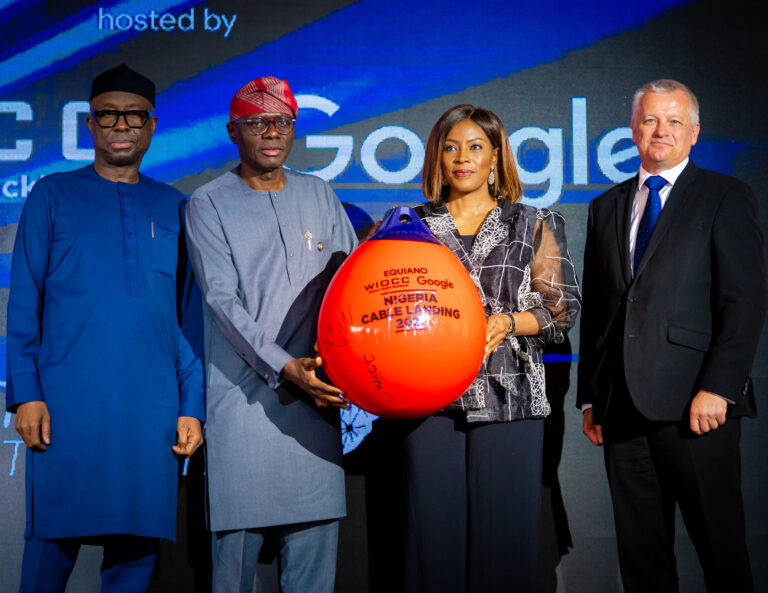
Lagos State Governor, Mr. Babajide Sanwo-Olu on Thursday witnessed the virtual landing of the Google Equiano Sea Cable System in Nigeria, saying the country will enjoy a boost of 1.6 million jobs and $10 billion in additional Gross Domestic Product (GDP) over the next three years, on account of the new cable system.

He said with the landing of the sea cable system and other investments in high-speed internet, Lagos is about to witness an unprecedented digital revolution that will cement its global reputation as a hub for entrepreneurial innovation.

Speaking at the reception marking the landing of the Equiano Sea Cable System in Nigeria on Thursday at the Open Access Data Centre at Lekki in Lagos, Governor Sanwo-Olu said the new cable system is the latest element in the transformation of the physical infrastructure landscape, new roads, bridges, jetties, factories, municipal and national rail lines, among others being delivered by his administration and a host of partners and stakeholders across public and private sectors.

The landing of Equiano Sea Cable System will firmly position Nigeria as the regional connectivity and content hub for West Africa, attracting cloud operators, content providers, content distribution networks and their associated ecosystems.

It is significant and a demonstration of the seriousness with which Google LLC views Nigeria, the economic and demographic giant of Africa.

The new cable system is named after a Nigerian hero, Olaudah Equiano, who survived enslavement in the 18th century and went on to become a famous writer and anti-slavery activist.

Governor Sanwo-Olu said his administration is more than ever determined to deliver on its promise to make and maintain Lagos as a safe, livable, innovative and prosperous megacity.

He said: “I am told that this new Equiano cable system, landing today, will deliver twenty times as much network capacity as any of the existing systems serving Nigeria.

“This means much faster internet speed, reduced cost, and greater access for our people. The net effect of this is much-needed jobs and economic growth. The economic impact assessment for the project estimates that Nigeria will enjoy a boost of 1.6 million jobs and 10 billion dollars in additional Gross Domestic Product (GDP) over the next three years, on account of the new cable system.

“There is much to be excited about, at a time like this in the unfolding history of Lagos State and of Nigeria. We are seeing an unprecedented inflow of investments into every part of Lagos, from local and foreign investors who understand the immense business and commercial potential that the State symbolises.

“We say it often, that wherever Lagos goes, Nigeria and West Africa follow. With this in mind, as the government of Lagos State, we are more than ever determined to deliver on our promise to make and maintain Lagos as a safe, livable, innovative and prosperous megacity.”

Governor Sanwo-Olu also commended Google LLC, the West Indian Ocean Cable Company (WIOCC) and other investors for identifying with his administration’s vision for a truly 21st century Lagos and a megacity all will forever be proud of.

“I congratulate Google LLC for envisioning this huge project, and the West Indian Ocean Cable Company (WIOCC) for helping implement it to the highest levels of excellence. Your partnership is commendable, and should be seen as a model by other players in the ecosystem, a testament to how much can be achieved when synergy is pursued.

“In addition to this cable system, I am told that WIOCC is presently completing, on this same site, a Tier III certified, Open Access Data Centre, which will also host the landing station for the Equiano cable. This data centre will be the most client-centric data centre, and the largest data center campus, in West Africa,” he said.

Speaking earlier, the Chief Executive Officer (CEO) of WIOCC, Chris Wood, described the landing of the submarine cables as a major investment for Nigeria’s digital economy and Lagos State in particular.

He said the submarine cables will deliver high-speed internet connectivity at a reduced cost

Wood also appreciated Governor Sanwo-Olu for providing an enabling environment for the investment of this nature to birth in Lagos State.

Continue Reading
Click to comment

Leave a Reply

Your email address will not be published. Required fields are marked *

Science & Tech

2nd World Humanoid Robot Games Take Off in Beijing: Chinese Robot Breaks Usain Bolt’s World Record

Published

on

Share

As the second ⁠edition of World Humanoid Robot Games kicked off at the National Speed Skating Oval for the 2022 Winter Olympics, in Beijing, a Chinese robot named Lightning ⁠has run ​the 100m in 9.32 seconds, ⁠beating the human world ⁠record, held by the Jamaican, Usain bolt, in 2009.

The humanoid, developed by the Chinese smartphone manufacturer Honor, ‌reached a peak speed of 14.5 metres per second during ‌a test event for ​the second World Humanoid Robot Games. The ​performance surpassed ​the ​9.58sec men’s ​100m world record ​set ​by Usain Bolt 17 years ago at the World Athletics Championships in Berlin.

China is in the lead of promoting humanoid robots as an emerging industry, with policymakers and companies ‌believing that these advances in AI and hardware will accelerate their deployment in manufacturing, logistics ​and consumer applications.

Lightning also won the Beijing half marathon in April in 50 minutes and 26 seconds, faster than the men’s world record. The robot stood 169cm tall and ​had ​95cm-long legs at ​the half marathon.

Researchers have since lengthened ​its legs ‌by 10​cm for these Games.

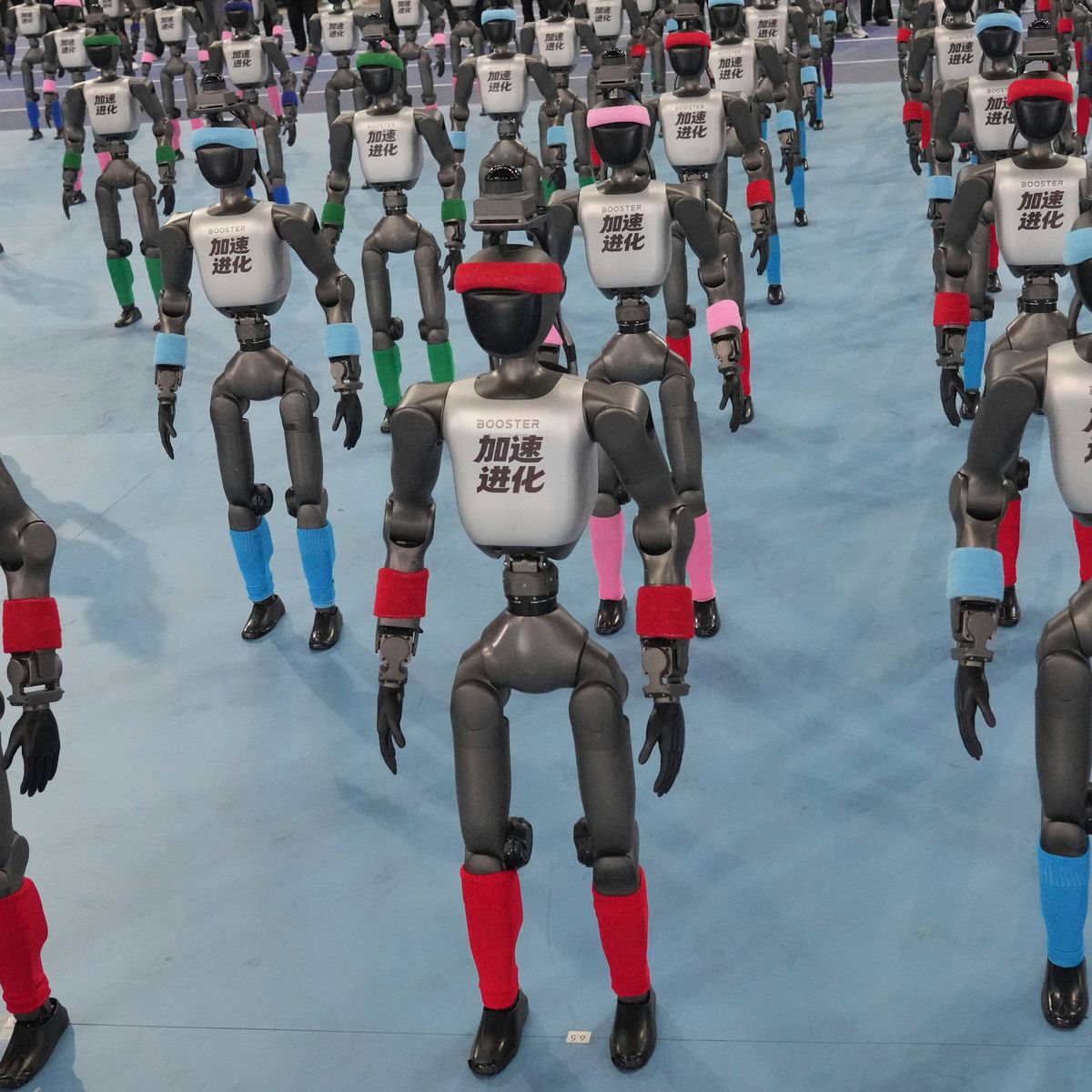
More than 2,000 humanoid robots are participating in the second edition of the five-day games, with the spectacle intended to demonstrate China’s rapid progress in advanced robotics as the technology race with the US heats up.

This edition has 51 events and more than 1,000 competitions taking place including running, table tennis and football.

The games opened the same week as Beijing held the 2026 World Robot Conference, where companies showcased around 3,000 products, including humanoid robots. China makes the majority of the world’s humanoid robots.

In what’s believed to be targeting China, last month, the US Federal Communications Commission announced a ban on imports of new foreign-made humanoid robots. The Pentagon recently also added Unitree, one of China’s leading humanoid robot makers, to its list of companies that it deemed have ties with the Chinese military. Beijing has hit back at the accusations.

At Saturday’s opening of the robot games, the organisers and robot makers said that Chinese humanoid robots defeated human world records, as hundreds of humanoid robots marched in formation on to the field in a massive display of synchronised coordination.

In a standing high jump, a humanoid robot was able to reach 2.88m, well above the 0.95m best result by a humanoid in last year’s first edition of the games.

It equally surpassed the human high jump record of 2.45m set by Cuba’s Javier Sotomayor in 1993. Both robots were from Beijing-based X-Humanoid.

Experts say humanoid robots are still mostly used for demonstrations, performances and research – at least for now – and it will take time to achieve mass real-world deployment. Some spectators at the robot games said they were excited about the humanoid robots’ quickly improving abilities.

Press reports indicate that humanoid robots are “evolving rapidly”, said Li Yanfeng, an education worker and a Beijing resident. “At first, I wasn’t very accepting of artificial intelligence. I was even a bit resistant to it, because of the possibility that it might replace or displace humans,” she said. “But now that I see this development is unstoppable, I decided to come and take a look.”

Yang Shangzheng, another spectator, said: “These sports are perfectly normal for humans, but now robots can do them. I find it amazing.” Liu Tao, who was watching the games with his son, said he was hoping to see “the best robots China currently has to offer”.

This year’s robot games – which the organisers say has 16 countries participating, among them Germany, Japan and the US – also includes other events such as weightlifting and tug of war.

Continue Reading

Science & Tech

Young Nigerian Drone Makers Richer $52 Million: Plan Ghana Factory Africa’s Largest

Published

on

Share

Nigerian defence-technology startup Terra Industries has raised another $18 million, taking its seed funding to $52 million amid preparation to open a drone factory in Ghana and launch its first international office in London.

Nathan Nwachuku, 22, and Maxwell Maduka, 24 are founders of the Abuja-based startup Terra Industries.

Its 34,000-square-foot Pax-2 factory in Ghana is scheduled to open in the fourth quarter and is expected to produce up to 50,000 aerial systems a year by 2028.

The funding gives the Nigerian company more capital to manufacture in Africa while expanding its sales and operations beyond the continent.

The company said the latest funding will support manufacturing, engineering, operations and business-development teams, as well as deployments across Africa and other markets in the Global South.

Terra’s Pax-2 factory in Ghana is scheduled to open in the fourth quarter. The 34,000-square-foot facility is expected to become Africa’s largest drone factory once operational, according to the company.

It is a significant next step after Terra’s funding reached $34 million in February, when the startup said it was scaling production of drones, surveillance towers and unmanned ground vehicles.

The Ghana facility is a more defined version of the company’s earlier plan to expand its manufacturing base beyond Nigeria. It will follow Terra’s 15,000-square-foot flagship factory in Abuja.

Terra says its systems are already used to help protect power plants, mines and other critical infrastructure assets valued at about $11 billion across multiple African countries.

The latest raise also comes as African governments and infrastructure operators look for locally built alternatives in a sector where the continent still receives a small share of global defence-technology funding.

From Abuja to Accra and London

Terra was founded in 2024 by Nathan Nwachuku and Maxwell Maduka. It develops autonomous aerial, land and maritime systems, including drones, interceptor drones, surveillance towers and unmanned ground vehicles.

Terra’s additional capital was provided by existing investors 8VC, Silent Ventures, Nova Global, Belief Capital and SV Angel. Norleo Space Investments and Grant Gordon also joined the round, Terra said in its funding announcement.

The company will open an office in London while keeping manufacturing in Africa. It plans further expansion across the Gulf, South America and South Asia.

The factory timetable

Pax-2 is expected to produce up to 50,000 systems a year by 2028. That figure is a company target, not current output.

The new factory is designed to produce Terra’s aerial-systems portfolio. Its planned capacity is more than three times the size of the company’s existing Abuja factory by floor area.

The project gives Ghana a direct role in the company’s next production phase, while Nigeria remains home to its original factory and founding team.

The funding does not mean the factory is already operational. Terra has said Pax-2 is due to open in the fourth quarter, and the planned annual capacity is tied to its 2028 target.

Continue Reading

News

Ekiti Knowledge Zone ‘ll Be Nigeria’s Innovation, Job Creation Hub- President Tinubu 

Published

on

Share


…project ‘ll create 100,000 jobs, Oyebanji assures


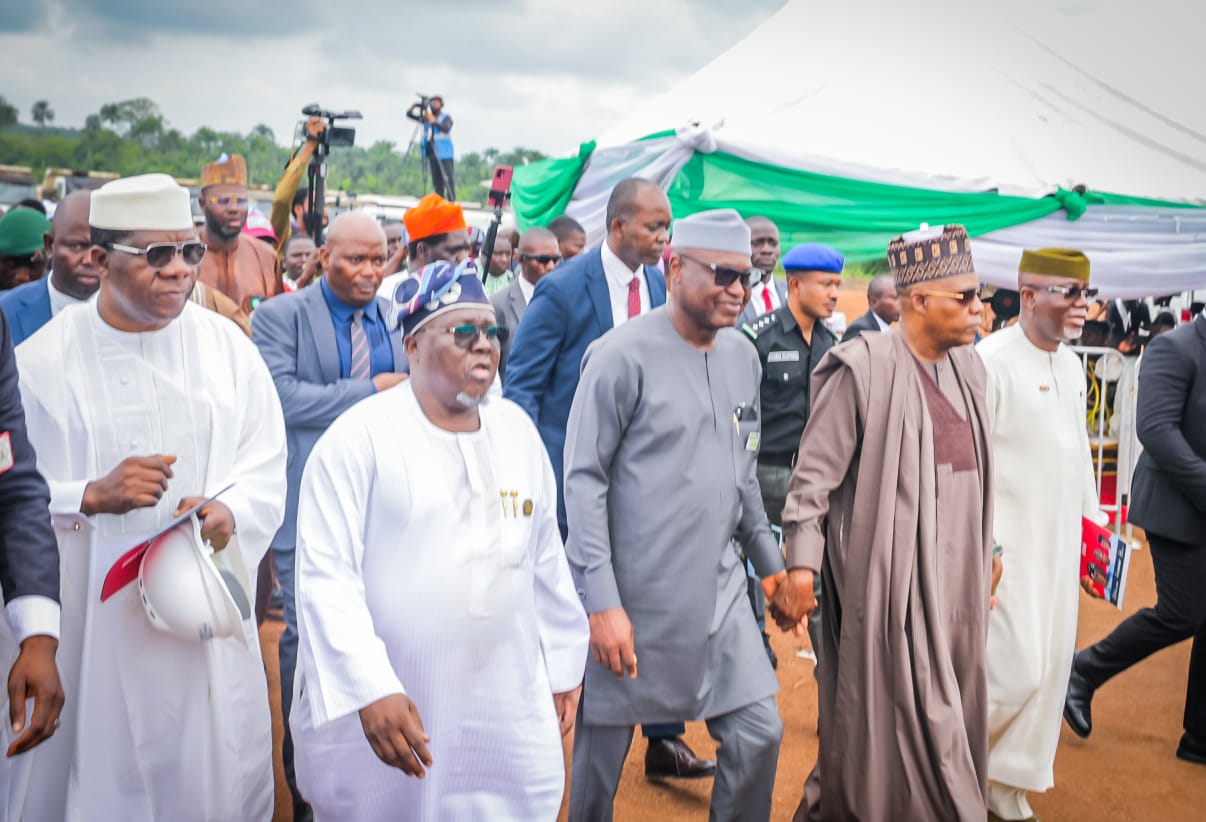
The President of Nigeria, Asiwaju Bola Ahmed Tinubu has hailed the Governor of Ekiti State, Mr Biodun Oyebanji, for sustaining and promoting the spirit behind the concept of Ekiti Knowledge Zone(EKZ), saying the project has a good prognosis of becoming a viable Nigeria’s hub of Innovations, research and skill development in the future.


The President described Ekiti as the home of scholars and posited that the EKZ, as a state government propelled investment, is capable of radicalising the potentials of talented Nigerians and serve as a launchpad for their relevance at the global stage.


The President spoke on Tuesday, during the turning of the sod for the Ekiti Knowledge Zone located at Ago Araromi in Ado Ekiti, the Ekiti State Capital.


The President, who was represented by the Vice President, Senator Kashim Shettima, said education remained the most viable inheritance of Ekiti people and commended Governor Oyebanji for demonstrating visionary leadership in governing the State through strategic alliances with critical stakeholders.

Describing the EKZ project as a masterpiece, the President said it was in alignment with Singaporean vision that any economy can be unlocked through education and technological innovation, assuring Governor Oyebanji and the entire citizens of the federal Government’s support to make the project thrive.


“Under President Tinubu’s administration, we are gradually moving from dependency to sustainability and self sufficiency. We are determined to encourage research, innovation and technological development to create jobs for our teeming youths.


“We are focused about this and I thank Governor Biodun Oyebanji for his leadership and initiative”.


Also speaking at the event , Governor Oyebanji revealed that the Ekiti Knowledge Zone was conceptualised to unlock the hidden potentials of Ekiti citizens and make the state the frontliner in skill, innovation, research and human capital development worldwide.


The governor said Ekiti has been known to be intellectual hub and for having the highest number of Professors in the country, who deserves serious attention in the area of innovation.


He added that the project commenced August 12, 2013 under Governor Kayode Fayemi-led government, with the intention to build the potentials of Ekiti citizens.


Oyebanji stated that he decided to sustain the EKZ in demonstration of the continuity agenda of his government as well as making significant investment in technology, industrial development, healthcare , research, science and innovation, and many other pivotal areas of the economy that would make Ekiti epicentre of development .


“This project is part of the 30 years Development Plan of this administration in its efforts to unlock the economic potentials of our state. And we are happy that we had been able to raise $80 million financial capital through the federal government and African Development Bank. We appreciate President Bola Ahmed Tinubu and AfDB for approving the deal.


“You could all remember that that the EKZ was designated as a Free Trade Zone by the administration of President Muhammadu Buhari. This EKZ is not only going to be the giant of innovation in Africa, but it represents a world class economic ecosystem that will serve as a catalyst for industrial development, innovation, job creation, opportunities for technology driven industries and skill acquisition platform.


“I am glad to inform you that the first phase when fully completed, over 20,000 jobs will be created in line with the local contents policy of our administration, while the entire phases is to generate about 100,000 jobs covering areas like research, science, technology, industry and education development”.


The Chief Executive Officer of CCECC, the contractor handling the project, Eric Shem, applauded the federal, state and African Development Bank for their partnership, saying their lofty contributions demonstrated how committed they are to the development of the human capital in the country.


Shem said the programme will change the future of the country by attracting investments and build the human capital, assuring that the project will be completed in record time to create employment opportunities and to meet other demands.


High profile figures at the ceremony were: the Governor of Ondo State, Mr. Lucky Ayedatiwa, Ekiti State Deputy Governor, Mrs Monisade Afuye, Senate Leader, Senator Opeyemi Bamidele, Speaker of the House of Assembly, Rt Hon Adeoye Aribasoye, former Governor Segun Oni, Senator Cyril Fasuyi, Special Adviser to the President on Political Matters, Hon Ibrahim Masari, the Onijan of Ijan Ekiti, Oba Adebanji Aladesuyi, commissioners, Special Advisers, political and community leaders, among others.

Continue Reading