Connect with us

Business & Economy

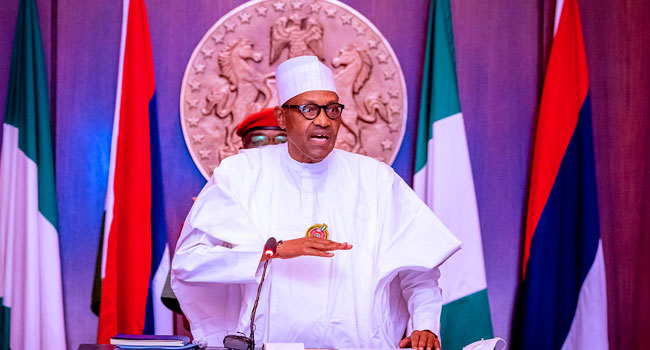
2022 Budget Won’t Fail Because APC Leads National Assembly – Buhari

Published

on

President Muhammadu Buhari
Share

President Muhammadu Buhari has said that he is certain the 2022 budget will accomplish the purpose for which it was created.

Speaking exclusively to Channels Television on Wednesday, the president said he is confident that the budget will succeed because the National Assembly is led by trusted members of the All Progressives Congress (APC).

When asked if he is afraid that the budget might not be able to achieve its purpose, the president replied, “No! Not at all”.

He said, “My confidence that we can successfully implement the budget is because, in both houses, the party is leading.

“It’s APC party and the leadership; look at the Senate President, he was in the House of Reps for two or three terms before he went to the Senate.

“Look at Femi Gbajabiamila, I was watching on the television, when he was an ordinary member, he was always on his seat fighting for the party and the system we believe in.

“Really, I consider myself lucky. My party and their competent leadership are both leading in the Senate and House of Representatives.

“That’s why you don’t hear much about me, I allow them to do all the things because I can’t go against my party and I can’t go against people I have absolute confidence in. I know they are doing their best,” President Buhari added.

He further asserted that the objections earlier raised before he assented to the budget will not cause a rift between the Executive and Legislative arms of government.

“The legislature is amazing,” the president said.

Following President Buhari’s assent to the 2022 budget, there were reports of friction between the presidency and the parliament.

The president had expressed strong reservations on the “worrisome changes” made by the National Assembly to the 2022 Executive Budget proposal.

He frowned at many changes that the National Assembly made to the 2022 Executive Budget proposal, including “Increase in projected FGN Independent Revenue by N400 billion, the justification for which is yet to be provided to the Executive; Reduction in the provision for Sinking Fund to Retire Maturing Bonds by N22 billion without any explanation; Reduction of the provisions for the Non-Regular Allowances of the Nigerian Police Force and the Nigerian Navy by N15 billion and N5 billion respectively”.

With all the irregularities encountered, the president still signed the budget, and the presidency has since said that though disagreements were encountered with the insertions, the president and the parliament have not fallen out.

Continue Reading
Click to comment

Leave a Reply

Your email address will not be published. Required fields are marked *

Business & Economy

Nigeria, UK Move to Close £1.2bn Trade Data Gap with Digital Customs Pact

Published

on

UK and Nigeria Flags
Share


Nigeria and the United Kingdom have agreed to deepen customs cooperation through a new digital data-sharing framework aimed at resolving a £1.2 billion discrepancy in bilateral trade figures, a longstanding issue affecting transparency and efficiency between both economies.

The agreement was reached during a high-level meeting in London on March 18, 2026, held on the sidelines of President Bola Tinubu’s state visit under the Nigeria–UK Enhanced Trade and Investment Partnership (ETIP).

According to the Nigeria Customs Service (NCS), the talks brought together Comptroller-General Adewale Adeniyi and Ms. Megan Shaw, Head of International Customs and Border Engagement at His Majesty’s Revenue and Customs (HMRC), with discussions focused on customs modernisation, trade data transparency, and operational collaboration.

At the centre of the engagement is a significant mismatch in trade statistics. Nigeria recorded about £504 million worth of imports from the UK in 2024, while UK data shows exports to Nigeria at approximately £1.7 billion over the same period — leaving a gap of roughly £1.2 billion.

Both sides described the discrepancy as structural and agreed on coordinated measures to address it. Chief among these is the proposed implementation of a pre-arrival data exchange system, which will connect digital customs platforms in both countries to improve data accuracy, strengthen risk management, and enhance compliance monitoring.

Adeniyi emphasised that stronger customs collaboration is vital for economic growth and sustainable trade, noting that customs authorities play a key role in ensuring secure and transparent cross-border trade flows.

The meeting also highlighted advancements in customs technology, with the UK showcasing artificial intelligence-driven tools, digital verification systems, and real-time analytics designed to improve cargo processing, risk assessment, and border security.

In addition to addressing the data gap, both countries agreed on several strategic initiatives, including the development of a Customs Mutual Administrative Assistance Framework, technical cooperation on capacity building, and the establishment of a joint engagement mechanism under ETIP.

The NCS said the outcomes of the meeting would enhance operational efficiency, boost trade facilitation, and support Nigeria’s broader economic reform agenda, positioning the country for improved competitiveness in global trade.

Continue Reading

Business & Economy

Nigeria’s “Shockproof” Economy: Cardoso Signals New Era of Stability to London Investors

Published

on

CBN Governor, Yemi Cardoso
Share

Central Bank of Nigeria (CBN) Governor Olayemi Cardoso issued a bullish assessment of the nation’s financial health yesterday, declaring that aggressive institutional reforms and disciplined monetary policy have built a “stronger capacity” to withstand global economic volatility.

Speaking at the Africa Capital Forum—held on the sidelines of President Bola Ahmed Tinubu’s state visit to the United Kingdom—Cardoso painted a picture of a Nigerian economy transitioning from a period of emergency stabilization to one of sustained investment.

A Fortress Against Volatility

The Governor’s address focused heavily on the “de-risking” of the Nigerian financial system. By emphasizing a shift toward a predictable policy framework, Cardoso aimed to reassure international stakeholders that the days of opaque, discretionary decision-making are ending.

“We are reviewing our policies with a view to developing meaningful policies and establishing a predictable policy framework to minimise discretion,” Cardoso stated, noting that consistency is the primary tool for reducing investor uncertainty.

The Governor highlighted several critical milestones achieved under the current administration’s reform agenda:

Banking Recapitalization: The CBN reported that over 30 banks have already met new capital requirements.

Notably, 28% of the newly raised funds originated from foreign investors—a metric Cardoso cited as a clear vote of international confidence.

FX Transparency: A new foreign exchange manual has been deployed, stripping away previous restrictions to boost liquidity and simplify operations for multinational businesses.

Remittance Surge: Increased diaspora remittances have bolstered foreign exchange reserves, providing a crucial buffer against external shocks.

Fiscal-Monetary Synergy: In a departure from previous friction, Cardoso noted that the inclusion of fiscal authorities on the CBN Board and the Monetary Policy Committee (MPC) has synchronized the nation’s broader economic strategy.

The Digital Frontier: “Vision for Nigeria”

Looking ahead, the Governor announced the completion of a new Payments System Vision. This initiative aims to cement Nigeria’s status as the continental leader in digital payments and cross-border transactions, specifically targeting the removal of regulatory hurdles for the nation’s burgeoning fintech sector.


Continue Reading

Business & Economy

Tinubu Swears in Taiwo Oyedele as Minister of State for Finance

Published

on

President Bola Ahmed Tinubu and Taiwo Oyedele
Share

President Bola Ahmed Tinubu on Monday swore in Taiwo Oyedele as Minister of State for Finance, praising his experience, dedication, and professionalism in public service.

Speaking shortly after the brief ceremony at the Presidential Villa in Abuja, the president described the appointment as a vote of confidence in Oyedele’s competence and commitment to national development.

Tinubu commended the new minister for his role in coordinating the work of the Presidential Committee on Fiscal Policy and Tax Reforms, noting that his expertise and deep knowledge of tax policy had been instrumental in shaping reforms aimed at simplifying Nigeria’s tax system, expanding the revenue base, and improving the business environment.

“We are very proud of your knowledge, your simplicity, ambition, and excellence,” the president said, while also acknowledging the support of Oyedele’s wife, whom he praised for standing by him despite the demands of public service.

Tinubu said Oyedele’s dedication, patience, and determination to serve the country made him well suited for the role, adding that the position carries significant responsibility at a time when Nigeria is pursuing economic stability and growth.

According to the president, the new minister’s efforts in reforming Nigeria’s tax framework have helped address policies he described as outdated and inconsistent with progressive economic thinking.

Oyedele, who hails from Ikaram in Akoko area of Ondo State, is an economist, accountant, and public policy expert.

He obtained a Higher National Diploma in Accountancy and Finance from Yaba College of Technology and later earned a Bachelor of Science degree in Applied Accounting from Oxford Brookes University.

He has also completed executive education programmes at London School of Economics, Yale University, Gordon Institute of Business Science, and Harvard Kennedy School.

Before his appointment, Oyedele spent 22 years at PricewaterhouseCoopers, where he joined in 2001 and rose to become Fiscal Policy Partner and Africa Tax Leader.

He also serves as a professor at Babcock University in Ogun State and as a visiting scholar at Lagos Business School.

Continue Reading