Connect with us

News

Ikoyi Building Collapse: Death Toll Rises To 17

Published

on

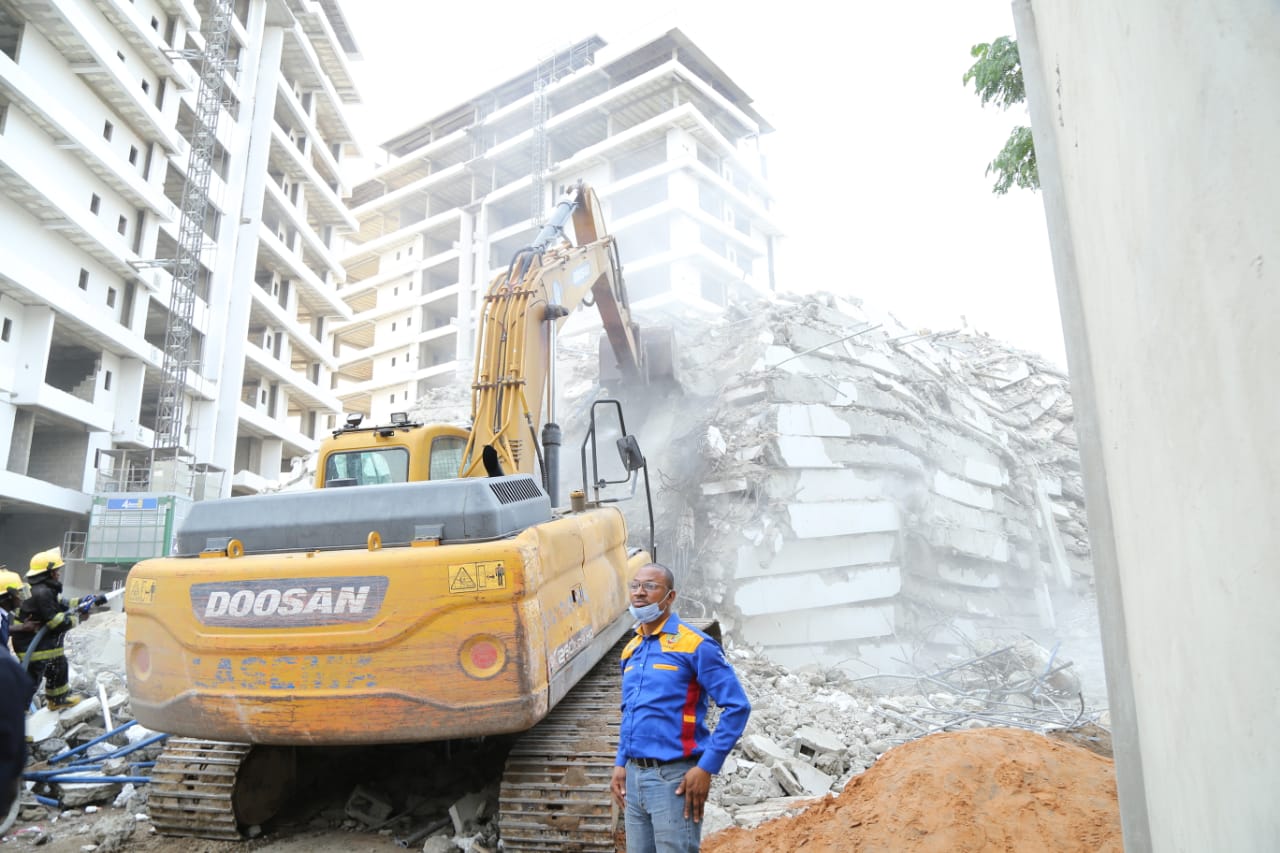
Site of the collapsed Building, Lagos
Collapsed Building site, Ikoyi Lagos
Share

*Sanwo-Olu orders LASBCA GM’s suspension

*Deputy Governor visits site

It has been confirmed that additional people have died and more survivors rescued hours after a high-rise building collapsed in the Ikoyi area of Lagos State.

The Building collapsed on Monday afternoon along Wesley Road in Ikoyi, Lagos State.

Four persons were killed and five others rescued as of Monday night, the death toll and number of survivors rose on Tuesday as rescue efforts continued through the night.

According to the spokesman for the National Emergency Management Agency (NEMA), 13 more bodies have been recovered.

He added that five more persons trapped under the rubble have been rescued by emergency responders at the scene.

This brings the total figures of those killed and rescued so far to 17 and 10 respectively.

Meanwhile Governor Babajide Sanwo-Olu has said the government will surely find out what went wrong and punish those indicted.

The Governor, as a first step, has directed that the General Manager of the Lagos State Building Control Agency (LASBCA), Mr. Gbolahan Oki, an architect, be suspended from work immediately.

The suspension is indefinite.

Similarly the Deputy Governor of Lagos, Dr Obafemi Hamzat, who visited the site amid tight security, explained that the premise of the collapsed building has been sealed by the government agency in charge of testing, for more investigation into the integrity of the structure.

Emergency workers have intensified rescue operations as more people are believed to be trapped under the rubble.

Meanwhile, the Chairman of the Nigerian Institute of Architects, Lagos State Chapter, David Majekodunmi, also visited the site of the building collapse.

He lamented that unfortunate incidents such as this should not have happened if authorities had done what was expected of them.

“My first impression is that the country is in a mess. We are in a mess because if we have done what we are supposed to do, either on the private or government side, we wouldn’t be having this kind of incident.

“Like it’s said by (Femi) Falana, the renowned lawyer, about six or seven weeks precisely where we have all the allied professionals in the construction industry together, he said ‘we should stop talking about building collapse; go and search yourselves, what is your regulatory building doing? Your regulatory body is supposed to regulate things like this,” said Majekodunmi.

He added, “Looking at this, you can’t determine what is actually the cause of the collapse. In a nutshell, we are standing in front of the signage which is supposed to be a prerequisite at a site.

“You cannot see the name of the architect, the structural engineer, and other consultants. But there is so much going on on the platform where the number written on all these consultants happens to be the developer.

“I will tell you just a little history because the government has a big fault for this. In 1986, a National Building Code was drafted by all the professional bodies in the construction industry – seven of them. This National Building Code was not signed until 20 years after it was drafted.”

Continue Reading
Click to comment

Leave a Reply

Your email address will not be published. Required fields are marked *

News

Bamidele: 2026 Electoral Act Reflects Stakeholders’ Consensus, Not Legislative Imposition

Published

on

Senate Leader, Senator Michael Opeyemi Bamidele
Share

The Leader of the Senate, Opeyemi Bamidele, has stated that the provisions of the 2026 Electoral Act were the outcome of broad consultations with stakeholders rather than unilateral decisions by the National Assembly.

In an Easter message issued on Sunday through his Directorate of Media and Public Affairs, Bamidele explained that the new electoral law aligns with global best practices and was not designed to serve any political interest. He urged political actors to adhere to the rules collectively established to ensure stability, peace, and order within Nigeria’s democratic system.

His remarks come amid criticisms from opposition parties, particularly the African Democratic Congress (ADC), which alleged that certain provisions—such as Sections 77 and 84 of the Act—were introduced to weaken their chances ahead of the 2027 general elections. However, Bamidele dismissed the claims, insisting that all sections of the law were products of consensus involving civil society groups, development partners, and other stakeholders.

He defended the requirement for political parties to submit a digital register of members to the Independent National Electoral Commission (INEC), describing it as a transparency measure aimed at preventing undue influence by individuals outside party structures. According to him, the reform is essential for strengthening internal democracy and ensuring that party decisions reflect the will of legitimate members.

Bamidele also justified the restriction of candidate nomination processes to either direct primaries or consensus arrangements, noting that the move is intended to eliminate the delegate system, which he said had been susceptible to manipulation by wealthy individuals. He added that the new system empowers party members and reinforces majority rule in line with democratic principles.

Beyond electoral matters, the Senate leader condemned recent violent attacks in Plateau and Kaduna states, describing them as unacceptable acts against innocent citizens. He assured that the National Assembly is collaborating with federal and state authorities to tackle insecurity and prevent further loss of lives.

He disclosed that ongoing legislative efforts, including amendments to the Terrorism (Prevention and Prohibition) Act, are aimed at introducing stricter penalties for kidnappers, their sponsors, and collaborators. Bamidele expressed confidence that these measures would help restore security and stability across the country.

Reflecting on Easter, Bamidele called on Nigerians, especially political leaders, to embrace the values of sacrifice, tolerance, and unity exemplified by the resurrection of Jesus Christ, urging a collective commitment to nation-building.

Continue Reading

News

FG to Deploy AI Cameras to Tackle Insecurity in Plateau — Tinubu

Published

on

President Bola Tinubu
President Bola Ahmed Tinubu
Share


President Bola Tinubu has announced that the Federal Government will deploy over 5,000 artificial intelligence-enabled digital cameras across Plateau State to help security agencies combat rising insecurity.

The President made this known on Thursday during a visit to Jos, following the March 29 gun attacks in Angwan Rukuba, Jos North Local Government Area, which claimed several lives. He assured residents that such incidents would not recur, pledging decisive action to bring perpetrators to justice.

Tinubu directed security chiefs, including the Minister of Defence, Chief of Army Staff, and Inspector General of Police, to track down those responsible for the killings. He also tasked the Minister of Communications and Digital Economy, Bosun Tijjani, with overseeing the immediate installation of the surveillance system, starting in Jos and later expanding across the state.

Expressing sympathy to affected families, the President said no compensation could replace lost lives but promised government support and justice. He also directed the Ministry of Humanitarian Affairs to compile data on victims to ensure fair distribution of relief.

Plateau State Governor Caleb Mutfwang described the incident as a temporary setback, noting that the state had previously enjoyed relative peace. He expressed confidence in ongoing security efforts and thanked the Federal Government for approving the recruitment of 1,000 forest guards to strengthen local security.

Stakeholders at the meeting, including former governors and political leaders, called for greater collaboration and dialogue among Plateau indigenes, stressing that lasting peace would require collective responsibility.

Continue Reading

News

El-Rufai Returned to ICPC Custody After Court Appearance in Kaduna

Published

on

Former Kaduna State Governor,Nasir El -Rufai
Share

Former Kaduna State governor, Nasir El-Rufai, has been returned to the custody of the Independent Corrupt Practices and Other Related Offences Commission (ICPC) following court proceedings in Kaduna.

El-Rufai, who had earlier left custody on March 27, 2026, due to the death of his mother, was re-arraigned on Tuesday.

He first appeared before the Kaduna State High Court over a separate charge filed by the ICPC. However, proceedings were stalled due to the absence of the second defendant, prompting the court to adjourn the case until April 10, 2026.

Following the adjournment, El-Rufai was taken to the Federal High Court in Kaduna, where his application for bail was scheduled to be heard.

The court had earlier fixed March 31, 2026, for the hearing of his bail application.

Continue Reading