Connect with us

News

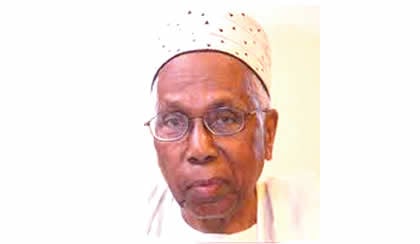
Super Perm Sect, Ahmed Joda, dies

Published

on

Ahmed-Joda
Ahmed-Joda
Share

Alhaji Ahmed Joda, a former super federal Permanent Secretary, is death.

His Personal Secretary, Alhaji Mohammed Baba, told the News Agency of Nigeria (NAN) on Friday in  Yola that Joda died after a brief illness at the Federal Medical Centre, Yola, on Friday.

Baba said the deceased was born in Yola in 1930, attended Yola Elementary School and Yola Middle School before proceeding to Barewa College from 1945 to 1948.

In the 1950s, he attended Pitman College, London, and gained practical experience in journalism while staying in Britain.

After completing his secondary education in 1948, Joda was admitted to Moor Plantation, Ibadan.

He worked briefly at an agricultural centre in Yola before entering the field of journalism at Gaskiya Corporation, Zaria.

He later worked for the Nigerian Broadcasting Commission serving as the editor of NBC Kaduna, then joined the Northern Nigeria civil service as Chief Information Officer and later permanent secretary in the regional Ministry of Information.

In 1967, he became a federal permanent secretary in the Ministry of Information and subsequently moved to Lagos.

“It is worthy to note that he was the chairman of the 18-member transition committee, nominated by General Muhammadu Buhari to receive the hand over notes from the Goodluck Jonathan-led administration in 2015.

“Ahmed Joda is an administrator, journalist and politician.

“Also worthy of note is the fact that, he was the chairman of the transition committee in 1979 when General Obasanjo handed over to president Shagari,” the source said.

Joda had been buried in Yola according to the Islamic rites.

Sheikh Tijjani Tahir, the Deputy Chief Imam of Yola town Central Mosque, led the funeral prayers.

The burial was attended by top Adamawa Government led by the Secretary to the State Government, Mr Bashir Ahmed, representatives of Adamawa Emirate Council and Politicians, among others.

Joda is survived by four children, comprising two males and two females, including Hajiya Asmau Joda, a female activist. (NAN)

Continue Reading
Click to comment

Leave a Reply

Your email address will not be published. Required fields are marked *

News

200,000 Asylum Seekers Risk Deportation as US Plans Mass Visa Revocation

Published

on

Share

The United State US Government headed by President Donald Trump is preparing to revoke the business and tourism visas of as many as 200,000 foreigners who have applied for or are currently seeking asylum in the United States, in what could become the largest single mass visa revocation in the country’s history.

The proposed action targets holders of B1 and B2 visas, which are generally issued for business travel and tourism. According to State Department documents obtained by the Associated Press and US officials, the visas under consideration were issued between 2016 and 2026 to people who subsequently sought asylum or have pending asylum claims.

The State Department is expected to begin announcing the revocations in the coming weeks, although officials have stressed that the final number remains uncertain and could change as the review progresses.

State Department spokesman Tommy Pigott said the agency was coordinating with the Department of Homeland Security to identify and revoke the visas of foreigners who entered the country claiming to be short-term visitors before filing for asylum.

The administration argues that the measure is aimed at addressing what it considers abuse of visitor visas and preventing people from using temporary visas as a route to remain permanently in the United States.

However, the proposed policy is likely to face legal challenges. Immigration advocates and lawyers are expected to question whether the government can use the visa-revocation process to broadly target people who later sought protection through the US asylum system.

The revocation of a B1 or B2 visa would not automatically mean that every affected person would be immediately deported. US officials told the AP that many people with pending asylum cases could instead be reclassified while losing their status as business or tourism visitors.

The distinction is significant because seeking asylum in the United States is a separate immigration process from holding a visitor visa.

The planned action would therefore primarily strip affected foreigners of their existing non-immigrant visa status rather than automatically determine the outcome of their asylum claims.

The proposed mass revocation comes as the Trump administration intensifies its broader immigration crackdown, including tougher visa screening, increased scrutiny of applicants’ backgrounds and social-media activity, and other restrictions on legal and humanitarian immigration.

The administration has already revoked more than 175,000 visas since Trump returned to office, according to Reuters, although those cancellations involved a range of cases and reasons.

If the planned B1 and B2 revocations proceed at the upper estimate of 200,000, the move would surpass previous large-scale visa cancellation efforts and represent an unprecedented use of visa revocation as part of the administration’s immigration enforcement strategy.

The State Department has not confirmed that exactly 200,000 visas will be revoked, and officials say the number remains dynamic. The final scope of the policy could also be affected by legal challenges or changes before implementation.

Continue Reading

News

How Tracking Helped ICPC Recover N2.06bn From Kaduna Projects

Published

on

Share

The tracking of 31 constituency and executive projects across the three senatorial districts of Kaduna State, has enabled the Independent Corrupt Practices and Other Related Offences Commission (ICPC) to recover N2.056 billion.

The projects, valued at about N2 billion, were monitored under the commission’s Constituency and Executive Project Tracking Initiative, which aims to ensure that public funds allocated to development projects are properly utilised and that projects are executed in line with approved specifications.

The exercise was coordinated by Chief Superintendent Haruna Aminu, who was among the commission’s officers monitoring the selected projects across the Kaduna South, Kaduna North, and Kaduna Central Senatorial Districts.

The officers visited selected project sites to assess their level of execution, determine whether they represented value for money and verify compliance with approved project specifications.

The commission also examined the utilisation of funds allocated to the projects as part of efforts to promote transparency and accountability in the implementation of government-funded projects.

The recovery of N2,056,467,766.86, representing Two Billion, Fifty-Six Million, Four Hundred and Sixty-Seven Thousand, Seven Hundred and Sixty-Six Naira, Eighty-Six Kobo, according to the ICPC, was facilitated by the monitoring exercise.

This feat, the commission maintained, gives highlights the importance of sustained monitoring of constituency and executive projects to protect public resources and ensure that government interventions deliver the intended benefits to citizens.

The ICPC’s project tracking initiative is designed to promote transparency, accountability and value for money in the implementation of government-funded projects, while deterring the diversion and misuse of public resources.

The recovery of the funds is therefore considered a significant outcome of the Kaduna State exercise, demonstrating the role of effective oversight in safeguarding government funds and ensuring proper implementation of public projects.

Continue Reading

News

New Zealand Moves to Ban Social Media for Under-16s

Published

on

Share

New Zealand’s government has introduced legislation to ban children under 16 from using social media, joining a growing international push to shield young people from harmful online content and the risks associated with excessive social media use.

Prime Minister Christopher Luxon said the proposed law was necessary to protect a generation of children from what he described as the growing harms of social media, including addictive technology, harmful content and online pressures.
“We simply cannot accept the harm being done to a generation of New Zealand children,” Luxon said.

The prime minister said one in three New Zealand children aged between 13 and 17 now spends at least five hours a day on social media. He said excessive use was affecting young people’s family life, mental health, sleep and education.

Under the proposed legislation, major platforms including Instagram, TikTok, Snapchat and Facebook would be required to take “reasonable steps” to ensure their users are at least 16 years old.

Platforms could use existing account information, facial age-estimation technology, digital identity services and formal identification documents to verify users’ ages.
Companies would also be required to assess the risks their platforms pose to children and report on measures taken to reduce those risks.

Firms that fail to comply could face penalties of up to 10 per cent of their global revenue.

Education Minister Erica Stanford said the bill would place clear legal obligations on social media companies, while children and their parents or caregivers would not face penalties.
However, the legislation faces significant political hurdles. The government’s coalition partners, the libertarian ACT Party and populist NZ First, have expressed opposition to the proposal.

NZ First criticised Australia’s experience with a similar ban, describing the legislation there as a “colossal failure.” ACT has also argued that the proposed restrictions would not work and that teenagers could easily find ways around them.

The main opposition Labour Party has yet to decide whether to support the bill. It has submitted dozens of questions concerning issues including how age verification would operate and which platforms would be covered.
“We take this legislation very seriously,” Labour spokesman Reuben Davidson said, warning that the safety of young people in Aotearoa New Zealand was at stake as they faced increasingly complex online risks.

New Zealand’s proposal follows Australia’s landmark social media restrictions, which came into effect in December 2025 and barred under-16s from platforms including Facebook, Instagram and TikTok. The Australian measures were introduced to tackle problems such as online bullying and exposure to “predatory algorithms.”
However, a peer-reviewed study by Australia-based researchers published in June found little evidence that teenagers had significantly reduced their use of social media following the ban.

New Zealand’s proposed legislation will therefore face close scrutiny over whether age restrictions can be effectively enforced and whether they can deliver the intended protections for young people without simply driving teenagers toward alternative ways of accessing social media.

Continue Reading