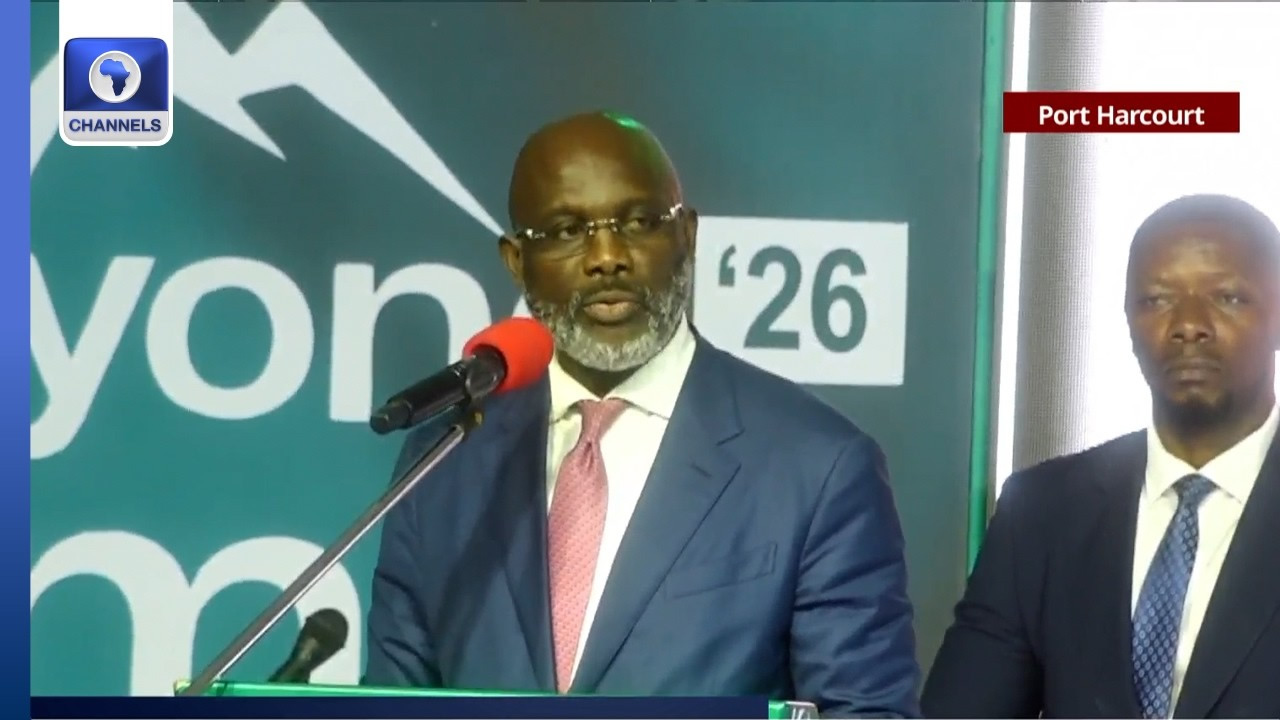
—George Manne Weah Tells NBA in Port Harcourt
I am glad to be here today, attending the 66th Annual General Conference of the Nigerian Bar Association here in Port Harcourt. With a membership of over One Hundred and Fifty Thousand, the Nigerian Bar is the largest, oldest and one of the most respected professional bodies on our continent.
I want to thank you for choosing a theme as bold as “Beyond Limits.” When I first heard it, I smiled, because if my own life has taught me one thing, it is that limits are very often not the walls we think they are. They are only the edge of what someone has tried so far.
I did not come into this hall as a lawyer, and I will not pretend to be one. I grew up in the ghetto of ‘Gibraltar’ in Monrovia, Liberia, where very few people believed that a boy raised largely by his grandmother would one day stand on the world’s biggest football stages, or take an oath as President of the Republic of Liberia.
I was told, in many quiet and not-so-quiet ways, what the limits of my life were supposed to be. I did not accept them — not out of arrogance, but because the limits placed on us by man are not the same as the limits placed on us by God. Beyond Limits, to me, is not a slogan. It is a living testimony of my life.
I am not here merely to tell you my story, but because what is true for one man can also be true for a profession, and for a continent.
Allow me to speak to you about two things today: first, the Bar and the Bench as guardians of our democracy, and the dangers that threaten that guardianship in West Africa today; and second, what it means for our peoples and our continent to truly go beyond limits — not in slogan, but in substance.
Let me start with a simple truth I came to understand not as a student of law, but as a man who has sat in the highest office of a nation. Democracy does not survive on the strength of elections alone. Elections are the doorway into democracy, not the house itself. What holds the house up — what keeps the roof from collapsing on the people who live inside it — are institutions, and among the most important of these, in every serious nation, is an independent judiciary, protected by a fearless, principled Bar.
And let me be plain about something else, because it is often the more dangerous of the two threats to democracy. The danger is not only that soldiers might seize power in the night, or that a defeated candidate might refuse to leave office. It is also that a leader who arrives in office through a free and fair election can, over time and often gradually, begin to govern like the very dictators the ballot was meant to guard against — leaning on the judiciary until it bends to his will, and strong-arming the legislature until it becomes an echo chamber rather than a check on his power. A tyrant with a certificate of return is still a tyrant. Democracy, properly understood, does not end on election night. It is tested every single day afterward, in how power treats the courts and the parliament that exist to restrain it.
I was glad to learn, in preparing to come before you, that your own outgoing President, Mazi Afam Osigwe, said something not long ago that I found myself nodding, as though he had seen my own notes before I wrote them. He said: “Democracy cannot survive on strong men. It survives on strong institutions.” That sentence deserves to be written above the door of every parliament and every courtroom in West Africa — a conviction that every serious African who has held power, and hopes to build something that stays after him, must eventually arrive at.
The rule of law is not an abstract phrase for law school lecture halls. It is the practical guarantee that a citizen’s rights do not depend on who is in office or what favor they can secure — that a journalist, a trader, or a student in Port Harcourt, Monrovia, or Bamako has the same protection under the law as a minister or a general.
The moment that guarantee weakens, everything else in a nation weakens with it: investment, security, public trust, and peace itself.
And here is the uncomfortable part: this danger does not only come from the coup-makers who seize power in the night. It also comes from governments that call themselves democratic — through budgets manipulation, wrong appointments, and pressure on judges, and deciding that courts should be a convenience rather than a check.
We have seen nations where a judiciary’s own budget must first pass through the executive it is meant to hold accountable. We have seen special courts created not to deliver justice but to secure political outcomes, and dozens of judges dismissed in a single stroke by presidential decree. And we have seen, across our region since 2020, an unsettling pattern of soldiers stepping over constitutions altogether.
I raise these examples because this Bar to which you belong and have gathered here in your thousands, cannot afford to assume that Nigeria, or Liberia, or any of us, is somehow immune. A court’s decision must mean what it says, without anyone’s political permission — it is what protects a nation from sliding, gradually but progressively, into the very conditions we condemn when soldiers do it with guns.
This is why I say to you: the Nigerian Bar Association is not merely a professional association negotiating welfare for its members. You are a standing sentinel of this Republic’s democracy. When the Bar is silent, courts become easier to be captured. When the Bar speaks with one voice, as guardians of the bench, the executive branch think twice before even dreaming of interference.
That tradition is not decoration. It is duty — because protecting the independence of your courts, and the rights of the ordinary Nigerian citizen, is protecting democracy itself, here in Nigeria and across our region.
Distinguished ladies and gentlemen, let me turn to the second thing I wish to leave with you: Beyond Limits is not only about defending what we have. It is about reaching for what we have not yet built. I have never believed that Africa’s limits are a matter of talent — I have stood beside the finest footballers our continent has produced, and sat at negotiating tables with heads of state from every corner of the earth. We Africans are not short of brilliance. We are short, too often, of the infrastructure and the organized will to let that brilliance connect to itself with us.
This room is proof of it. The Nigerian Bar counts among its numbers some of the finest legal minds in the world, many of whom have built extraordinary careers abroad — in London, in Washington, in the Gulf. That is nothing to be ashamed of, but it is something we must be strategic about. For too long we have called this only “brain drain,” as though it is purely a loss. I ask you to think instead about brain circulation — pulling that expertise back into nation-building without demanding anyone abandon what they have earned and learned abroad.
Our African diaspora already sends home well over one hundred billion dollars a year in remittances alone, more than the foreign aid and investment Africa receives combined. Imagine that same energy formally invited into legal reform and judicial modernization, as a deliberate national strategy.
Because the fight against poor governance and economic deprivation is not one we can afford to enter with half our talent unaccounted for. A Nigerian-trained lawyer on an arbitration panel in Paris, or advising a global institution in New York, is not lost talent — it is talent operating at the highest global standard, available to be called home if we organize the bridge for it to cross.
This, too, is what going Beyond Limits must mean for us: refusing to accept that our infrastructural and governance challenges, are any kind of ceiling on what is possible. I did not accept the limits the slum seemed to set for me.
I say this to you not as a theory but as something I have lived. In November 2023, when the early, provisional results of our run-off election made clear which way our country had voted, I did not wait for the count to be completed or for the final results to be formally announced before I picked up the telephone to congratulate my successor.
There were those around me who suggested patience — who argued that a sitting president owes it to himself to contest every figure until the very last vote is certified.
I chose otherwise. I chose to concede while the counting was still underway, because I have always believed, and still believe, that the will of the people must stand above the ambition of any one man in a democratic setting. Once elections do not follow democratic precepts, it is very dangerous for the peace and security of a country.
I am told that when this Association extended its invitation to me, its citation spoke directly of that decision — of a leader who chose to put his country before his own ambition. I want to thank the Nigerian Bar Association for that recognition.
It means a great deal to me, not because I need reminding of what I did, but because it tells me that this Bar understands precisely what is at stake when we insist that no office, however high, is worth more than the peace and the will of the people who conferred it.
If a small nation like mine can insist on that standard for itself, then surely this continent, with all its wealth of talent gathered in this very hall today, can insist on standards beyond the limits others have too often assumed for us.
Let me say, then, not only as a former president, but as a brother — a fellow traveler on this great continent of Africa, someone who understands deeply what it means to look at a wall of obstacles and decide to climb over it. When your leadership invited me to speak on the theme Beyond Limits, it resonated with the very core of my life’s journey.
To go beyond limits is not a phrase reserved for athletes who break records or politicians who win elections. It is a daily mandate for every lawyer, every judge, every leader, and every citizen who refuses to let their present circumstances dictate their ultimate destination. Limits, more often than not, are imagination born out of fear, of history, or of the low expectations others have placed upon us.
You already know part of my story — that boy from the slums of Monrovia. By every worldly measure, that boy was not supposed to play on the grandest stages of world football, let alone win the Ballon d’Or. He was certainly not expected to one day lead his nation, democratically, as president. So when I tell you that limits can be broken, I am not offering you a theory. I am offering you a life. How do we break these boundaries? We do it by anchoring our lives in five timeless, unshakeable values.
The first is discipline. Discipline is the bridge between goals and accomplishment. In football, talent without discipline gets you benched, or cut from the team entirely. In the law, brilliance without discipline leads to compromised justice. Discipline is the quiet commitment to doing what is right, what is necessary, and what is ethical, even when no one is watching.
Coupled with discipline is the raw necessity of hard work, because there are no elevators to success — you must take the stairs. To push past the barriers of systemic corruption, weak infrastructure, or institutional inertia, we must be willing to outwork our problems. As legal minds, your hard work secures the liberties of the common man and fortifies the rule of law.
Yet our labor means nothing if it is not governed by respect — respect for the dignity of every human being, for the sanctity of our institutions, and for the constitution that binds us.
True leaders do not go beyond limits by tearing others down. We go beyond limits by lifting others up, by respecting diversity of thought, and by upholding the integrity of the judicial process.
When you push against limits, the limits push back. That is where perseverance becomes your greatest weapon. You will face defeats. I lost elections before I ever won one. I lost matches before I ever raised a trophy.
Perseverance is the internal voice that says, “I will rise again.” For the legal profession in Nigeria and across Africa, perseverance means standing firm for justice even when the political or social winds blow fiercely against you.
Most importantly, we cannot transcend human limits without being spiritually strong. We must acknowledge a power greater than ourselves.
Spiritual strength gives us moral clarity when our choices are blurred. It gives conscience to our intellect and soul to our ambition. And it reminds us that every position of leadership we hold is a temporary stewardship, granted by the Almighty, to serve His people.
My distinguished friends, Nigeria holds a key to the promise of our whole continent. When the Nigerian Bar Association decides to go beyond limits, the legal architecture of Africa itself grows stronger. Let us commit today to breaking the chains of mediocrity — applying discipline to our craft, hard work to our duty, respect to our peers, perseverance to our trials, and faith to our foundational values.
Distinguished ladies and gentlemen, let us all stand for true justice — for the rule of law that builds greater unity, that makes a nation more attractive to investment, and that creates a stable environment in place of internal conflict.
True justice is blind. It does not know politics. It does not see family or friendship. It knows only the truth, and it interprets the law the same way whether or not anyone is watching.
Let us all interpret the law fairly, and apply it more effectively. Let justice prevail, and be done to all men and women, rather than spending our energy on division. The true measure of a lawyer is not how many cases you have won, how many titles you hold, or how much you earn. It is this: when the country needs courage, do you have the courage to stand? When justice needs a voice, will you give it one? And when the law itself is threatened, will you go beyond every limit to defend it? The law must never be an instrument of chaos. It must never become a weapon of war. It must remain what it was always meant to be: an instrument of remedy, of peace, of unity, and of accountability — an instrument for humanity, for transparency, and for truth.
My dear members of Nigerian Bar Association, I invite you to think of yourselves as referees who interpret the law fairly and plainly. As a lawyer, you must be able to protect the law whether the voice before you is rich, poor, or powerful.
As the law provides, you must be able to stand in defense of those who cannot defend themselves. You must ensure that due process is honored. Let us respect the law, and let us interpret it faithfully. I say to you, as with Lady Justice herself: carry the scales of substance and of justice, and let nothing tip them but the truth.
My brothers and sisters, Nigerians depend on you. West Africa depends on you. Africa depends on you. The world depends on you. Democracy depends on you. And free elections depend on you.
So I say to all of you here today: Africa must continue in peaceful coexistence, and we must all stand up for the rule of law. Stand up for fairness. Stand up for impartiality. Stand up for gender equality. Stand up for equality. Stand up for humanity. Stand up for peace and for democracy. Stand up against discrimination. Stand up for accountability. Stand up for free and fair elections.
Bravo, Nigerian Bar Association.
God bless the Nigerian Bar Association, and may God bless our beloved Africa.
I thank you.
Keynote Address
By George Manneh Weah,
Former President of the Republic of Liberia
At The 66th Annual General Conference of the Nigerian Bar Association
Theme: “Beyond Limits”
Port Harcourt, Rivers State. August 23, 2026.