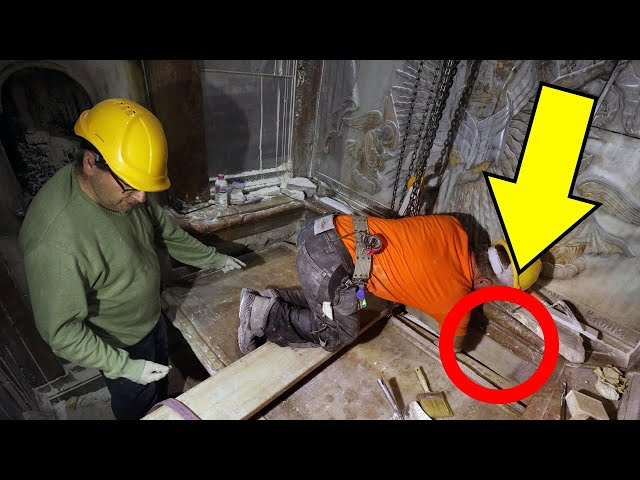
Modern-day Israel has some of the most revered Christian holy sites, but the Church of the Holy Sepulcher, said to be the tomb of Jesus, is the most important. After centuries of water deterioration and structural damage, scientists began a long-overdue renovation of the tomb in October 2016. Beneath a marble slab removed for the first time in hundreds of years, a never-before-seen discovery was found.
*The most significant tomb in the Christian religion.*
The narrations within the New Testament intricately detail the construction of Jesus’ tomb in close proximity to the site of his crucifixion, meticulously designed to enshroud both his mortal remains and the noble cross upon which he met his tragic fate.
The annals of history resound with unwavering certainty regarding the hallowed significance of the Church of the Holy Sepulcher—a revered beacon of faith and pilgrimage today.
*The Quest for Christ’s Sepulcher*
Commencing on a poignant quest engendered by an imperial decree, Helena, the venerable mother of Constantine, embarked upon a sacred mission to unearth the elusive resting place of Jesus—rekindling the embers of a past discovery, with the guiding light of Bishop Eusebius illuminating her path towards the venerated sepulcher.
Steeped in the annals of ancient history, around the epoch of 326 CE, the illustrious Roman Emperor Constantine the Great orchestrated the grand inauguration of the first church on the very sanctified grounds that cradled the divine mysteries of Christ’s life and resurrection, destined to serve as a sanctuary not only for his imperial majesty but also as a custodian of the profound spiritual heritage woven into the fabric of Christianity.
Initial renovations
From its inception by Emperor Constantine’s mother to the enduring impact of the Crusaders, each chapter in its narrative has contributed to the intricate tapestry of reverence that cloaks this revered sanctuary.
Over the passage of centuries, the Church of the Holy Sepulcher has stood as a timeless witness to the ebb and flow of history, bearing the indelible imprints of successive transformations that have shaped its sacred presence on the religious landscape.
*Spiritual Revival*
The enduring legacy of the Crusaders resonates within the very stones of the church, marking a pivotal era that left an indelible mark on its architectural form and spiritual essence.
Their influence transcends mere physical renovations, delving deep into the spiritual marrow of the structure, infusing it with layers of significance and historical gravitas that resonate to this day. Amidst the shifting tides of time, the Franciscan friars emerged as custodians of restoration, embarking on a noble quest to revive the dilapidated grandeur of the church after the poignant collapse of the bell tower in 1545. Their meticulous efforts not only breathed new life into the timeworn walls but also reaffirmed the sanctity of the edicule enshrining the sacred tomb of Jesus, underscoring their unwavering commitment to preserving this venerated place of worship for generations to come.
*Spiritual Revival*
The crypt was sealed
In 1555, Franciscan monks took a significant step to safeguard the sanctity of the tomb by sealing its entrance.
*They sealed the crypt.*
With solemn reverence, they carefully positioned a sturdy marble slab over the ancient limestone tomb, shielding it from the touch of eager pilgrims who sought a connection to the hallowed resting place of Jesus. This act of guardianship effectively closed the tomb off from direct access, preserving its sacred aura for generations to come.
_Housejogger_