Connect with us

News

Benue Socio-Cultural Groups Demand IDP Resettlement First, Reject FG Pilot Ranching Plan,

Published

on

Share

Three major socio-cultural organizations in Benue State have rejected the Federal Government’s proposed pilot National Ranching Scheme for the Middle Belt, insisting that the safe return and resettlement of over 500,000 Internally Displaced Persons must come first.

The position was presented on Friday, August 15, 2026, at a press conference in Makurdi by Air Commodore Titus Agbecha, rtd., Chairman of the Benue Socio-Cultural Organizations, on behalf of Mdzough U Tiv, Ochetoha ‘k Idoma, and Omi Ny’Igede.

The Federal Government had announced that Benue, Nasarawa and Plateau States would serve as pilot states for the ranching programme, with rollout expected to begin in Plateau.

While acknowledging that ranching as a modern practice of animal husbandry could reduce farmer-herder conflict and improve food security, the groups said Benue’s peculiar realities make implementation impossible at this time.

The groups listed three critical issues.

First, they said over 500,000 Benue indigenes are currently living in IDP camps across the state “with no home to return to, no shelter, no farms, and no livelihood.”
“It is unjust to talk about new land use for ranches when the owners of the land are still refugees in their own state,” Agbecha said.

Second, he noted that for over five years, several communities in Benue have been “under siege,” with villages attacked, occupied, and residents killed or displaced.
“There has been no comprehensive mediation, no justice, and no resettlement of these communities. Establishing ranches under this atmosphere will be seen as rewarding violence and dispossession,” he added.

Third, the groups cited pressure on land due to rapid population growth. “Benue remains the food basket of the nation. Any program that involves large-scale land acquisition must not undermine food production,” Agbecha stated.

The socio-cultural leaders called on the Federal Government to prioritize the safe return and resettlement of all IDPs to their ancestral homes before any pilot scheme begins.

They also demanded “genuine mediation, security of lives, and restoration of occupied communities,” stressing that “peace must precede policy.”

On implementation, the groups said any ranching programme must be done through “proper consultation, consent, and compensation with host communities.”
“We are not against modern ranching, but it must be voluntary, community-driven, and must not displace food production. Land is a sensitive issue and cannot be imposed,” Agbecha said.

He further urged Benue people to “remain calm and law-abiding” as the organizations engage relevant authorities to ensure their concerns are addressed through dialogue.

“Benue is the food basket of the nation. For Nigeria to be food secure, Benue farmers must first be secure on their land,” he concluded.

News

Bamidele Celebrates Wole Olanipekun at 75, Hails His Landmark Courtroom Victories as Pillars of Nigeria’s Democracy

Published

on

Chief Wole Olanipekun
Share


Says legal icon’s five decades at the Bar, philanthropy and commitment to justice have strengthened the rule of law


Leader of the Senate, Senator Opeyemi Bamidele, has celebrated renowned legal luminary and former President of the Nigerian Bar Association (NBA), Chief Wole Olanipekun, SAN, on his 75th birthday and 50 years of distinguished service at the Nigerian Bar.

Bamidele described Olanipekun as an undisputed icon of the legal profession and one of the greatest ambassadors of Ekiti State, whose outstanding contributions to law, democracy, education and human capital development have continued to make a lasting impact on society.

In a congratulatory statement issued on Tuesday by his Directorate of Media and Public Affairs, the Senate Leader, who also chairs the National Assembly South-West Caucus, commended the legal icon for his remarkable courtroom victories, noting that several of the landmark cases he prosecuted went beyond securing victories for clients to shaping Nigeria’s jurisprudence and strengthening its democratic foundations.

He particularly recalled Olanipekun’s leading role in the legal battles that secured the electoral mandates of former Edo State Governor, Comrade Adams Oshiomhole; former Ekiti State Governor, Dr Kayode Fayemi; and former Ondo State Governor, Dr Olusegun Mimiko.

He also cited his contribution to the legal battle against the nullification of former Vice President Atiku Abubakar’s nomination as the presidential candidate of the defunct Action Congress in 2007, as well as the legal efforts that led to the reversal of the impeachment of former Oyo State Governor, Oba Rashidi Ladoja, now the Olubadan of Ibadan.

According to Bamidele, these cases were not merely courtroom victories but defining moments that reinforced constitutionalism, protected democratic mandates and affirmed the supremacy of the law.

Tracing Olanipekun’s professional journey from Ikere-Ekiti to the pinnacle of the legal profession, Bamidele described his achievements as a testament to brilliance, discipline, character and dedication.

He noted that Olanipekun was called to the Nigerian Bar in July 1976 and attained the prestigious rank of Senior Advocate of Nigeria (SAN) in July 1991, barely 15 years after his call to Bar.

The Senate Leader also acknowledged his distinguished public service as Attorney-General and Commissioner for Justice of the old Ondo State in 1992, President of the Nigerian Bar Association in 2002, and Chairman of the Body of Benchers between 2022 and 2023.

Beyond the legal profession, Bamidele praised Olanipekun’s commitment to philanthropy and educational advancement, particularly through his scholarship scheme, which he said had transformed the lives of numerous Ekiti indigenes and provided opportunities for many to excel in their chosen careers.

He described the celebrant’s five decades at the Bar as an extraordinary legacy of service, courage and commitment to justice, recalling his popular appellation, Akoni Niwaju Adajo (Fearless Advocate Before the Judge).

Bamidele wished Olanipekun many more years of good health, strength and fulfilment, expressing confidence that his wealth of experience and contributions would continue to inspire generations of legal practitioners and Nigerians.

Continue Reading

News

Bamidele Bags Sun Senator of the Year Award, Says State Police Bill Will Reach Tinubu This Week

Published

on

Share

…Says 32 State Assemblies have approved bill, awaits four others

…Questions irresponsible use of social media, calls for responsible information dissemination

The Leader of the Senate, Senator Michael Opeyemi Bamidele, has disclosed that the National Assembly is set to transmit the State Police (Constitution Alteration) Bill, 2026, to President Bola Ahmed Tinubu for assent this week, following its approval by 32 State Houses of Assembly.

Bamidele made this known on Friday night while receiving The Sun Senator of the Year Award in Lagos, in recognition of his effective management of parliamentary affairs and proactive approach to lawmaking since the inauguration of the 10th National Assembly in June 2023.

He disclosed that four additional State Houses of Assembly were expected to submit their reports on or before the National Assembly reconvenes on November 17, 2026, but maintained that the legislative process must move forward regardless of whether the outstanding reports are received.

According to him, the approval by 32 State Assemblies has satisfied the constitutional threshold stipulated under Section 9(2) of the 1999 Constitution, as amended.

“We are now under obligation to transmit the State Police (Constitution Alteration) Bill, 2026, to the President and Commander-in-Chief of the Armed Forces, His Excellency Bola Ahmed Tinubu, GCFR, for assent.
“This is a responsibility we must consciously discharge on behalf of our constituents and in the interest of national peace, progress and stability,” he stated.

The Senate Leader explained that the proposed legislation would establish a Federal Police Service alongside State Police Services, describing it as a historic step towards addressing Nigeria’s security challenges after more than 15 years of unsuccessful attempts to reform the country’s policing architecture.

He also dismissed concerns that state policing could lead to the establishment of ethnic or state armies, insisting that the initiative was designed to promote community-based policing within clearly defined constitutional safeguards.

Bamidele, who dedicated the award to Almighty God, President Tinubu, his 108 colleagues in the Senate and his constituents, said the recognition was not a personal achievement but a validation of the collective responsibility of the 10th National Assembly.

The award was presented by Senator Orji Uzor Kalu, Founder of The Sun Publishing Limited and Chairman of the South East Development Commission, at a ceremony attended by serving and former governors, senators, political associates and other prominent personalities.

Among those who accompanied Bamidele were former Ogun State Governor, Chief Olusegun Osoba; Senator Gbenga Daniel; Senator Adetokunbo Abiru; Senator Patrick Ndubueze; and Senator Francis Onyewuchi.

Speaking after receiving the honour, Bamidele urged Nigerians to assess the performance of the National Assembly not merely by the number of bills passed but by the tangible impact of its legislative interventions on citizens.

He reaffirmed his commitment to proactive and evidence-based lawmaking, stressing that legislation must be effectively implemented, monitored and periodically reviewed to ensure that it delivers measurable benefits to the people.

Highlighting the achievements of the 10th National Assembly, the Senate Leader cited the Student Loan (Access to Higher Education) Act, 2024, through which the Nigerian Education Loan Fund (NELFUND) has disbursed over ₦204 billion to beneficiaries across 89 colleges, 108 polytechnics and 126 universities nationwide.

He said the initiative had helped reduce the rate of student dropouts in tertiary institutions by expanding access to interest-free educational loans.

He also listed the National Social Investment Programmes Act, 2023; Minimum Wage (Amendment) Act, 2024; Tax Reform Acts, 2025; Investments and Securities Act, 2025; Electoral Act, 2026; Nigerian Insurance Industry Reform Act, 2024; and the Regional Development Commissions Acts among the major legislative interventions of the parliament.

Bamidele maintained that the laws were designed to strengthen public finance, promote economic growth, deepen electoral credibility and improve the welfare of Nigerians.

The Senate Leader also used the occasion to raise concerns over the irresponsible use of social media, warning against character assassination, blackmail, deliberate misinformation and the unjustified discrediting of public institutions.

While reaffirming his commitment to press freedom, an open parliament and sustained engagement with journalists, he called on media stakeholders to work towards defining standards for responsible information dissemination across traditional and social media platforms.

He urged the Newspaper Proprietors’ Association of Nigeria, Broadcasting Organisations of Nigeria, Nigerian Guild of Editors and Nigeria Union of Journalists to take the lead in addressing the growing abuse of digital communication platforms.

Bamidele, who disclosed that he had personally been a victim of online attacks and misinformation, questioned whether society should continue to allow an unregulated digital space where falsehoods are freely circulated and reputations destroyed.

He stressed that information dissemination must be guided by international best practices and conducted objectively and responsibly.

According to him, the ultimate objective of journalism and information sharing should be to inform rather than disinform, build rather than destroy, and promote development rather than blackmail.

He concluded by reiterating that the media remained an indispensable partner in strengthening democracy, national stability and good governance.

Continue Reading

News

Tinubu Warns Politicians Against Violence, Orders Security Agencies To Crush Thuggery Ahead Of 2027 Elections

Published

on

President Bola Ahmed Tinubu
Share


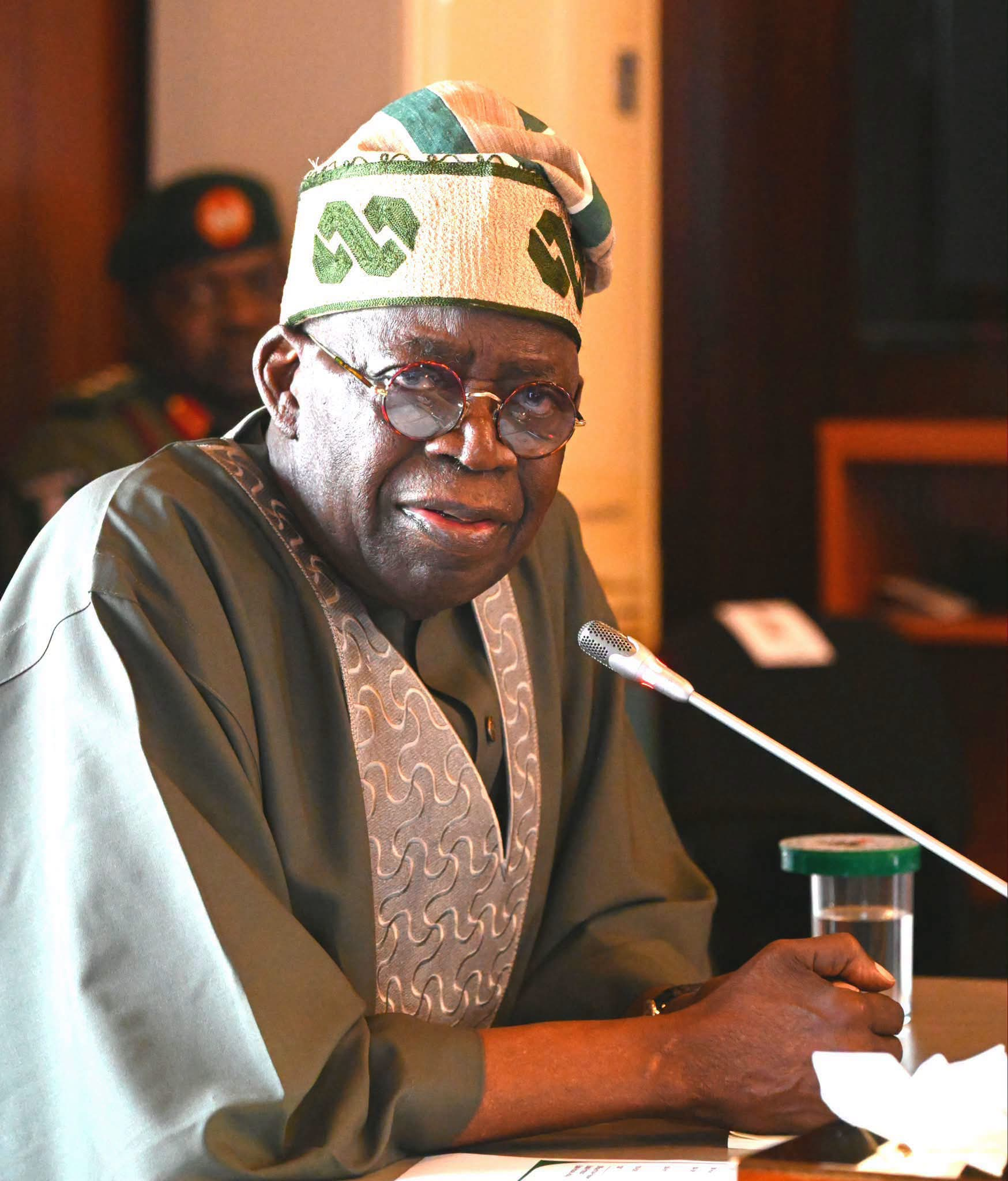
President Bola Ahmed Tinubu has warned politicians and their supporters against violence as political activities gather momentum ahead of the 2027 general elections, directing security agencies to deal firmly with acts of thuggery and other anti-democratic activities.

Tinubu gave the warning in a statement on Friday, November 13, following reports of violence accompanying political events in different parts of the country.

The President condemned all forms of political violence, insisting that election campaigns should focus on issues, policy ideas and proposals capable of improving the welfare of Nigerians and advancing national development.

He reaffirmed his administration’s commitment to ensuring peaceful, free and fair elections, while urging political leaders and supporters across party lines to conduct themselves responsibly.

According to him, political differences and competing ambitions should not turn Nigerians into enemies, stressing that members of different political parties remain part of the same national household.

Tinubu also reiterated his directive to security agencies to remain strict and firm against individuals seeking to undermine public order.

He said all political parties and candidates must be allowed to campaign freely across the country without intimidation, harassment or threats to their safety.

The President, however, warned that his administration would not tolerate irresponsible conduct by politicians and their supporters.

He authorised security agencies to confront political thuggery and other anti-social and anti-democratic activities with full force.

Continue Reading