Connect with us

Agriculture

See How Kaduna State is Reducing Duplication in Agricultural Interventions

Published

on

Share

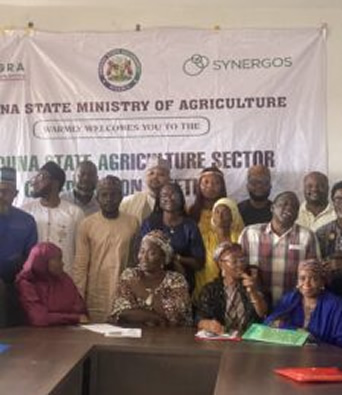
The Kaduna State Government says it is reducing duplication of interventions hence improving policy implementation by strengthening coordination among agricultural stakeholders.

Murtala Dabo, Commissioner for Agriculture, said this on Thursday at a quarterly sector coordination meeting under the Policy and Agricultural Systems Strengthening (PASS) project in the state.

NewsBlast gathered that PASS is supported by the Alliance for a Green Revolution in Africa (AGRA) with technical assistance from Synergos.

Represented by Dr. Pakachi Zakariya, Director, Veterinary Services, the commissioner  said the platform brought together stakeholders across the agricultural value chain.

According to him, the aim is to review activities, share updates and align interventions with government priorities.

“This forum enables stakeholders to understand government programmes and identify areas for collaboration.

“A lot of people do not know what government is doing or how to engage. This creates that opportunity,” he said.

Esther Ibrahim, Programme Officer, AGRA, said the platform was promoting policy coherence and better coordination among agricultural stakeholders.

“For us, this is about bringing all actors together to ensure coherence and reduce duplication,” she stated.

Ibrahim added that the stakeholders presented reports on second-quarter activities, while providing updates for the third.

According to her, the participation of the Kaduna State Bureau of Statistics will strengthen data-driven planning in the sector.

“We may not have all the answers, but we are aligning on solutions and taking them to government,” she said.

Victor Adejor, Country Director, Sinagos, said the platform was critical to policy formulation and implementation.

Adejor said it brought together farmers, government, private sector operators, seed companies, development partners, media organisations and other key actors.

He added that  the involvement of ministries, departments and agencies with agriculture-related mandates was helping to improve coordination.

Adejor noted that the platform had contributed to the development of policies, including contract farming and gender policies.

The country director said the coordination was reducing duplication and fragmentation of interventions in the agricultural sector.

“A lot is happening because people are talking. People are coming together, reasoning together and planning together,”Adejor  said.

Continue Reading
Click to comment

Leave a Reply

Your email address will not be published. Required fields are marked *

Agriculture

New Ranching Model to Commence in Plateau, 5 Other States, Including FCT

Published

on

Minister of Livestock Development, Alhaji Idi Maiha
Share

The Federal Government said the pilot programme for the new ranching model would commence at the Wase Grazing Reserve in Plateau state as a proof of concept for the new ranching mode

Minister of Livestock Development, Alhaji Idi Maiha, disclosed this after briefing President Bola Tinubu on the ministry’s activities at the Presidential Villa, Abuja, on Tuesday.

Maiha identified six states and the Federal Capital Territory (FCT) for the pilot implementation of its National Ranching Policy.

He identified the states as Benue, Plateau, Nasarawa, Kaduna and Adamawa, alongside the FCT.

According to him, the areas were selected because they have recorded some of the highest incidences of farmer-herder conflicts in recent years.

“Our understanding is that large numbers of cattle on the move are crisis-prone because grazing routes have disappeared due to farming, urbanisation and infrastructure development.

“Nomadism, as we know it, is no longer sustainable and we need a different concept,” he said.

Maiha said the government had engaged more than 34 pastoral organisations and would continue consultations to build support for the policy.

He said the ministry recently met pastoralist leaders under the leadership of the Sultan of Sokoto, Alhaji Muhammadu Sa’ad Abubakar III, and would hold another engagement within two weeks.

The minister said the policy would encourage pastoralists to rear animals in designated locations rather than move them over long distances in search of feed and water.

“Today, we go and fetch the grass and bring it where the animals are. Better still, grow the grass where the animals are.

“There are genetically developed grasses with all the nutritional value required to feed livestock,” he said.

Maiha said the government would provide housing, veterinary clinics, schools, primary healthcare centres, solar lighting and water infrastructure in designated ranching communities.

He added that each grazing reserve would evolve into an economic hub capable of attracting milk processors, modular abattoirs, bio-digesters and other livestock-related businesses.

“Imagine what you are going to have if you have 30,000 herds of cattle in one area. The milk collection alone will attract processors and many other investments,” he said.

The minister said the Federal Government was also implementing a nationwide livestock identification programme using radio frequency technology.

According to him, all four-legged livestock would be tagged for identification, geolocation and proof of ownership.

He said the initiative would help combat cattle rustling, recover lost animals and build a comprehensive national livestock database.

Maiha said the ministry was also promoting dairy development, commercial fodder cultivation, modern abattoirs, veterinary services and poultry production.

He disclosed that seven model veterinary clinics had been established, with plans to provide at least one model veterinary hospital in every state.

The minister added that the government was strengthening vaccine storage facilities and encouraging investments in dairy and red meat value chains.

On the ministry’s progress, Maiha said about 20 states had established similar livestock ministries or agencies, reflecting growing acceptance of the Federal Government’s livestock development agenda.

He commended Tinubu for his support and commitment to transforming the livestock sector.

He quoted the President as saying, “The value chains in the livestock sector are fantastic,” while urging Nigerians to take advantage of opportunities across the industry.

Continue Reading

Agriculture

WAVE: FG, BOA Signed MoU for 3 Million Women Farmers to Benefit

Published

on

Share

An MoU to provide agricultural support and opportunities for three million women through the Women Agro-Value Expansion (WAVE) Programme has been signed between the Federal Ministry of Women Affairs and Social Development and the Bank of Agriculture (BOA).

Expanded women’s access to finance, mechanisation and opportunities across Nigeria’s agricultural value chain is what the deal aims to achieve.

The Minister, Hajiya Imaan Sulaiman-Ibrahim, while speaking at the signing ceremony in Abuja on Tuesday, said the initiative aligned with President Bola Tinubu’s Renewed Hope Agenda on food security and women’s economic empowerment.

She acknowledged women’s vital roles in agriculture but lacked adequate access to finance and resources needed to expand their businesses.

“This MoU with the Bank of Agriculture fills the critical financing gap confronting women in agriculture.

“Women are already farming, but many cannot scale because they lack access to finance and support.

“Access to finance will move women beyond smallholder farming into agro-entrepreneurship, creating agro-billionaires,” she said.

The minister hoped the WAVE Programme would enable women to participate across the agricultural value chain, including mechanised farming, input supply, processing and other agribusiness opportunities.

According to her, the programme will also provide education, digital tools and other support systems to improve women’s productivity and business success.

Sulaiman-Ibrahim said about 33,000 women had already indicated interest, while the Federal Government was targeting three million beneficiaries in the coming years.

She urged women across the country to embrace the initiative, saying their economic empowerment would strengthen families, communities and national development.

“Women are the solution. We must attract more women into agriculture and create opportunities that amplify the gains of this partnership,” she said.

Earlier, Managing Director of BOA, Mr Ayo Sotinrin, said the bank was committed to expanding agricultural financing for women, who accounted for a significant proportion of its reliable loan beneficiaries.

He said the bank would support women through input financing, mechanisation and other interventions designed to improve productivity and incomes.

Sotinrin said farmers would access improved seeds and other inputs at subsidised interest rates to boost yields.

“Instead of one tonne per hectare, farmers can harvest up to five tonnes through improved seeds and better support. Raising productivity remains Nigeria’s most pressing agricultural priority,” he said.

He added that women would also access tractors at subsidised rates, with repayment spread over three to five years.

“A woman can acquire a tractor, provide services to farmers and repay gradually until she owns it outright.

“This strengthens the business case for women in mechanisation,” he said.

Sotinrin said BOA would work with farmer aggregation companies and cooperatives to improve access to loans, ensure repayment and expand agricultural financing.

He expressed optimism that the programme would attract greater support from development partners and relevant government institutions.

Earlier, the ministry’s Permanent Secretary, Esuabana Nko Asanye, said the MoU would help move women from subsistence farming to commercial agriculture.

She said the partnership would provide access to mechanisation, input financing, improved seeds, demonstration farms and agricultural knowledge.

She added that beneficiaries would also become tractor owners, operators, seed producers, input suppliers and agribusiness managers.

“The programme begins modestly but progressively empowers women to become financially independent,” she said.

Asanye said the initiative would improve wo

Continue Reading

Agriculture

FG to Disburse Interest-Free Loans to 22,000 Farmers Under FarmerMoni Scheme

Published

on

President Bola Ahmed Tinubu
Share

The Federal Government has announced that at least 22,000 farmers across the country will benefit from interest-free loans under the FarmerMoni Dry and Wet Season Programme.

The initiative, implemented through the National Social Investment Programme Agency (NSIPA), was unveiled during the inauguration of the Renewed Hope GEEP 3.0 and the FarmerMoni Technical Working Group in Abuja.

Speaking at the event, the National Programme Manager of the Government Enterprise and Empowerment Programme (GEEP) under NSIPA, Mr. Hamza Baba, said the loans would be interest-free and collateral-free, aimed at boosting agricultural productivity nationwide.

According to Baba, the application portal has been opened for eligible farmers to register. Each beneficiary will receive up to N300,000, depending on the economic value of specific farming activities.

He stated that the programme targets vulnerable and low-income farmers at the grassroots.

To qualify, applicants must be Nigerian citizens aged 18 and above, actively engaged in farming, and either own or lease farmland.

They must also have a bank account, National Identification Number (NIN), municipal identification, and be registered members of a farming cooperative or association within their local government area.

Baba said the programme will cover all 774 local government areas, with an average of 28 farmers expected to benefit from each council in the current phase. He noted that state programme managers, enumerators, partner banks, FinTech recovery agents, agricultural development projects, and farmer associations would collaborate to ensure effective implementation across the 36 states and the Federal Capital Territory.

Minister of Humanitarian Affairs and Poverty Reduction, Dr. Bernard Doro, said the launch of Renewed Hope GEEP 3.0 and FarmerMoni underscores the administration’s commitment to strengthening agricultural development and expanding economic opportunities.

He stated that the programmes align with President Bola Tinubu’s Renewed Hope Agenda, which prioritises inclusion, resilience, and shared prosperity. According to him, FarmerMoni is designed to support farmers during both planting seasons, reduce seasonal risks, improve yields, and enhance national food security.

Doro added that investing in agriculture remains critical to poverty reduction and rural development, noting that the initiative seeks to empower farmers through sustainable financial support.

Continue Reading