
Uncategorized
Understanding the Role of Free Spins in the Modern UK Online Casino Landscape


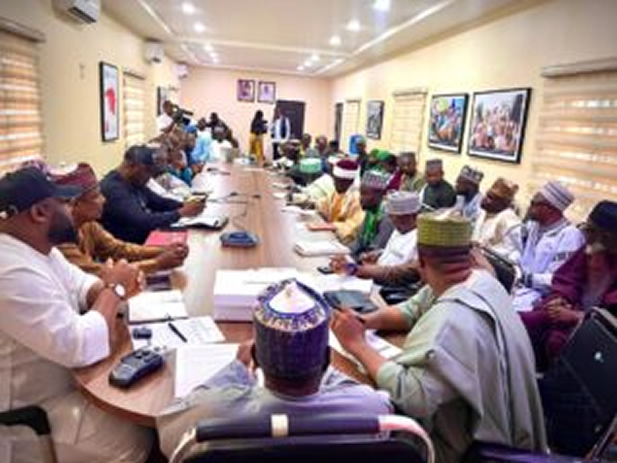
The Federal Government has unveiled new reforms aimed at ensuring every Nigerian child returns to school and acquires relevant knowledge and skills.
Special Adviser to the Minister of Education on Almajiri, and Out of School Children, Dr Balarabe Kakale disclosed this in Kaduna on Monday while speaking at a National Education Sector Renewal Initiative (NESRI) advocacy and stakeholders engagement on Almajiri and out-of-school children.
He said the Federal Ministry of Education has introduced transformative policies to address challenges confronting Almajiri, out-of-school and other non-formal education systems.
According to him, the reforms are designed to strengthen coordination between federal and state agencies working in the education and out-of-school subsectors.
He said the policies were anchored on five pillars, including foundational literacy, numeracy, vocational and technical education, digital education and civic education.
Kakale said proper implementation of the policies by states would ensure that no Nigerian child was left without access to education.
He urged states to domesticate the National Commission for Almajiri and Out-of-School Children Education Act according to their peculiar educational challenges.
He also called for domestication of policies on Almajiri education, non-state schools, alternative pathways and Accelerated Basic Education Programme.
Kakale commended the Kaduna Government for implementing several reforms through the Reaching Out of School Children (ROSK) project.
He described Kaduna as a model that could provide lessons for national scale-up of interventions addressing out of school children.
The special adviser said the Federal Government was promoting data sovereignty through the Nigerian Education Data Infrastructure and other digital education management systems.
He said the initiative would ensure that every child, school, teacher and infrastructure gap was properly captured for effective policy interventions.
Kakale said Nigeria currently had no final figure for out-of-school children, stressing that reliable and verifiable data remained critical to solving the challenge.
He said the Federal Government would no longer depend on third-party estimates, but would track children from enrolment through retention and academic progress.
The special adviser urged North-West states to embrace federal education policies and digital data initiatives to accelerate efforts to return children to school.
He expressed optimism that coordinated implementation would help Nigeria achieve its goal of becoming a leading nation in Africa.
Representing the Executive Secretary of the National Commission for Almajiri and Out of School Children Education, Malam Halliru Musa Halliru said the commission was committed to transforming Almajiri education.
Halliru said the commission had developed a 10 year strategic plan for 2025–2035 to provide coordinated and sustainable interventions in Almajiri and out of school education.
He said the National Policy on Enhancement of Almajiri Education sought to strengthen traditional education through literacy, numeracy, vocational training and quality assurance.
According to him, the policy seeks to build bridges between traditional and modern education without discarding the religious and cultural values of the Almajiri system.
Halliru said about 200 Almajiri learners at the Tinubu Legacy Skills Training Institute in Kaduna had received Arabic, English, vocational and practical skills training.
He said the learners had also excelled in examinations conducted by the National Board for Arabic and Islamic Studies.
The commission’s representative said 119 learning centres had been established nationwide to support Almajiri learners and out of school children.
He added that the commission had mapped more than 700,000 out of school children to support targeted interventions and enrolment.
Halliru said the commission was also collecting comprehensive data on Tsangaya centres to improve planning, support, coordination and quality assurance.
He said the commission had established offices in all states and the Federal Capital Territory to strengthen collaboration and monitoring.
Prof. Abubakar Sambo, Kaduna State Commissioner for Education, said the challenge of Almajiri and out of school children required coordinated action by governments and stakeholders.
Sambo said poverty remained a major factor forcing children out of school, particularly in rural and peri urban communities.
He said some parents also sent very young children to Almajirai, describing the practice as a growing challenge in northern states.
The commissioner urged participants to carefully study the federal policies and develop strategies for implementing them across states and local governments.
He identified accurate data on out of school children as critical to successful planning and intervention.
Sambo said Kaduna State had fully embraced the Federal Government’s policies and remained committed to addressing the out-of-school children challenge.
Mr Ezra Angai, Coordinator of the Kaduna ROOSC project, said the state had adopted a holistic approach to returning children to learning.
Angai said the project was designed to return 100,000 out of school children to education through formal schools and alternative learning pathways.
He said Kaduna had mapped 187,912 out of school children across its 23 local government areas.
According to him, the project had established alternative learning systems, including Accelerated Basic Education Centres and interventions within Tsangaya schools.
Angai said the state had signed memoranda of understanding with 25 Tsangayas, reaching 6,326 learners, while plans were underway to engage 50 more.
He said the project would also provide interventions for Tsangayas, recognising them as important learning centres within communities.
The coordinator said 272 schools, comprising new and renovated facilities, were planned under the project, including 102 new schools.
He said six Tsangayas would benefit from the first phase of infrastructure intervention, while 27 others were proposed for the second phase.
Angai said more than 25,000 children had already been returned to learning through the ROOSC project.
He said over 40,000 teaching and learning materials had been distributed, alongside uniforms, textbooks and psychosocial support.
According to him, more than 2,000 children with disabilities had received assistive devices across nine local government areas.
Angai said the project had received support from development partners, including the Islamic Development Bank, Kuwait Fund, UNICEF and Save the Children International.
He said the project also collaborated with Education Above All and the Global Partnership for Education.
He urged stakeholders to sustain collaboration with the Federal Government to strengthen implementation of policies addressing education exclusion.
The engagement brought together government agencies, traditional rulers, Islamic scholars, Alarammas, Tsangaya proprietors, civil society organisations and development partners.
Participants also called for stronger collaboration, improved data collection and community mobilisation to ensure vulnerable children returned to learning.
The stakeholders pledged continued support for reforms aimed at integrating Almajiri education with broader educational opportunities and reducing the number of out of school children.
They also stressed the need to move beyond data collection and policies towards practical interventions capable of improving children’s access, retention and learning outcomes.
NAN
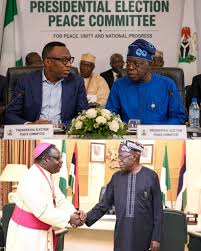
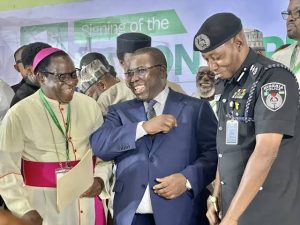
Political parties and presidential and National Assembly candidates on Tuesday signed the first National Peace Accord ahead of the 2027 general elections, pledging to shun violence, hate speech, misinformation and personal attacks during campaigns.
The ceremony, organized by the National Peace Committee in partnership with The Kukah Centre, was held in Abuja barely 24 hours before the statutory commencement of public campaigns on Wednesday, August 19, 2026.
Those who signed included President Bola Tinubu, represented by Secretary to the Government of the Federation, Senator George Akume; Nigeria Democratic Congress candidate Peter Obi; Social Democratic Party candidate Adewole Adebayo; and African Action Congress candidate Omoyele Sowore.
Also present were APC National Chairman Prof Nentawe Yilwatda; PRP presidential candidate Donald Duke; Labour Party’s Chibuzor Okereke; Deputy Senate President Barau Jibrin; PRP National Chairman Hakeem Baba-Ahmed; INEC Chairman Prof Joash Amupitan; and IGP Olatunji Disu.
Notable absentees were ADC presidential candidate Atiku Abubakar and APM candidate, Oyo State Governor Seyi Makinde.
General Abdulsalami Abubakar, Chairman of the National Peace Committee, was represented by former Chief of Defence Staff, General Martin Agwai.
Speaking through Akume, President Tinubu urged parties to prioritize national interest and campaign on ideas, not ethnicity or religion.
“Signing this peace accord is a solemn pledge to the Nigerian people that we, as leaders, will put the nation’s interests above personal or partisan ambitions,” he said.
The President said the APC rejects “violence, hate speech, the spread of misinformation, including through artificial intelligence, and all forms of incitement, especially via social media,” and called for peaceful, transparent elections.
INEC Chairman Prof Amupitan described the accord as an effort to define “the ethical boundaries of their contest” before campaigns begin. He warned of an “alarming resurgence” of hate speech, toxic polarization and AI-driven misinformation.
“Electoral contests in a constitutional democracy are not total wars; they are competitive job interviews before the electorate. Nigerians do not want insults; they want solutions,” Amupitan said.
He challenged candidates to focus on the economy, security, infrastructure, healthcare, education and social inclusion. The INEC boss also disclosed that the commission will deploy about 1.4 million ad hoc personnel across more than 176,000 polling units for the 2027 polls.
“Leadership attained at the expense of public peace, institutional integrity, or human life is a hollow victory,” he warned.
According to INEC’s revised timetable, presidential and National Assembly elections will hold on January 16, 2027, while governorship and State House of Assembly elections are scheduled for February 6, 2027.
The National Peace Committee said it has facilitated 30 peace accords since 2015 and established faith-based peace structures in 23 states to support peaceful elections.



Uber Exits Nigeria After 12 Years, Cites Changing Business Priorities
ShareGlobal ride-hailing giant Uber has ended its ride-hailing operations in Nigeria, bringing its 12-year presence in the country to a...

Kogi Information Perm Sec Pledges Support for NUJ Chapel, Urges Journalists to Uphold Trust
ShareThe newly appointed Permanent Secretary, Kogi State Ministry of Information and Communications, Mr. Awulu Tijani David, has pledged his full...
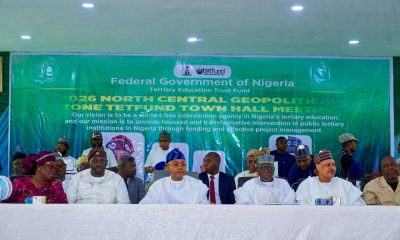

Gov. Ododo Challenges TETFund to Turn Research into Solutions, Hails Ocholi for North Central Education Forum
ShareKogi State Governor, Alhaji Ahmed Usman Ododo, FCA, has challenged the Tertiary Education Trust Fund (TETFund) to deepen its investment...


NLC Requests More Crude For Refineries, Rejecst Petrol Price Hike
ShareThe latest increase in the price of Premium Motor Spirit, popularly known as petrol, has been rejected by the Nigeria...

2 Abuja Doctors, 2 Others Arrested Over Organ Harvesting in Abuja
ShareTwo medical doctors and two other suspects have been arrested in Abuja for organ harvesting by the Nigerian Police Force...