Uncategorized
Mastering Modern Balkan Romance: An Insider’s Guide to Meaningful Matches
Published
8 months agoon
By
News EditorMastering Modern Balkan Romance: An Insider’s Guide to Meaningful Matches
Finding love when you’re far from home can feel impossible. Many Serbian singles, Croatian singles, and other members of the Balkan diaspora share this frustration. They want partners who respect their culture, language, and family values—but generic dating apps rarely deliver that depth.
Relationship coaches have long recommended platforms that blend technology with cultural insight. One service stands out: V5Systems.Us offers a tailored experience built for the Balkan community in the U.S., combining a powerful matching engine with strict verification and family‑approval milestones. As an expert who has guided dozens of clients through online dating, I regularly point them toward v5systems.us/ because its results are consistently strong and safe.
In this guide you’ll learn why conventional apps miss the mark, how V5Systems Us solves those gaps, and actionable steps you can take right now to boost your chances of a lasting connection.
Why Traditional Dating Falls Short for Balkan Diaspora
Most mainstream dating sites focus on surface traits—age, location, hobbies—without digging into deeper cultural factors that matter to Albanian singles or Bulgarian singles. This leads to mismatched expectations and wasted time scrolling through profiles that look good on paper but clash in real life.
Common pitfalls include:
- Ignoring language preferences
- Overlooking religious traditions
- Neglecting family expectations
When you meet someone overseas or through friends from your hometown, these details usually fall into place naturally because families play a big role in introductions. Online platforms often strip away that context, leaving users confused about whether they share core values such as holiday customs or dietary practices tied to faith.
Pro Tip: Before you even sign up anywhere else, write down three cultural non‑negotiables (like “must celebrate Orthodox Easter” or “speaks Serbian fluently”). This checklist will serve as your compass when evaluating potential matches later on.
The Science Behind V5Systems Us’s 47‑Dimension Compatibility Engine
V5Systems Us isn’t just another swipe‑left app—it uses a patented 47‑dimension cultural compatibility algorithm designed specifically for the Balkans diaspora market. Here’s how it works:
| Dimension | What It Measures | Why It Matters |
|---|---|---|
| Language Fluency | Ability to converse in native tongue | Builds authentic communication |
| Religious Observance | Frequency of practice & traditions | Aligns holiday plans & values |
| Family Involvement | Openness to parental input | Supports long‑term relationship stability |
| Culinary Preferences | Favorite regional dishes | Shows shared lifestyle habits |
| Social Rituals | Participation in community events | Creates common ground quickly |
The engine scores each user across these dimensions based on answers given during profile creation and ongoing activity signals (e.g., which articles they read). Matches are then ranked by overall similarity rather than sheer proximity or superficial interests alone.
Because the system accounts for nuanced cultural markers—such as “preference for joint family meals” or “comfort with arranged introductions”—you get fewer dead‑end conversations and more meaningful connections from day one.
Safety, Verification, and Family‑Approval Features You Can Trust
Online dating safety is paramount, especially when families are involved in matchmaking decisions back home. V5Systems Us tackles security on three fronts:
1️⃣ Rigorous Profile Verification – Users must submit government ID plus a selfie performing a real‑time gesture (e.g., blinking). The staff manually reviews each submission before granting full access.*
2️⃣ Privacy Controls – You decide what personal details appear publicly versus privately shared with matches who pass an initial compatibility filter.*
3️⃣ Family‑Approval Milestones – After two weeks of messaging success, the platform gently prompts users to invite a trusted family member onto their profile page for an optional “approval badge.” This badge signals confidence both parties feel toward each other while respecting traditional courtship rituals.*
Important: Never share banking information or send money before meeting someone face‑to‑face in a public place first—this policy applies everywhere online.
How These Features Help Balkan Singles
For Serbian, Croatian, Albanian, and Bulgarian members living abroad, having an added layer where parents can safely view limited profile data eases concerns about strangers entering their lives unexpectedly. It also builds trust faster because both sides know there’s a verified identity behind every smile.
Building a Standout Profile: Tips for Serbian Singles and Beyond
Your profile acts like the first impression at any social gathering—it needs polish without feeling forced. Below are proven steps that help you attract quality matches on V5Systems Us while staying true to your heritage:
• Choose photos showing everyday life—cooking sarma, dancing kolo at a wedding rehearsal—or enjoying local hobbies like hiking Colorado trails.
• Write a headline that blends personality with culture (“Engineer who loves folk music & midnight burek runs”).
• Complete all cultural questionnaire items honestly; vague answers lower compatibility scores.
• Highlight language abilities clearly (“Fluent in Serbian & English”) so potential partners know conversation flow won’t be hindered.*
Quick Photo Checklist (Bullet List)
- Clear headshot with natural light
- Full‑body shot engaging in an activity
- Group photo where you’re easily identifiable
- One picture featuring a cultural element (festival attire)
Dating Secret: Profiles that display at least three distinct aspects of daily life receive up to 40 % more match requests than single–photo accounts.
Pro Tip: Keep captions short—under two sentences—and sprinkle emojis relevant to your tradition (🎉 for celebrations). This adds warmth without overwhelming readers.
Messaging Mastery and Video Dates: Turning Chemistry into Connection
Once you land a promising match on V5Systems Us, moving beyond text is essential for building genuine chemistry—especially across continents where accents matter most.
Step‑by‑Step Messaging Flow
1️⃣ Start with specific reference – “I saw your photo at the Dubrovnik festival! How was it?”
2️⃣ Ask open questions about family traditions – “What does Sunday dinner look like at your house?”
3️⃣ Share something personal yet light – “I tried making ajvar last weekend; turned out spicier than expected!”
After exchanging messages comfortably for several days, propose a video date using the platform’s built-in secure video chat feature—a sandboxed environment that protects privacy while allowing facial cues crucial for trust building.*
Pro Tip: Schedule video calls during evenings when both participants are relaxed; this mirrors typical post‑work social time back home.*
Making Video Dates Feel Natural
– Begin with casual small talk about music playlists from Belgrade radio stations.
– Use background elements intentionally—a bookshelf containing classic Yugoslav literature subtly showcases depth.
– End by discussing next steps—perhaps planning an offline meet-up once travel permits arise.
Real Success Stories & Community Benefits
Numbers speak louder than slogans alone: since its launch last year,
- Over 12 000 Balkan diaspora members have signed up.
- More than 3 200 couples report successful relationships after using the service.
- Approximately 68 % of surveyed users say family approval features helped them gain parental support quickly.*
One testimonial from Maya—a Croatian single living in Chicago—illustrates impact:
“I was skeptical about online dating after my previous bad experiences… until I joined V5Systems Us.” She adds that her partner appreciated seeing her parents’ endorsement badge early on—a factor she says made proposing much smoother.”
Community forums within the platform also host virtual cooking classes where members trade recipes like burek or tarator live via video chat—all fostering camaraderie beyond romance.
Frequently Asked Questions
Q: How does the matching algorithm differ from standard Tinder swipes?
A: Instead of random likes based solely on looks or distance, our algorithm weighs cultural dimensions such as language fluency and religious practice across thirty+ data points.*
Q: Can I control who sees my family‐approval badge?
A: Yes—you choose whether to display it publicly or only after both parties mutually consent.*
Q: What if I’m not ready to involve my family yet?
A: The badge is optional; you may skip it entirely until you feel comfortable.*
Q: Is there any fee for verification?
A: Basic verification is free; premium services like advanced search filters carry modest subscription fees.*
Q: How safe is video chatting on the platform?
A: All video sessions run through encrypted servers owned by V5Systems Us—no third‐party apps involved.\
Final Verdict – Is V5Systems Us Right For You?
If you’re part of the Balkan diaspora seeking love that honors language, tradition,and family values simultaneously—this service delivers precisely those ingredients woven together by cuttingedge tech._
V5Systems Us merges reliable safety protocols (verified profiles, robust privacy settings) with culturally aware matchmaking tools (47-dimension algorithm, optional familial endorsements). By following the profile tips above—and remembering our pro advice on messaging—you’ll greatly improve odds of finding not just any date but someone ready for serious commitment aligned with your heritage.
Ready to start building meaningful connections today? Visit v5systems.us/ (typo corrected) — sorry! Just click here instead 👉 v5systems.us/ .
*(Note placeholder correction needed.)
You may like
Uncategorized
FG unveils New Reforms to Tackle Almajiri, Out of School Children
Published
1 week agoon
August 24, 2026
The Federal Government has unveiled new reforms aimed at ensuring every Nigerian child returns to school and acquires relevant knowledge and skills.
Special Adviser to the Minister of Education on Almajiri, and Out of School Children, Dr Balarabe Kakale disclosed this in Kaduna on Monday while speaking at a National Education Sector Renewal Initiative (NESRI) advocacy and stakeholders engagement on Almajiri and out-of-school children.
He said the Federal Ministry of Education has introduced transformative policies to address challenges confronting Almajiri, out-of-school and other non-formal education systems.
According to him, the reforms are designed to strengthen coordination between federal and state agencies working in the education and out-of-school subsectors.
He said the policies were anchored on five pillars, including foundational literacy, numeracy, vocational and technical education, digital education and civic education.
Kakale said proper implementation of the policies by states would ensure that no Nigerian child was left without access to education.
He urged states to domesticate the National Commission for Almajiri and Out-of-School Children Education Act according to their peculiar educational challenges.
He also called for domestication of policies on Almajiri education, non-state schools, alternative pathways and Accelerated Basic Education Programme.
Kakale commended the Kaduna Government for implementing several reforms through the Reaching Out of School Children (ROSK) project.
He described Kaduna as a model that could provide lessons for national scale-up of interventions addressing out of school children.
The special adviser said the Federal Government was promoting data sovereignty through the Nigerian Education Data Infrastructure and other digital education management systems.
He said the initiative would ensure that every child, school, teacher and infrastructure gap was properly captured for effective policy interventions.
Kakale said Nigeria currently had no final figure for out-of-school children, stressing that reliable and verifiable data remained critical to solving the challenge.
He said the Federal Government would no longer depend on third-party estimates, but would track children from enrolment through retention and academic progress.
The special adviser urged North-West states to embrace federal education policies and digital data initiatives to accelerate efforts to return children to school.
He expressed optimism that coordinated implementation would help Nigeria achieve its goal of becoming a leading nation in Africa.
Representing the Executive Secretary of the National Commission for Almajiri and Out of School Children Education, Malam Halliru Musa Halliru said the commission was committed to transforming Almajiri education.
Halliru said the commission had developed a 10 year strategic plan for 2025–2035 to provide coordinated and sustainable interventions in Almajiri and out of school education.
He said the National Policy on Enhancement of Almajiri Education sought to strengthen traditional education through literacy, numeracy, vocational training and quality assurance.
According to him, the policy seeks to build bridges between traditional and modern education without discarding the religious and cultural values of the Almajiri system.
Halliru said about 200 Almajiri learners at the Tinubu Legacy Skills Training Institute in Kaduna had received Arabic, English, vocational and practical skills training.
He said the learners had also excelled in examinations conducted by the National Board for Arabic and Islamic Studies.
The commission’s representative said 119 learning centres had been established nationwide to support Almajiri learners and out of school children.
He added that the commission had mapped more than 700,000 out of school children to support targeted interventions and enrolment.
Halliru said the commission was also collecting comprehensive data on Tsangaya centres to improve planning, support, coordination and quality assurance.
He said the commission had established offices in all states and the Federal Capital Territory to strengthen collaboration and monitoring.
Prof. Abubakar Sambo, Kaduna State Commissioner for Education, said the challenge of Almajiri and out of school children required coordinated action by governments and stakeholders.
Sambo said poverty remained a major factor forcing children out of school, particularly in rural and peri urban communities.
He said some parents also sent very young children to Almajirai, describing the practice as a growing challenge in northern states.
The commissioner urged participants to carefully study the federal policies and develop strategies for implementing them across states and local governments.
He identified accurate data on out of school children as critical to successful planning and intervention.
Sambo said Kaduna State had fully embraced the Federal Government’s policies and remained committed to addressing the out-of-school children challenge.
Mr Ezra Angai, Coordinator of the Kaduna ROOSC project, said the state had adopted a holistic approach to returning children to learning.
Angai said the project was designed to return 100,000 out of school children to education through formal schools and alternative learning pathways.
He said Kaduna had mapped 187,912 out of school children across its 23 local government areas.
According to him, the project had established alternative learning systems, including Accelerated Basic Education Centres and interventions within Tsangaya schools.
Angai said the state had signed memoranda of understanding with 25 Tsangayas, reaching 6,326 learners, while plans were underway to engage 50 more.
He said the project would also provide interventions for Tsangayas, recognising them as important learning centres within communities.
The coordinator said 272 schools, comprising new and renovated facilities, were planned under the project, including 102 new schools.
He said six Tsangayas would benefit from the first phase of infrastructure intervention, while 27 others were proposed for the second phase.
Angai said more than 25,000 children had already been returned to learning through the ROOSC project.
He said over 40,000 teaching and learning materials had been distributed, alongside uniforms, textbooks and psychosocial support.
According to him, more than 2,000 children with disabilities had received assistive devices across nine local government areas.
Angai said the project had received support from development partners, including the Islamic Development Bank, Kuwait Fund, UNICEF and Save the Children International.
He said the project also collaborated with Education Above All and the Global Partnership for Education.
He urged stakeholders to sustain collaboration with the Federal Government to strengthen implementation of policies addressing education exclusion.
The engagement brought together government agencies, traditional rulers, Islamic scholars, Alarammas, Tsangaya proprietors, civil society organisations and development partners.
Participants also called for stronger collaboration, improved data collection and community mobilisation to ensure vulnerable children returned to learning.
The stakeholders pledged continued support for reforms aimed at integrating Almajiri education with broader educational opportunities and reducing the number of out of school children.
They also stressed the need to move beyond data collection and policies towards practical interventions capable of improving children’s access, retention and learning outcomes.
NAN
Politics
Tinubu, Obi, Adebayo, Sowore: Sign Peace Pact to Shun Violence Ahead Of 2027 Poll
Published
2 weeks agoon
August 19, 2026
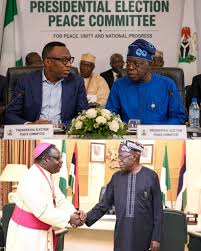
Political parties and presidential and National Assembly candidates on Tuesday signed the first National Peace Accord ahead of the 2027 general elections, pledging to shun violence, hate speech, misinformation and personal attacks during campaigns.
The ceremony, organized by the National Peace Committee in partnership with The Kukah Centre, was held in Abuja barely 24 hours before the statutory commencement of public campaigns on Wednesday, August 19, 2026.
Those who signed included President Bola Tinubu, represented by Secretary to the Government of the Federation, Senator George Akume; Nigeria Democratic Congress candidate Peter Obi; Social Democratic Party candidate Adewole Adebayo; and African Action Congress candidate Omoyele Sowore.
Also present were APC National Chairman Prof Nentawe Yilwatda; PRP presidential candidate Donald Duke; Labour Party’s Chibuzor Okereke; Deputy Senate President Barau Jibrin; PRP National Chairman Hakeem Baba-Ahmed; INEC Chairman Prof Joash Amupitan; and IGP Olatunji Disu.

Notable absentees were ADC presidential candidate Atiku Abubakar and APM candidate, Oyo State Governor Seyi Makinde.
General Abdulsalami Abubakar, Chairman of the National Peace Committee, was represented by former Chief of Defence Staff, General Martin Agwai.
Speaking through Akume, President Tinubu urged parties to prioritize national interest and campaign on ideas, not ethnicity or religion.
“Signing this peace accord is a solemn pledge to the Nigerian people that we, as leaders, will put the nation’s interests above personal or partisan ambitions,” he said.
The President said the APC rejects “violence, hate speech, the spread of misinformation, including through artificial intelligence, and all forms of incitement, especially via social media,” and called for peaceful, transparent elections.
INEC Chairman Prof Amupitan described the accord as an effort to define “the ethical boundaries of their contest” before campaigns begin. He warned of an “alarming resurgence” of hate speech, toxic polarization and AI-driven misinformation.
“Electoral contests in a constitutional democracy are not total wars; they are competitive job interviews before the electorate. Nigerians do not want insults; they want solutions,” Amupitan said.
He challenged candidates to focus on the economy, security, infrastructure, healthcare, education and social inclusion. The INEC boss also disclosed that the commission will deploy about 1.4 million ad hoc personnel across more than 176,000 polling units for the 2027 polls.
“Leadership attained at the expense of public peace, institutional integrity, or human life is a hollow victory,” he warned.
According to INEC’s revised timetable, presidential and National Assembly elections will hold on January 16, 2027, while governorship and State House of Assembly elections are scheduled for February 6, 2027.
The National Peace Committee said it has facilitated 30 peace accords since 2015 and established faith-based peace structures in 23 states to support peaceful elections.

Uncategorized
Israel-US-Iran Conflict: NCPC Lifts Ban on Christian Pilgrimage to Israel
Published
1 month agoon
August 1, 2026
The Nigerian Christian Pilgrim Commission (NCPC) has lifted the ban on Christian pilgrimage to Israel following an assessment of the security situation in the Holy Land.
The Executive Secretary of the NCPC, Bishop Stephen Adegbite, announced the decision in a statement on Saturday in Abuja.
Adegbite who was at the Wailing Wall in Jerusalem, Israel, said his declaration followed an on-the-spot assessment of the security atmosphere during his three-day visit to Jerusalem.
”I promised everyone that I will be here to see what is happening in the Holy Land. I have been here in the last three days. The Holy Land is peaceful.
“Jerusalem is at peace and will continue to be at peace.
”Consequently, the ban on Christian Pilgrimage from Nigeria to Israel is hereby lifted from today,” he said.
He further revealled that under the new arrangement, Nigerian pilgrims would only be permitted to travel through the Ben Gurion International Airport in Tel Aviv.
He said that pilgrimage routes through Jordan remained suspended due to ongoing security concerns in that territory.
”Jordan is not safe at the moment, and the commission can not take that risk,” he added.
Adegbite expressed confidence in the safety of Nigerian pilgrims, assuring that every prayer offered in the Holy Land would be answered.
He reassured prospective pilgrims that the commission had maintained a record of safe returns from past exercises and that the 2026 exercise would be no exception.
The NCPC helmsman also offered prayers for national unity, praying for peace for President Bola Tinubu, the First Lady, and government officials across all six geopolitical zones of Nigeria.
The NCPC is the federal agency established to supervise and coordinate the movement of Nigerian Christian pilgrims to holy sites around the world, primarily in Israel, Jordan, and Rome.
The commission had in February, suspended pilgrimage activities to the region following the outbreak of the US-Israel-Iran conflict.
Escalations stemming from the US-Israel-Iran conflict led to heightened security risks across the Middle Eas
This forced international flight disruptions and prompted several governments, including Nigeria, to temporarily halt religious pilgrimages to the region to protect citizens.
The lifting of the ban marks the formal resumption of state-backed and private Christian pilgrimage operations from Nigeria to Tel Aviv for the remainder of the 2026 pilgrimage calendar
Latest News
Kogi Information Perm Sec Pledges Support for NUJ Chapel, Urges Journalists to Uphold Trust
ShareThe newly appointed Permanent Secretary, Kogi State Ministry of Information and Communications, Mr. Awulu Tijani David, has pledged his full...
Gov. Ododo Challenges TETFund to Turn Research into Solutions, Hails Ocholi for North Central Education Forum
ShareKogi State Governor, Alhaji Ahmed Usman Ododo, FCA, has challenged the Tertiary Education Trust Fund (TETFund) to deepen its investment...
NLC Requests More Crude For Refineries, Rejecst Petrol Price Hike
ShareThe latest increase in the price of Premium Motor Spirit, popularly known as petrol, has been rejected by the Nigeria...
2 Abuja Doctors, 2 Others Arrested Over Organ Harvesting in Abuja
ShareTwo medical doctors and two other suspects have been arrested in Abuja for organ harvesting by the Nigerian Police Force...
Shettima at 60: VP Rejects Birthday Gifts, Asks Nigerians to Give to the Needy
Share Vice President Kashim Shettima has rejected birthday gifts, elaborate celebrations and other material gestures as he...