
Politics
2027: INEC Commissioner Defends Timetable, Insists Digital Membership Deadline Feasible









Politics
‘Exclusion of Tiv on Tinubu’s Campaign Council’ Deliberate – Hembe, Benue ADC Gov Candidate

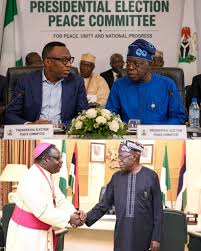
Political parties and presidential and National Assembly candidates on Tuesday signed the first National Peace Accord ahead of the 2027 general elections, pledging to shun violence, hate speech, misinformation and personal attacks during campaigns.
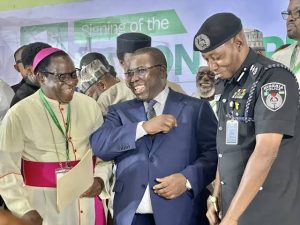
The ceremony, organized by the National Peace Committee in partnership with The Kukah Centre, was held in Abuja barely 24 hours before the statutory commencement of public campaigns on Wednesday, August 19, 2026.
Those who signed included President Bola Tinubu, represented by Secretary to the Government of the Federation, Senator George Akume; Nigeria Democratic Congress candidate Peter Obi; Social Democratic Party candidate Adewole Adebayo; and African Action Congress candidate Omoyele Sowore.
Also present were APC National Chairman Prof Nentawe Yilwatda; PRP presidential candidate Donald Duke; Labour Party’s Chibuzor Okereke; Deputy Senate President Barau Jibrin; PRP National Chairman Hakeem Baba-Ahmed; INEC Chairman Prof Joash Amupitan; and IGP Olatunji Disu.
Notable absentees were ADC presidential candidate Atiku Abubakar and APM candidate, Oyo State Governor Seyi Makinde.
General Abdulsalami Abubakar, Chairman of the National Peace Committee, was represented by former Chief of Defence Staff, General Martin Agwai.
Speaking through Akume, President Tinubu urged parties to prioritize national interest and campaign on ideas, not ethnicity or religion.
“Signing this peace accord is a solemn pledge to the Nigerian people that we, as leaders, will put the nation’s interests above personal or partisan ambitions,” he said.
The President said the APC rejects “violence, hate speech, the spread of misinformation, including through artificial intelligence, and all forms of incitement, especially via social media,” and called for peaceful, transparent elections.
INEC Chairman Prof Amupitan described the accord as an effort to define “the ethical boundaries of their contest” before campaigns begin. He warned of an “alarming resurgence” of hate speech, toxic polarization and AI-driven misinformation.
“Electoral contests in a constitutional democracy are not total wars; they are competitive job interviews before the electorate. Nigerians do not want insults; they want solutions,” Amupitan said.
He challenged candidates to focus on the economy, security, infrastructure, healthcare, education and social inclusion. The INEC boss also disclosed that the commission will deploy about 1.4 million ad hoc personnel across more than 176,000 polling units for the 2027 polls.
“Leadership attained at the expense of public peace, institutional integrity, or human life is a hollow victory,” he warned.
According to INEC’s revised timetable, presidential and National Assembly elections will hold on January 16, 2027, while governorship and State House of Assembly elections are scheduled for February 6, 2027.
The National Peace Committee said it has facilitated 30 peace accords since 2015 and established faith-based peace structures in 23 states to support peaceful elections.


Benin-Asaba Road to Be Redesigned on Concrete Pavement
Share The Minister of Works, Dave Umahi, has said the 136-kilometre Benin-Asaba Road will be redesigned with reinforced concrete pavement...

NECO Releases 2026 SSCE Results, 58.67% Get Five Credits Including English, Maths
Share The National Examinations Council (NECO) has released the results of the 2026 Senior School Certificate Examination (SSCE) Internal, with...


Ogun, DP World Seal $7bn Port, Blue Marine SEZ Investment Deal
Share The Ogun State Government and DP World MEA FZE have signed Memoranda of Understanding (MoUs) for the development of...

FG Cuts Interest Rate on Late Tax Payments, New Order Takes Effect October 1
ShareThe Federal Government has introduced a new tax administration order reducing the interest rate charged on late payment of taxes....

Bamidele: Nigeria’s Full Potential Depends on Meaningful Gender Inclusion
Share The Leader of the Senate, Senator Opeyemi Bamidele, has called for greater and more meaningful inclusion of women in...