Connect with us

News

INEC has no plans to postpone 2023 elections, says Yakubu

Published

on

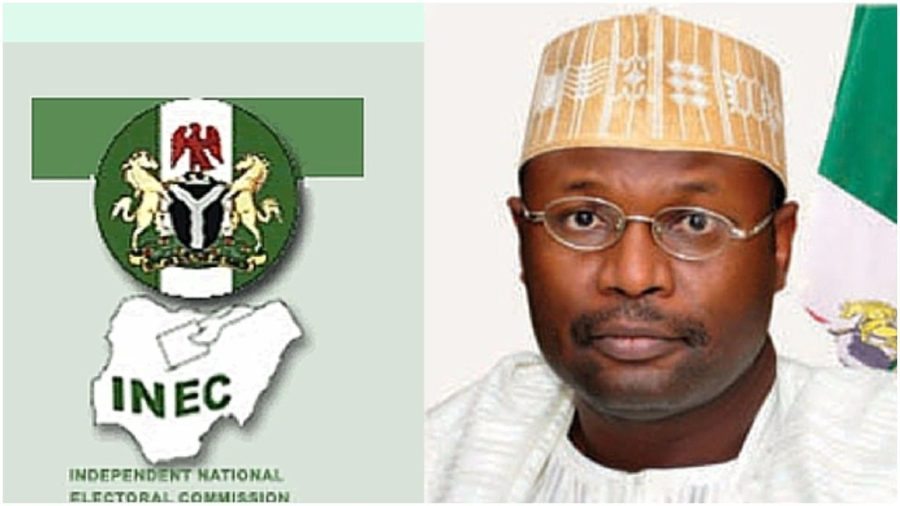
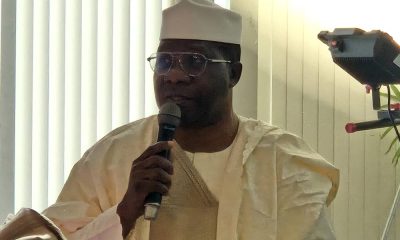
INEC Logo and Chairman,, Prof. Mahmood Yakubu
Share

The Chairman of Independent National Electoral Commission (INEC), Prof. Mahmood Yakubu, says the commission is not contemplating any adjustment to the elections’ timetable, let alone postpone the 2023 general elections.

Yakubu stated this at the presentation of electronic copy of the 93,469,008 voter register to leaders of political parties on Wednesday in Abuja.

He said that more than ever before the commission was more prepared for the 2023 general elections and had now successfully implemented 11 out of the 14 activities on schedule for the elections.

“Already, substantial quantities of sensitive and non-sensitive materials have been deployed to various locations across the country.

“The last batch of the Bimodal Voter Accreditation System (BVAS) has been received while the ongoing configuration of the critical technology in readiness for elections will soon be completed. In the last two days, we commenced the airlifting of other sensitive materials to States across the country.

“Already, some of the materials for 17 States in three geo-political zones have been delivered. Furthermore, 13,868,441 Permanent Voters’ Cards (PVCs) have been printed, delivered to States and are being collected by citizens as new voters or by existing voters who applied for transfer or replacement of cards as provided by law.

He added that similarly, following the display of the voters’ register nationwide and the conclusion of claims and objections by citizens, a new national register of voters has been compiled.

“In short, at no time in the recent history of the Commission has so much of the forward planning and implementation been accomplished 44 days ahead of a General Election.

“Therefore, the commission is not contemplating any adjustment to the election timetable, let alone the postponement of the general elections.

“For the avoidance of doubt, the Presidential and National Assembly elections will hold on Saturday Feb. 25, 2023 while Governorship and State Assembly elections will hold two weeks later on Saturday March 11, 2023.

“The repeated assurance by the security agencies for the adequate protection of our personnel, materials and processes also reinforces our determination to proceed.

“The 2023 general election will hold as scheduled. Any report to the contrary is not the official position of the Commission.’’

On the register voter, Yakubu said after the cleaning up of the data from the last Continuous Voter Registration (CVR) from June 2021 to  July 2022, where  9,518,188 new voters were added to the exiting 84,004,084 voters, the preliminary register voters was 93,522,272.

He said that when the register was presented to Nigerians for claims and objections as required by law, INEC received 53,264 objections from Nigerians to the prevalence of ineligible persons on the register by virtue of age, citizenship or death, which were verified and removed from the register.

“Consequently, the register of voters for the 2023 general election stands at 93,469,008. Of this cumulative figure, 49,054,162 (52.5 per cent) are male while 44,414,846 (47.5 per cent) are female.

“The distribution by age group shows that 37,060,399 (39.65 per cent ) are youth between the ages of 18 and 34; 33,413,591 (35.75 per cent ) are middle aged persons between the ages of 35 and 49;

“17,700,270 (18.94 per cent ) are elderly voters between the ages of 50 and 69 while 5,294,748 (5.66%) are senior citizens aged 70 and above.

“In terms of occupational distribution, students constitute the largest category with 26,027,481 (27.8%) of all voters, followed by 14,742,554 (15.8 per cent ) Farmers/Fishermen and 13,006,939 (13.9 per cent) housewives.

“The data on disability was not collected for previous registration. However, the cumulative figure of 85,362 persons from the recent CVR indicates that there are 21,150 (24.5 per cent ) persons with Albinism; 13,387 (15.7 per cent ) with physical impediment and 8,103 (9.5 per cent) are blind.”

Yakubu said that the softcopy of the breakdown and analysis would be uploaded to INEC website and social media platforms shortly.

He reiterated INEC commitment to transparent, credible and inclusive 2023 General Election, saying INEC would continue to take every step to protect the sanctity of the votes cast by citizens and to deal with infractions.

This according to Yakubu, includes the arrest and prosecution of persons that attempt to perpetuate illegality at Polling Units on Election Day, be they underaged voters or vote buyers.

On the collection of PVCs at 8,809 Registration Areas/Wards nationwide,  Yakubu said that locations for collection could be identified by sending a short text message to any of the two dedicated telephone lines

In his response IPAC Chairman, Yabagi Sani commended INEC efforts in ensuring that power is peacefully transferred in the country; in spite the challenges and plots by anti-democratic agents to truncate the process.

Sani, who was represented by IPAC General Secretary, Yusuf Dantalle said that political parties were resolved to ensure to support INEC, security agencies and traditional rulers for peaceful conduct of 2023 general election.

He said that party leaders were confidence in INEC technology for the election including BVAS and IReV for electronic transmission of result.

Sani said the deployment of the technology would discourage vote buying and situation where people write election results from their rooms and ask INEC official to declare it for people to go to court..

“It makes evidence that so many efforts are in place to ensure that this did not work but we are equally appealing to political party leaders in the country to see that power belongs to God and He gives it to whoever He will.

“We will try the best we can, but we political leaders must the country forward. We do not under intense pressure as if we don’t want this democracy or this election will not succeed.’’

NAN reports that Lagos has the highest number of voters with 7, 060,195, followed by Kano State with 5,921,370 and Kaduna with 4,335,208 registered voters.

Ekiti State has the least registered voters with 987,647, followed by Bayelsa with 1,056,862 and Yobe with 1,485,146  registered voters.


(NAN)


News

Police Arrest 5 PakistanI Nationals, Recover 35 Phones in Benue Intelligence Ooperations

Published

on

Share

The Benue State Police Command has arrested five Pakistani nationals and recovered thirty-five mobile phones in separate intelligence-led operations in Otukpo and Ugbokolo areas of the state.

The arrests were disclosed in a statement issued on Thursday, August 7, 2026, by the Command’s Public Relations Officer, DSP Orchia Peter Aondongu.

According to the statement, operatives acting on credible intelligence arrested three Pakistanis at Adoka Motor Park, Otukpo Local Government Area, on August 4, 2026.

The suspects were identified as Younas Mohammad, 36; Ahmad Nunil, 38; and Aslam Muhammad, 46. They were intercepted while attempting to board a vehicle to Adoka village.

During preliminary questioning, the suspects claimed they were in Otukpo to market cosmetics and mobile gadgets, none of which were found in their possession.

“This made their explanation, activities and movements within the area suspicious, requiring more clarification,” the PPRO stated.

In a separate operation on August 5, 2026, two other Pakistanis, Juma Sharif, 30, and Muhammed Sharif, 25, were arrested at a local hotel in Ugbokolo following another credible intelligence.

The two claimed to be dealers in Android phones. A search of their belongings led to the recovery of eleven Tecno Camon 50 Pro mobile phones.

Further investigation and operational follow-up resulted in the recovery of an additional twenty-three Tecno Camon 50 Pro phones and one Infinix Hot 60 phone, bringing the total number of recovered mobile phones to thirty-five.

The five suspects have been transferred to the State Criminal Investigation Department, SCID, Makurdi, where discreet and comprehensive investigations are ongoing to establish the circumstances surrounding their presence, activities and movements within the state.

The Command said it strongly suspects that the possession of the mobile phones may be a decoy for clandestine activities in rural areas of the state, noting that the suspects “hardly speak or understand English.”

The Commissioner of Police, Benue State Command, CP Cletus C. N. Nwadiogbu, commended the officers involved in the operations and members of the public whose timely information contributed to the arrests.

He reassured residents that the operations form part of the Command’s proactive, intelligence-led policing strategy aimed at identifying potential security threats, preventing criminal activities and safeguarding lives and property across the state.

CP Nwadiogbu further urged residents to remain vigilant and promptly report suspicious persons, movements or activities to the Police.

“The Command will continue to work with relevant stakeholders and members of the public to maintain peace and security across Benue State. The public will be updated as the investigation progresses,” the statement added.

Continue Reading

News

HURIWA Calls for Probe of Adeyemi’s Govt Collaborators

Published

on

Human Right Writers Association of Nigeria, HURIWA
Share

The Human Rights Writers Association of Nigeria (HURIWA) has dismissed the interim report of the Independent Corrupt Practices and Other Related Offences Commission (ICPC) on the controversial Presidential Foreign Intervention Promotion Council (PFIPC), alleging that its findings have raise more questions than answers.

HURIWA, National Coordinator, Comrade Emmanuel Onwubiko, in a statement, on Friday, argued that the report appeared to focus largely on alleged offences committed by one individual while failing to establish how a purportedly non-existent government agency operated within official circles for an extended period.

The organisation therefore opposed the prosecution of Prince Adeniyi Adeyemi, ICPC’ sole accused for forging documents, falsely presenting himself as Director-General of the PFIPC, creating additional agencies, opening bank accounts with forged instruments and exploiting weaknesses in government institutions.

HURIWA insisted that the alleged activities of Adeyemi could not, on their own, explain how the PFIPC acquired the appearance of an official government institution.

In HURIWA’s view, the central issue was not merely who allegedly forged documents, but how such documents were accepted and acted upon by government institutions.

It asked how a non-existent agency could acquire official legitimacy, who admitted its operators into government circles, who authorised meetings and engagements with public institutions and why elementary verification procedures failed to detect the alleged fraud.

The group also questioned how the PFIPC found its way into the 2026 Appropriation Act with a budgetary allocation running into billions of naira if it did not legally exist.

“The questions confronting Nigeria are neither difficult nor complicated,” HURIWA said.

It said there is a need to establish who processed documents linked to the agency, who ignored red flags and who enabled it to operate without challenge.

The organisation expressed concern that the ICPC’s interim findings could give the impression that the scandal was essentially the work of a lone individual.

It argued that such a conclusion would be difficult to reconcile with the scale and duration of the alleged activities, particularly given the involvement of multiple Ministries, Departments and Agencies (MDAs).

“HURIWA refuses to accept the proposition that one private citizen, acting entirely alone, successfully penetrated multiple Ministries, Departments and Agencies, operated for an extended period, secured official interactions and allegedly built an elaborate structure involving forged instruments without significant failures or possible complicity within the public service,” Onwubiko stated.

The association noted that the ICPC itself had identified weaknesses in inter-agency coordination, verification mechanisms and internal controls, arguing that such weaknesses required further investigation.

It said Nigerians deserved to know whether the failures were merely administrative lapses or whether some officials deliberately facilitated the activities of the alleged fake agency.

HURIWA was particularly critical of any recommendation for administrative sanctions against public officers whose negligence may have enabled the operation.

Continue Reading

News

Why Alia revamped Abandoned Benue N70bn Taraku Mill After 40 Years

Published

on

Share
The Benue State Gov. Hyacinth Alia  says he revived the N70 billion moribund Taraku Mill after 40 years because the state could no longer afford to waste its economic potential.
Alia made the disclosure on Friday in Makurdi during a media chat with the Renewed Hope Ambassadors Presidential Media Team.
The team was led by Mr Bayo Onanuga, Special Adviser to the President Bola Tinubu on Media and Strategy.
The News Agency of Nigeria (NAN) reports the team was in Benue to inspect completed and ongoing federal and state infrastructure projects, including the Taraku Mill, located in Gwer East Local Government Area.
The governor said the revival of the mill, located in Taraku, was part of his administration’s broader strategy to establish sustainable economic structures capable of surviving changes in political leadership.
He said previous administrations had lacked a comprehensive development plan, resulting in projects being initiated without adequate consideration for continuity and the actual needs of citizens.
“​​There has to be a direction. There has to be a mission and there has to be a vision,” Alia said.
According to him, his administration’s development blueprint was designed after consultations with communities to distinguish between what people wanted and their actual priority needs.
He said that the approach required government to understand the needs of market women, farmers and other residents before committing resources to projects.
Alia said the objective was to move Benue from  “a glorified village status” and improve the state’s towns and economic centres.
He said sustainability was built into the projects being implemented, stressing that government must put measures in place to ensure investments remained productive after the tenure of the current administration.
The governor argued that government could not completely stay away from business when strategic investments were necessary to create employment, retain capital and stimulate the local economy.
He cited the newly established Benue Brewery, juice factory and concentrate factory as examples of investments intended to process local agricultural products and strengthen the state’s value chain.
Alia said Benue produced sorghum, cassava, maize, oranges and soybeans in large quantities, but needed industries capable of converting the agricultural produce into finished products.
He said the development of such industries would create markets for farmers, generate employment and reduce capital flight caused by importing products that could be produced locally.
The governor said farmers with orchards and farms had been identified and organised into cooperatives, enabling them to access support while providing industries with dependable sources of raw materials.
He said the improved road network linking Benue with Abuja would further enhance opportunities for farmers to take fresh agricultural produce to the federal capital and other markets.
Alia said the revival of Taraku Mill was particularly significant because Benue was previously a leading soybean-producing state, but the collapse of the mill disrupted the market for farmers.
He said the return of the mill would provide a sustained market for soybean farmers, adding that his administration had begun providing incentives and farm inputs to identified producers.
The governor said the revival was, therefore, not limited to restoring the factory but was aimed at rebuilding an agricultural ecosystem in which farmers could consistently earn income from their produce.
Earlier, the inspection team visited the Taraku Mill, where the governor’s Chief Press Secretary, Mr Tersoo Kula, explained that production had continued until around the mid-1990s.
Kula said the factory subsequently became moribund until the Alia administration decided to revamp it, with the machinery serviced and currently undergoing test runs.
He commended residents of the area for protecting the abandoned facility over the years, saying they collectively ensured that no equipment was removed from the premises.
According to him, the mill will produce soybean and groundnut oil, process maize and manufacture animal feeds, thereby restoring its former role as an economic booster for the area.
Kula also attributed the revival to improved economic conditions and support from the Federal Government, saying major investments of that magnitude required adequate resources.
He said the administration had also rehabilitated the Otobi Waterworks and its treatment plant in Otukpo Local Government Area to provide water needed for operations at the mill.
Mr Terngwu Kyuve, General Manager of the mill, said the revived facility would create no fewer than 2,000 direct and indirect jobs when fully operational.
Kyuve said the plant comprised oil, maize and animal-feed divisions, adding that its maize plant had a capacity to process 72,000 metric tonnes annually.
He said the animal-feed plant could process 172,300 metric tonnes annually, while the oil division had mechanical pressing, flaking, solvent extraction and refining facilities.
According to him, the mechanical press can process 200 metric tonnes of seeds daily, solvent extraction 320 metric tonnes daily, while the refinery can process 100 metric tonnes of oil daily.
Kyuve, a pioneer staff member, said maintenance and test-running were ongoing, adding that dry and wet testing would precede actual production.
He expressed optimism that products would begin coming out of the factory within two months, marking the return of Taraku Mill to industrial production after decades of inactivity.

Continue Reading