Connect with us

News

Tinubu restates commitment to double-digit GDP 

Published

on

Bola-Ahmed-Tinubu
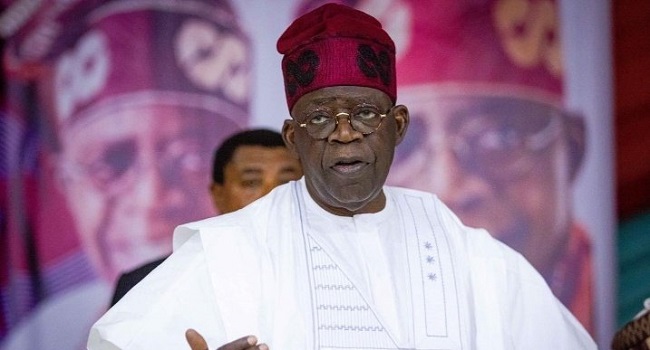
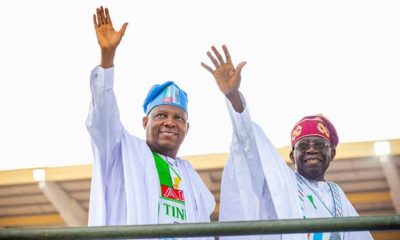
APC Presidential Flagbearer Bola Ahmed Tinubu, President Muhammadu Buhari and others
Share


PRESS

*Let’s secure Nigeria’s future together – APC candidate

…promises continuous open door for collaboration

All Progressives Congress Presidential Candidate, Asiwaju Bola Ahmed Tinubu, has again restated his administration’s resolve to hit a double figure Gross Domestic Product (GDP) if he wins the 2023 presidential election.

Tinubu stated this on Tuesday during his townhall meeting with the Business Community and Organised Private Sector at Eko Hotel and Suites, Victoria Island, Lagos.

The town hall session had in attendance the Vice Presidential candidate, Senator Kashim Shettima, Governors Babajide Sanwo-Olu, Simon Bako Lalong who is also the Director-General of the APC Presidential Campaign Council, Atiku Bagudu, Abdulrahman Abdulrasaq, Abubakar Badaru, Dapo Abiodun, Adegboyega Oyetola, Nasir El-Rufai and Abdullahi Ganduje as well as other party leaders and chieftains.

The business community was fully represented with President of Dangote Group, Aliko Dangote, Jim Ovia, Chairman of Zenith Bank, Tony Elumelu, Chairman of UBA, Aigboje Aig-Imoukhuede, former Chief Executive of Access Bank, Herbert Wigwe, Group Chief Executive of Access Bank and other business leaders representing sectoral groups such as agriculture, Oil and Gas, Trade, Manufacturing, creative Sector among others.

The APC presidential candidate laid out his Action Plan before the business leaders. Tinubu said having achieved similar economic success as Lagos State governor, he has the capacity to repeat the same in the country as president.

He said, “Lagos is an appropriate venue for this meeting.

“You may have heard that I was once governor of this dynamic economic force. However, may I remind you that when I first entered office, Lagos was a different story.

“My team and I developed a blueprint, a master plan, for Lagos. I can say that plan has been largely successful.

“We turned this state into a safer, more prosperous place where people can go about any legitimate vocation or venture regardless of their ethnicity, religion, region or prior social station.

“We did more than open Lagos for business. We opened the door for all Nigeria to join and experience the decent things progressive democratic governance can bring.

“We were not perfect but we did a lot.

“In doing so, we worked hand in hand with the business community as partners sharing the same goals of prosperity and renewed hope.

“Well, as you might have heard at some point recently, I now stand before you, seeking a bigger yet similar job.”

He therefore called on the Lagos Business Community to join hands with him to achieve this, stating that a viable economy requires collaboration between the political and business communities.

“Nigeria stands at the threshold between indifference and greatness, prosperity and poverty, the future and the past.

“The door is ajar. Together, let us open it so that we may cross over to the better side and secure for this beloved nation its finer destiny.

“The productive and beneficial things we seek do not lie in the sole domain of one sector. They reside in the cooperation between government and the private sector.

“I see no conflict between the business community and government. Yet, with equal conviction, I believe the private sector and government should constantly be at war.

“But they wage this battle not as enemies. They must stand as inseparable allies combating the mutual enemies of scarcity, underdevelopment, joblessness and the fear these bad things breed.

“The pragmatic problem solving and teamwork that improved Lagos, I want to bring to this nation.

“I ask your help as the task ahead is doable but also difficult,” he added.

He empathised that the nation needed to move from dependence on exporting its raw materials to nations who sell the finished products to us at exorbitant prices to one that refines its raw materials for upward export itself.

Praising the President Muhammadu Buhari-led administration for its patriotism and commitment, he itemised his administration plans to build on their achievements.

These, he said include reviving dead industries, promote agriculture, provide power, produce and use made in Nigeria goods, build infrastructure and most importantly improve the country’s security.

“From its very inception, our political economy has been imbalanced and in need of major reform. Our political economy is much too dependent on the export of raw material or unfinished goods and the import of increasingly expensive finished products. Over the course of the time, gains from natural resource exports will prove largely insufficient to meet the rising costs of imports let alone support even the most basic demands of modern democratic governance.

“The time is now to cure this lapse. And time is of the essence for it does not wait for man or nation.

“We commend the work of prior administrations, especially the present government. This government has performed with patriotism and commitment during trying times.

“We simply must go farther and faster. My experiences in both the private sector and elective office afford me a special appreciation of the economic potency that close collaboration between government and the business community can bring.

“Allow me to share a few ideas that provide some insight into my vision for a more prosperous and secure nation where hope is renewed and despair rebuffed.

1. Regular Dialogue – All Nigerians must be invested in our better future. We must maintain the channels and spirit of respectful and productive dialogue. At times what I say may help you. Other times, what you say may enlighten me. We must always talk and confer with the best of intentions. Just as this open door policy is with me before the election, I shall continue to honor it after the election.

2. GDP Growth Rate: We must target double digit GDP to begin to reduce the poverty rate and I am determined to accomplish thua

3. Revive Industry: We shall bring the nation’s industrial policy to life. Key to this is our aim to create major and minor industrial hubs in each geopolitical zone. We shall not be satisfied by bolstering traditional sectors. We will foster productive excellence in new areas such as light manufacturing and the Nollywood entertainment sector. Through active participation in the digital economy, we shall make Nigeria a leader, instead of a bystander, in the fourth industrial revolution.

4. Promote Agriculture: We shall continue to press reforms in the sector that will increase productivity, improve farm incomes while lowering food prices and bringing enough food to the tables of ordinary people.

5. Power Nigeria: I am determined to give you the affordable and reliable power you need to drive your businesses in a way that lifts the entire economy.

6. Produce and buy Nigerian: We seek a consumer credit revolution, working in concert with the banking industry lead by the CBN. Credit at affordable rates enables the purchase of more cars and the construction of more homes. The standard of living shall rise and the strength of the business sector shall increase in similar measure.

7. Build Nigeria: We must continue with the expansion of infrastructure commenced by the current government From our roads and ports that will path the way to more commerce, to improvement in irrigation and water management/catchment systems to stem the humanitarian and economic tragedy visited on us by seasonal flooding.

8. I have saved the single most important point for last. May I conclude with my thoughts on security.

“We shall continue the fight against insecurity by redefining our counterinsurgency doctrine and practice. Our response to terror, kidnapping and violent criminality will be defined by the following elements:

a. We shall enlist more people in the armed forces, security services and the police.

b. Our forces will be given better tactical communications, mobility as well as improved aerial and ground surveillance capacity.

“Through these and other measures, we shall better identify, monitor, track, and defeat these evil groups where they are. They shall have no respite until they surrender or are utterly defeated,” he added.


News

Police Arrest 5 PakistanI Nationals, Recover 35 Phones in Benue Intelligence Ooperations

Published

on

Share

The Benue State Police Command has arrested five Pakistani nationals and recovered thirty-five mobile phones in separate intelligence-led operations in Otukpo and Ugbokolo areas of the state.

The arrests were disclosed in a statement issued on Thursday, August 7, 2026, by the Command’s Public Relations Officer, DSP Orchia Peter Aondongu.

According to the statement, operatives acting on credible intelligence arrested three Pakistanis at Adoka Motor Park, Otukpo Local Government Area, on August 4, 2026.

The suspects were identified as Younas Mohammad, 36; Ahmad Nunil, 38; and Aslam Muhammad, 46. They were intercepted while attempting to board a vehicle to Adoka village.

During preliminary questioning, the suspects claimed they were in Otukpo to market cosmetics and mobile gadgets, none of which were found in their possession.

“This made their explanation, activities and movements within the area suspicious, requiring more clarification,” the PPRO stated.

In a separate operation on August 5, 2026, two other Pakistanis, Juma Sharif, 30, and Muhammed Sharif, 25, were arrested at a local hotel in Ugbokolo following another credible intelligence.

The two claimed to be dealers in Android phones. A search of their belongings led to the recovery of eleven Tecno Camon 50 Pro mobile phones.

Further investigation and operational follow-up resulted in the recovery of an additional twenty-three Tecno Camon 50 Pro phones and one Infinix Hot 60 phone, bringing the total number of recovered mobile phones to thirty-five.

The five suspects have been transferred to the State Criminal Investigation Department, SCID, Makurdi, where discreet and comprehensive investigations are ongoing to establish the circumstances surrounding their presence, activities and movements within the state.

The Command said it strongly suspects that the possession of the mobile phones may be a decoy for clandestine activities in rural areas of the state, noting that the suspects “hardly speak or understand English.”

The Commissioner of Police, Benue State Command, CP Cletus C. N. Nwadiogbu, commended the officers involved in the operations and members of the public whose timely information contributed to the arrests.

He reassured residents that the operations form part of the Command’s proactive, intelligence-led policing strategy aimed at identifying potential security threats, preventing criminal activities and safeguarding lives and property across the state.

CP Nwadiogbu further urged residents to remain vigilant and promptly report suspicious persons, movements or activities to the Police.

“The Command will continue to work with relevant stakeholders and members of the public to maintain peace and security across Benue State. The public will be updated as the investigation progresses,” the statement added.

Continue Reading

News

HURIWA Calls for Probe of Adeyemi’s Govt Collaborators

Published

on

Human Right Writers Association of Nigeria, HURIWA
Share

The Human Rights Writers Association of Nigeria (HURIWA) has dismissed the interim report of the Independent Corrupt Practices and Other Related Offences Commission (ICPC) on the controversial Presidential Foreign Intervention Promotion Council (PFIPC), alleging that its findings have raise more questions than answers.

HURIWA, National Coordinator, Comrade Emmanuel Onwubiko, in a statement, on Friday, argued that the report appeared to focus largely on alleged offences committed by one individual while failing to establish how a purportedly non-existent government agency operated within official circles for an extended period.

The organisation therefore opposed the prosecution of Prince Adeniyi Adeyemi, ICPC’ sole accused for forging documents, falsely presenting himself as Director-General of the PFIPC, creating additional agencies, opening bank accounts with forged instruments and exploiting weaknesses in government institutions.

HURIWA insisted that the alleged activities of Adeyemi could not, on their own, explain how the PFIPC acquired the appearance of an official government institution.

In HURIWA’s view, the central issue was not merely who allegedly forged documents, but how such documents were accepted and acted upon by government institutions.

It asked how a non-existent agency could acquire official legitimacy, who admitted its operators into government circles, who authorised meetings and engagements with public institutions and why elementary verification procedures failed to detect the alleged fraud.

The group also questioned how the PFIPC found its way into the 2026 Appropriation Act with a budgetary allocation running into billions of naira if it did not legally exist.

“The questions confronting Nigeria are neither difficult nor complicated,” HURIWA said.

It said there is a need to establish who processed documents linked to the agency, who ignored red flags and who enabled it to operate without challenge.

The organisation expressed concern that the ICPC’s interim findings could give the impression that the scandal was essentially the work of a lone individual.

It argued that such a conclusion would be difficult to reconcile with the scale and duration of the alleged activities, particularly given the involvement of multiple Ministries, Departments and Agencies (MDAs).

“HURIWA refuses to accept the proposition that one private citizen, acting entirely alone, successfully penetrated multiple Ministries, Departments and Agencies, operated for an extended period, secured official interactions and allegedly built an elaborate structure involving forged instruments without significant failures or possible complicity within the public service,” Onwubiko stated.

The association noted that the ICPC itself had identified weaknesses in inter-agency coordination, verification mechanisms and internal controls, arguing that such weaknesses required further investigation.

It said Nigerians deserved to know whether the failures were merely administrative lapses or whether some officials deliberately facilitated the activities of the alleged fake agency.

HURIWA was particularly critical of any recommendation for administrative sanctions against public officers whose negligence may have enabled the operation.

Continue Reading

News

Why Alia revamped Abandoned Benue N70bn Taraku Mill After 40 Years

Published

on

Share
The Benue State Gov. Hyacinth Alia  says he revived the N70 billion moribund Taraku Mill after 40 years because the state could no longer afford to waste its economic potential.
Alia made the disclosure on Friday in Makurdi during a media chat with the Renewed Hope Ambassadors Presidential Media Team.
The team was led by Mr Bayo Onanuga, Special Adviser to the President Bola Tinubu on Media and Strategy.
The News Agency of Nigeria (NAN) reports the team was in Benue to inspect completed and ongoing federal and state infrastructure projects, including the Taraku Mill, located in Gwer East Local Government Area.
The governor said the revival of the mill, located in Taraku, was part of his administration’s broader strategy to establish sustainable economic structures capable of surviving changes in political leadership.
He said previous administrations had lacked a comprehensive development plan, resulting in projects being initiated without adequate consideration for continuity and the actual needs of citizens.
“​​There has to be a direction. There has to be a mission and there has to be a vision,” Alia said.
According to him, his administration’s development blueprint was designed after consultations with communities to distinguish between what people wanted and their actual priority needs.
He said that the approach required government to understand the needs of market women, farmers and other residents before committing resources to projects.
Alia said the objective was to move Benue from  “a glorified village status” and improve the state’s towns and economic centres.
He said sustainability was built into the projects being implemented, stressing that government must put measures in place to ensure investments remained productive after the tenure of the current administration.
The governor argued that government could not completely stay away from business when strategic investments were necessary to create employment, retain capital and stimulate the local economy.
He cited the newly established Benue Brewery, juice factory and concentrate factory as examples of investments intended to process local agricultural products and strengthen the state’s value chain.
Alia said Benue produced sorghum, cassava, maize, oranges and soybeans in large quantities, but needed industries capable of converting the agricultural produce into finished products.
He said the development of such industries would create markets for farmers, generate employment and reduce capital flight caused by importing products that could be produced locally.
The governor said farmers with orchards and farms had been identified and organised into cooperatives, enabling them to access support while providing industries with dependable sources of raw materials.
He said the improved road network linking Benue with Abuja would further enhance opportunities for farmers to take fresh agricultural produce to the federal capital and other markets.
Alia said the revival of Taraku Mill was particularly significant because Benue was previously a leading soybean-producing state, but the collapse of the mill disrupted the market for farmers.
He said the return of the mill would provide a sustained market for soybean farmers, adding that his administration had begun providing incentives and farm inputs to identified producers.
The governor said the revival was, therefore, not limited to restoring the factory but was aimed at rebuilding an agricultural ecosystem in which farmers could consistently earn income from their produce.
Earlier, the inspection team visited the Taraku Mill, where the governor’s Chief Press Secretary, Mr Tersoo Kula, explained that production had continued until around the mid-1990s.
Kula said the factory subsequently became moribund until the Alia administration decided to revamp it, with the machinery serviced and currently undergoing test runs.
He commended residents of the area for protecting the abandoned facility over the years, saying they collectively ensured that no equipment was removed from the premises.
According to him, the mill will produce soybean and groundnut oil, process maize and manufacture animal feeds, thereby restoring its former role as an economic booster for the area.
Kula also attributed the revival to improved economic conditions and support from the Federal Government, saying major investments of that magnitude required adequate resources.
He said the administration had also rehabilitated the Otobi Waterworks and its treatment plant in Otukpo Local Government Area to provide water needed for operations at the mill.
Mr Terngwu Kyuve, General Manager of the mill, said the revived facility would create no fewer than 2,000 direct and indirect jobs when fully operational.
Kyuve said the plant comprised oil, maize and animal-feed divisions, adding that its maize plant had a capacity to process 72,000 metric tonnes annually.
He said the animal-feed plant could process 172,300 metric tonnes annually, while the oil division had mechanical pressing, flaking, solvent extraction and refining facilities.
According to him, the mechanical press can process 200 metric tonnes of seeds daily, solvent extraction 320 metric tonnes daily, while the refinery can process 100 metric tonnes of oil daily.
Kyuve, a pioneer staff member, said maintenance and test-running were ongoing, adding that dry and wet testing would precede actual production.
He expressed optimism that products would begin coming out of the factory within two months, marking the return of Taraku Mill to industrial production after decades of inactivity.

Continue Reading